



Ebola disease in DRC: find out how we're responding
Learn more
4633 Results
 
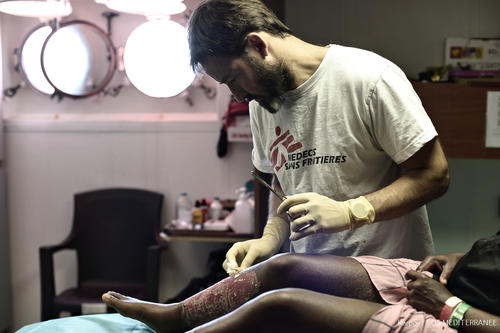
MSF medics on Aquarius continue painstaking daily dressing changes for more than 20 patients who have suffered serious fuel burns. If not treated properly, these burns will go on to cause chronic pain, disfigurement, and horrific scars.
Mediterranean migration

The Aquarius Aquarium

As an MSF nurse, François-Xavier Daoudal returned at the end of June after spending three weeks on board the Aquarius. During his time on the ship, 629 people were rescued. However, immediately after the rescue operation, the Italian and Maltese authorities refused the ship permission to dock, triggering a huge political and media furor. The Aquarius was left stranded at sea for several days before being able to transfer some of the rescued migrants to two Italian navy ships. All passengers were finally disembarked in Spanish port Valencia. What can be drawn from such an experience? Read on to see what F-X had to say during an interview on the political implications, life on board the Aquarius and the issue of people smuggling. He also shared with us what the migrants themselves had to say. msf-crash.org - 13 Sep 2018
 
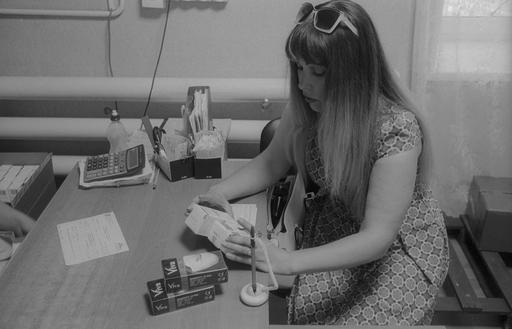
Olena Melnikova, receiving hepatitis C medications, 2018
Hepatitis C

MSF calls for end to Gilead’s hepatitis C drug monopoly

This week in Munich, the European Patent Office is hearing a legal challenge filed by groups in 17 countries in March 2017, against an unmerited patent that allows US pharmaceutical corporation Gilead Sciences to charge exorbitant prices in Europe for the key hepatitis C drug sofosbuvir Press Release - 11 Sep 2018
 
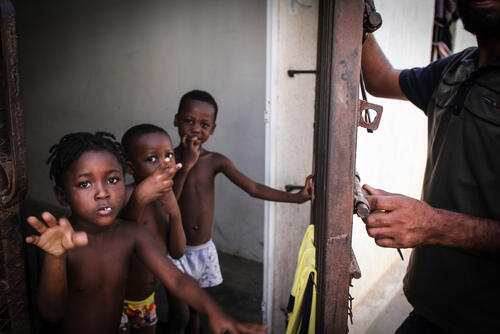
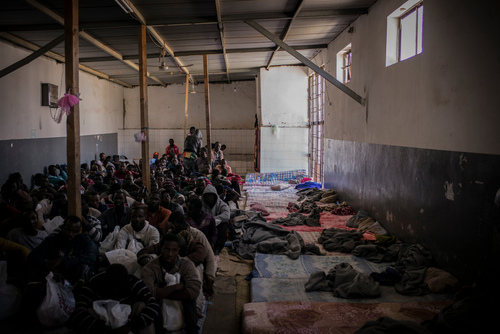
Children in detention centre.
On September 2nd, 276 people were brought by the Libyan coast guard to Khoms (120 km east of Tripoli) - among them 181 men, 42 women and 24 children including 2 babies less than 12 months old. They were then transferred to detention center where MSF works. Reportedly, they were in two rubber coats, one stopped due to engine failure, while the other boat continued to navigate for several hours before deflating and sinking. Survivors told MSF teams that over a hundred people died in the shipwreck.
Mediterranean migration

Refugee Libya shipwreck survivors condemned to drown at sea or face arbitrary detention

More than a hundred people have reportedly died in a shipwreck off the Libyan coast one week ago. MSF has been providing urgent medical assistance following disembarkation. Project Update - 10 Sep 2018
 
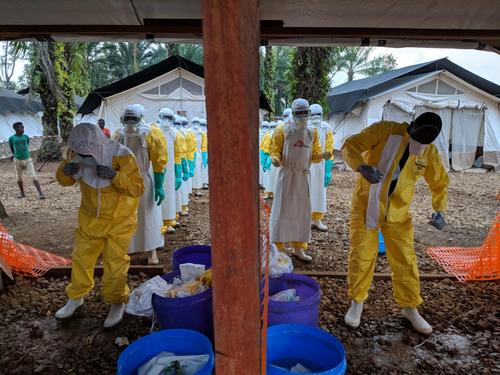
A team that has just finished setting up a tent in the high-risk zone in the Ebola treatment centre, getting out of their personal protective equipment (PPE). It’s hard work, and harder still in such attire. 

Une équipe retire son équipement de protection individuelle après avoir monté une tente dans la zone de haut risque dans le centre de traitement Ébola. C’est un travail difficile a faire avec l’équipement de protection.
DRC Ebola outbreaks

North Kivu: MSF treats 65 Ebola patients in first month

Médecins Sans Frontières (MSF) has treated 65 patients confirmed to be diagnosed with Ebola in the first month of intervention in the latest Ebola outbreak, in North Kivu, Democratic Republic of Congo (DRC). Project Update - 7 Sep 2018
 
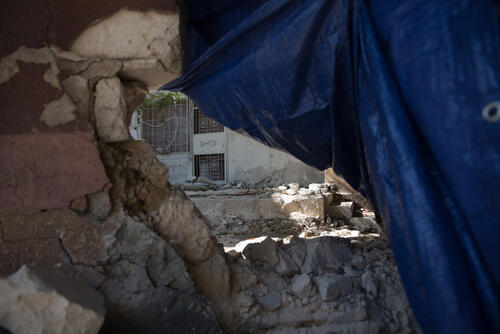
Damaged building in Bin Ashour area consequence of a rocket fired by unknown militia during the fighting that erupted in Tripoli on 26th of August.
Libya

Evacuation of refugees and migrants out of Libya is urgently needed

Thousands of refugees, migrants and asylum seekers arbitrarily held in Libyan detention centres must be immediately released and evacuated to safety out of the country. Press Release - 7 Sep 2018
 
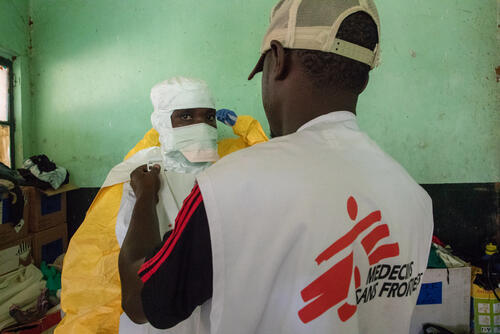
Staff getting dressed in full PPE in the ETC (Ebola Treatment Centre) in Bikoro.
DRC Ebola outbreaks

New Ebola outbreak declared in North Kivu

On 1 August 2018, Democratic Republic of Congo (DRC) declared an outbreak of Ebola in the northeastern North Kivu province. Project Update - 5 Sep 2018
 
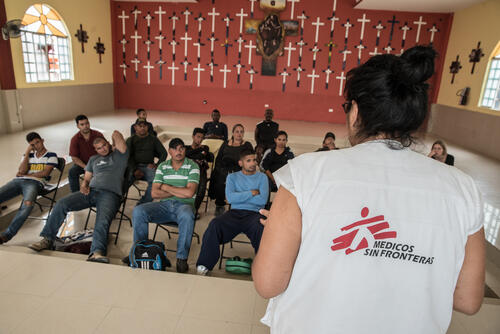
A large number of those attempting the crossing, especially the minors, have no information about the extent of the route, the available assistance and their rights during transit. Here Anabel, an MSF social worker, explains basic information to a group of newly arrived migrants.
Mexico

Abductions and violence, the price to pay to cross Mexico

Eight years after the San Fernando massacre, a 22-year-old Honduran patient in the Coatzacoalcos shelter where MSF works shares his story of violence and abductions as he attempts to cross Mexico. Project Update - 3 Sep 2018
 
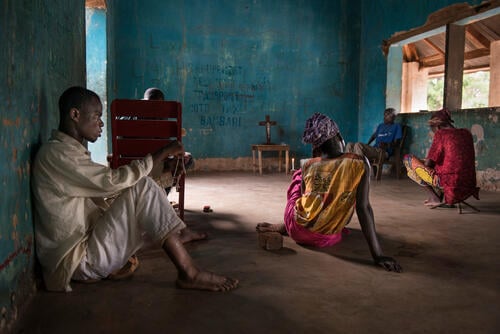
A church in an abandonned administrative building near the Alternatif IDP camp, Bambari. A group of IDP believers meet once a day to pray.
Central African Republic

Suffering mounts as armed groups return to Bambari

Following an upsurge in violence in May, indiscriminate criminality has increased in Bambari, affecting civilians and medical facilities. Project Update - 31 Aug 2018
 
Men detained in Abu Salim detention centre, in Tripoli, Libya.
Libya

Conflict in Tripoli puts lives in danger, demonstrating that Libya is not a place of safety

MSF calls on European governments to acknowledge that Libya is not a place of safety. More must be done to help people trapped within its borders to find a safe and dignified way out. Press Release - 31 Aug 2018
 
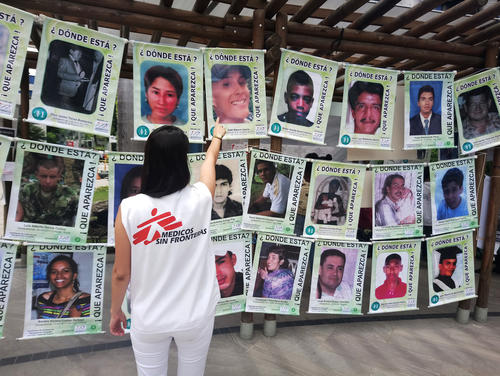
Acto en la Universidad de Santiago de Cali
Colombia

Suspended grief

In 50 years of war in Colombia, 83,000 people disappeared at the hands of guerrillas, paramilitaries, criminal groups and state forces. Giulia Panseri, MSF’s project coordinator in Puerto Asís and Cali, explains what MSF is doing in Puerto Asís and Cali to accompany the family members of those disappeared. Project Update - 30 Aug 2018
Four mothers posing in a corridor of the Hospital in Bili. All four of them are staying in the hospital with their child, that's suffering from a severe case of malaria. Since the beginning of the project in 2016, the pediatric ward already treated more than 4.000 cases of complicated/severe form of malaria.
Médecins Sans Frontières (MSF)

Independent medical humanitarian assistance

We provide medical assistance to people affected by conflict, epidemics, disasters, or exclusion from healthcare. Our teams are made up of tens of thousands of health professionals, logistic and administrative staff - most of them hired locally. Our actions are guided by medical ethics and the principles of independence and impartiality. We are a non-profit, self-governed, member-based organisation.

Learn more