



Ebola disease in DRC: find out how we're responding
Learn more
2094 Results
 
msf-placeholder
Ukraine

Activity Update, May 2015

MSF continues to expand its medical activities to meet the needs of people living in the hardest-hit areas, and to people who had to flee the conflict. MSF has offices in Kyiv, Artemivsk, Kurakhove, Donetsk, Mariupol and Lugansk and its activities are run by 69 international and 241 local staff. Crisis Update - 27 May 2015
 
msf-placeholder
Iraq

MSF provides assistance to the displaced and refugees in Kurdistan

Médecins Sans Frontières (MSF) has been working in the Erbil region or northern Iraq since 2013 providing primary healthcare and mental health services to Syrian refugees who have fled from the conflict that continues to rage in their country. MSF also assists Iraqis who have been forced out of their homes by the violence. Crisis Update - 26 May 2015
 
Continuing clashes in Upper Nile state in South Sudan are leading to more deaths and displacements of people. Since the beginning of April, over 6,600 people have fled their homes to seek shelter at the congested UN protection of civilians (PoC) base in Malakal. The new internally displaced people are living in big tents, with dozens of families sharing the same tent and sleeping on the floor.
South Sudan

"The situation has been tense"

An MSF doctor describes his experience while working in a Protection Of Civilians site outside Malakal where about 30,000 people displaced by civil war are living. Voices from the Field - 22 May 2015
 
Consultations by MSF in the "Protection of Civilians" site near Bentiu.
South Sudan

Alarming humanitarian situation as conflict escalates

Escalating fighting is exposing civilians to widespread violence and severely restricting the provision of desperately needed aid. Press Release - 22 May 2015
 
msf-placeholder
Yemen

Life in the MSF hospital in Aden, Yemen

A video illustrating life in the MSF hospital in Aden, Yemen. Filmed before the ceasefire. Project Update - 20 May 2015
 
Najiba is 14, she was in her kitchen when a rocket fell on her house and caused the roof to collapse on her. When her family found her body, they thought she was dead. But the villagers realized that she was still breathing and took her to Kunduz City, to the MSF trauma Center.
Afghanistan

MSF treats war wounded as spring offensive rages in the north

Heavy fighting between Afghan forces and armed opposition groups in the north-eastern province of Kunduz is increasingly isolating people living in the districts from the provincial capital, where Médecins Sans Frontières’ (MSF) trauma centre has been receiving wounded patients. Press Release - 19 May 2015
 
In recent days, 1,300 Nigerians were evacuated from Lake Chad (where they had taken refuge after fleeing the conflict in the northeast of the country). These departures are following major ongoing clashes on the islands of Lake Chad, Niger side. These thousands of refugees are the first returns on Borno State - northeast of Nigeria - more are expected in the coming days. MSF initiates emergency assistance for these people.
Nigeria

1200 Nigerian refugees flee fighting in Lake Chad and return to Nigeria

MSF provides assistance to Nigerian returnees fleeing Niger Crisis Update - 12 May 2015
 
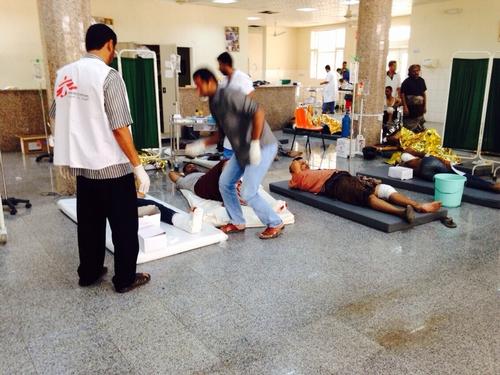
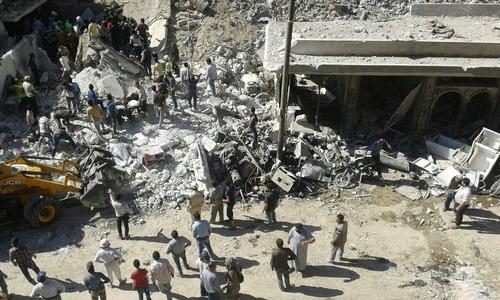
MSF supports the hospital in the town of Haradh . Al Mazraq Camp was hit by an airstrike on March 30th. At least 34 people wounded in the attack were brought by ambulance to the MSF-supported hospital in Haradh (in the photo). Twenty-nine people were dead on arrival, among them women and children.  Roughly 500 new families had arrived in the camp over the last two days, escaping bombings in the western area of Saada. Al Mazraq Camp was established in 2009, when thousands of people fled fighting between government troops and Houthi forces in Saada Governorate.
Yemen

First person account from Saada under bombardment

An MSF team spent last night in the city of Saada under intense bombing from the coalition led by Saudi Arabia. On Friday night the coalition gave an ultimatum to the population to leave the city and its surrounding area, as the whole province in the North of the country would become a military target. Voices from the Field - 9 May 2015
 
Mothers and their children sit in the waiting area of the ambulatory therapeutic feeding centre (ATFC) in MSF’s hospital in Leer, Unity state, South Sudan. The nutritional situation in Leer is shocking. When the conflict tore through the town in late January/early February, stocks of food were looted and people’s houses razed to the ground. The MSF hospital in Leer was, in effect, destroyed, and the MSF teams were forced to evacuate. As people fled into the bush, they survived on little but lily roots and whatever else could be scavenged. Since then, the ongoing fighting has made it difficult for people to plant crops. The MSF hospital re-opened at the beginning of May 2014 and as of Friday, 13th June 2014, 1,713 children were enrolled in MSF’s ATFC in Leer, with 15 severely malnourished children admitted into the intensive therapeutic feeding centre (ITFC).
South Sudan

MSF calls on warring parties to respect medical facilities in South Sudan as the humanitarian organization is forced to evacuate staff again

MSF is gravely concerned about an imminent attack on the town of Leer in South Sudan, and the potential impact on civilians and medical facilities. Press Release - 9 May 2015
 
msf-placeholder
Yemen

MSF statement in response to latest coalition offensive

"The bombing of civilian targets, with or without warning, is a serious violation of international humanitarian law. It is even more serious to target a whole province." Statement - 8 May 2015
Four mothers posing in a corridor of the Hospital in Bili. All four of them are staying in the hospital with their child, that's suffering from a severe case of malaria. Since the beginning of the project in 2016, the pediatric ward already treated more than 4.000 cases of complicated/severe form of malaria.
Médecins Sans Frontières (MSF)

Independent medical humanitarian assistance

We provide medical assistance to people affected by conflict, epidemics, disasters, or exclusion from healthcare. Our teams are made up of tens of thousands of health professionals, logistic and administrative staff - most of them hired locally. Our actions are guided by medical ethics and the principles of independence and impartiality. We are a non-profit, self-governed, member-based organisation.

Learn more