Ebola disease in DRC: find out how we're responding
Learn more
2094 Results
 
On october 26th, the Haydan hospital we support in northern Yemen has been hit by several air strikes. The first bombing took place at 22:30 local time and last midnight.
Miriam, project coordinator in Saada, went this morning Haydan, but could not enter the building because there were still bombs that had not exploded.
The hospital is completely destroyed: the emergency room, OPD, IPD, the laboratory, motherhood and the block. But the bombing did not cause any casualties. Only one person was slightly injured. Staff and two hospitalized patients could leave the building after the first strike.
This hospital was still functional only for the whole Haydan region which has a population of about 200,000 inhabitants. On average 150 patients had received emergency a week by personnel from the Department of Health that is supported with incentives.
The Haydan region bordering Saudi Arabia is in Sa'ada governorate, which is controlled by the Houthis. It is bombarded every day by the coalition led by Saudi Arabia.
Yemen

MSF hospital destroyed by airstrikes

Airstrikes carried out late last night by the Saudi-led coalition in northern Yemen destroyed a small MSF supported hospital. Hospital staff and patients managed to escape before subsequent airstrikes occurred over a two hour period. With the hospital destroyed, at least 200,000 people now have no access to lifesaving medical care. Press Release - 27 Oct 2015
 
msf-placeholder
Yemen

Medical aid blocked from entering besieged area in Taiz

Despite weeks of intense negotiations with Houthi officials, stocks of essential medical supplies cannot be delivered to two hospitals in a besieged enclave of the city of Taiz, in southern Yemen. Today MSF’s trucks have been stopped again at Houthi’s checkpoints and denied access to the area. Press Release - 25 Oct 2015
 
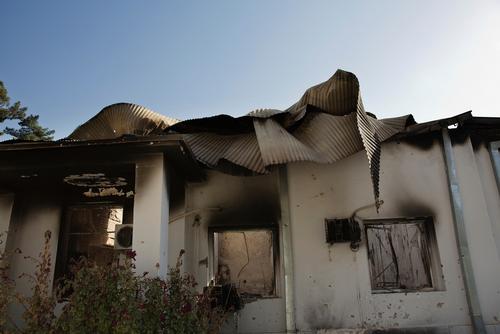
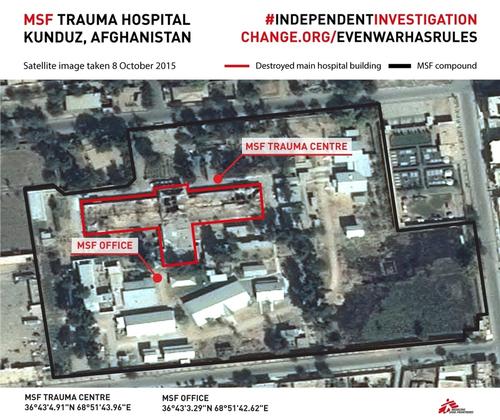
Iron roofing and rubble litter a corridor in the MSF Kunduz Trauma Centre as the facility lies destroyed following the 03 October aerial attack which killed 22 staff and patients in northern Afghanistan.

The bomb blasts were so strong that the corrugated iron roof caved in here in the blood laboratory corridor, and elsewhere in the hospital building.
Afghanistan

Death toll from the MSF hospital attack in Kunduz still rising

As of 23 October the revised figures now stand at 13 MSF staff dead and 1 MSF staff presumed dead, 10 patients dead and 2 patients presumed dead. Efforts are ongoing to determine the identities of seven other unrecognisable bodies found in the wreck of the hospital, all of whom have now been buried. These unfortunately may not be final numbers. Crisis Update - 23 Oct 2015
 
msf-placeholder
Palestine

MSF attends five times more patients than in regular activities after peak in violence

Since 2 October, MSF teams haves provided mental health psycho-social services to around 521 patients with 40 group psycho-educations sessions at community level and 95 psychological first aid services. Project Update - 22 Oct 2015
 
msf-placeholder
Syria

Crisis Update - October 2015

What was an already dismal situation for millions trapped by conflict in Syria at the beginning of 2015 deteriorated further throughout the year, pushing hundreds of thousands of people to make the hard decision to make a dangerous and sometimes deadly crossing into Europe Crisis Update - 22 Oct 2015
 
Situated in the Lake Chad region, the site of Koulkimé in Chad hosts approximately 1,800 displaced people according to OCHA. They have fled Islamic State's West Africa Province (ISWAP), also known as Boko Haram, as well as military operations carried out by the Chadian government.  MSF is working together with the Chadian Ministry of Health to support the primary health centre in Koulkimé.
Chad

Plunging from one nutrition crisis to the next

MSF's medical teams are responding to a nutrition crisis in Bokoro, in the Hadjer-Lamis region of central Chad.“Providing feeding programmes and medical assistance to acutely malnourished children is essential, but it is simply not enough to stop hundreds of thousands of children across Chad repeatedly descending into emergency levels of malnutrition,” says Alberto Jodra, MSF head of mission in Chad. “Far more needs to be done to address malnutrition’s multiple structural causes and to ease the suffering of communities like Bokoro from plunging from one hunger crisis to the next.” Project Update - 16 Oct 2015
 
msf-placeholder
Central African Republic

Thousands flee latest violence in Bangui

40,000 people have fled from their neighbourhoods. “They left with nothing and now they’re living in the most appalling conditions. Most have no shelter, no food and almost no access to medical care”, says Jean-Guy Vataux, MSF head of mission in Bangui. Project Update - 14 Oct 2015
 
msf-placeholder
Syria

MSF commemorates two years of saving Syrian war-wounded lives in Jordan

MSF has commemorated the second year anniversary for its Emergency Trauma Surgical Project which provides quality medical treatment to Syrian war-wounded patients in Al-Ramtha Government Hospital in the Ramtha district of northern Jordan. Press Release - 14 Oct 2015
 
MSF set up operations in Borno in May 2013 but had to pull out because of the security situation. In August 2014, MSF returned to Maiduguri on a permanent basis. The security situation in Borno continues to be extremely volatile with regular reports of clashes between the military and insurgents, particularly in rural areas. The government is planning the return of IDPs to their home communities by January 2016.  But this plan encounters resistance from IDPs as the security situation in the surrounding areas remains tense. 

Since 28 September 2015, an MSF team has been working in the 11-bed emergency room at Umaru Shehu hospital in Maiduguri. MSF continues its sanitarian and health surveillance/monitoring in 15 IDP camps. MSF also continues its medical activities in 2 camps – ATC and Teachers Village camps – where we provide primary healthcare and antenatal consultations.  MSF also carries out water & sanitation activities in 9 of the 15 IDP camps. In late September 2015 MSF transferred secondary healthcare activities from Maimusari clinic to the Infectious Diseases Hospital. MSF continues to run two clinics in urban districts in Maimusari and Bolori to provide primary healthcare.
Nigeria

A new MSF emergency project in Maiduguri

Since 28 September 2015, MSF has been working at Umaru Shehu hospital in Borno State capital Maiduguri in northeast Nigeria, treating patients referred from smaller health facilities and providing care to people wounded during attacks. Project Update - 13 Oct 2015
 
Fires burn in the MSF emergency trauma hospital in Kunduz, Afghanistan, after it was hit and partially destroyed by missiles 03 October 2015.
Kunduz hospital attack

MSF under attack in Kunduz

Learn about MSF's hospital in Kunduz, the people it treated, and the terrible attack that killed twelve staff and at least 10 patients. Photo Story - 12 Oct 2015
Four mothers posing in a corridor of the Hospital in Bili. All four of them are staying in the hospital with their child, that's suffering from a severe case of malaria. Since the beginning of the project in 2016, the pediatric ward already treated more than 4.000 cases of complicated/severe form of malaria.
Médecins Sans Frontières (MSF)

Independent medical humanitarian assistance

We provide medical assistance to people affected by conflict, epidemics, disasters, or exclusion from healthcare. Our teams are made up of tens of thousands of health professionals, logistic and administrative staff - most of them hired locally. Our actions are guided by medical ethics and the principles of independence and impartiality. We are a non-profit, self-governed, member-based organisation.

Learn more