



Ebola disease in DRC: find out how we're responding
Learn more
1993 Results
 
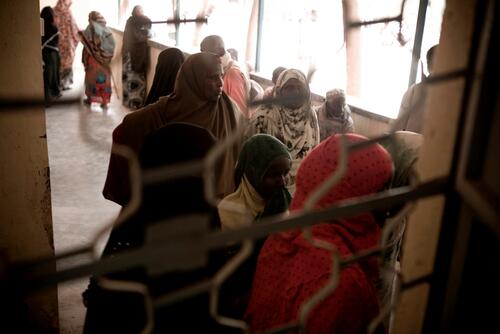
Women wait in line to have their eyes checked at the MSF Hospital in Galcayo South, Somalia on March 20, 2011. Eye problems such as the common cataract (clouding in the lens of the eye), can all too often lead to blindness if left untreated. The impact on lives is devastating, especially in a country where many people face a daily struggle to survive.
Somalia

MSF suspends operations in Medina area, Mogadishu, following direct attacks on its compound

“Following these incidents, we need to re-engage with local authorities and communities to re-evaluate if acceptable security conditions can still be guaranteed,” added Delville. “MSF calls upon all parties in Somalia to respect the lives of the civilian population and to ensure that humanitarian workers can safely access people in need”. Project Update - 30 Mar 2011
 
msf-placeholder
Democratic Republic of Congo

'Measles epidemic spiralling out of control' according to MSF

Over the past six months a measles epidemic has been sweeping through the Democratic Republic of Congo. MSF is raising the alarm and calling for concerted action to halt the spread of the disease. Project Update - 28 Mar 2011
 
msf-placeholder
Libya

MSF returns to Benghazi

“Since we first entered on February 24, our aim has been to reach areas where the ongoing fighting has left the most needs,” explained Simon Burroughs, MSF Emergency Coordinator in Libya. MSF is also trying to enter Libya from Tunisia. But, in spite of continuous efforts since February 23, the teams have still not received authorization to cross the border. Project Update - 26 Mar 2011
 
msf-placeholder
Japan

MSF works with psychologists in aftermath of Japanese quake

“Many people now are in a phase of acute stress disorder, which is a totally natural response to this level of trauma,” said Ritsuko Nishimae, a clinical psychologist working with the MSF team in Minami Sanriku. Project Update - 25 Mar 2011
 
msf-placeholder
War and conflict

Support to health facilities in the Middle East and North Africa

Ever since civil unrest and violence erupted in countries across North Africa and the Middle East, teams from Medecins Sans Frontieres (MSF) have been supplying and assisting hospitals and health structures where medical staff are facing increased numbers of injured people. Teams are also assisting people who are fleeing to neighbouring countries. Project Update - 23 Mar 2011
 
msf-placeholder
Japan

Interview with Eric Ouannes, General Director of MSF Japan

Interview with Eric Ouannes, General Director of MSF Japan, who has been working at the earthquauke zone. Project Update - 20 Mar 2011
 
msf-placeholder
Côte d'Ivoire

MSF responding to latest violence in Abidjan, Ivory Coast

Increasingly intense confrontations have had serious repercussions for the population at large, much of which has been trapped in the conflict. Over the two weeks prior to March 16, the teams treated 129 patients. However, seeking treatment is not a simple matter for people who require care but are afraid to leave their homes. Travel within the city is risky because of fighting and because groups of young men have erected blockades in the streets. The instability makes it difficult to access populations, particularly in areas close to the front lines. Project Update - 19 Mar 2011
 
msf-placeholder
Japan

MSF teams spread to new areas throughout the earthquake zone

The majority of consultations were elderly patients with chronic diseases. Many of them were running out of medications for hypertension and diabetes. Overnight, the weather in the area was poor, with snow and sub-zero temperatures. A few hyperthermia cases were seen, as well as some respiratory tract infections, possibly due to the crowded conditions in some of the evacuation centres. Project Update - 17 Mar 2011
 
msf-placeholder
Côte d'Ivoire

Ivory Coast population trapped in conflict

Increasingly intense armed confrontations over recent weeks in Ivory Coast, together with political gridlock, have had serious consequences on the country’s population. Fighting has led to new displacements of people in the capital, Abidjan, and in the western region of the country. Insecurity and shortages of medicine resulting from international sanctions have made it very difficult for victims of violence - and all those in need - to obtain care. Project Update - 16 Mar 2011
 
msf-placeholder
Japan

MSF works in isolated Japanese community devastated by quake

From Tuesday, MSF staff plan to start a small clinic in another town near to Minamisanriku using drugs donated on Monday. Once additional medical resources from the massive Japanese relief effort arrive, MSF will try to find other pockets of communities who may need medical assistance. Project Update - 16 Mar 2011
Four mothers posing in a corridor of the Hospital in Bili. All four of them are staying in the hospital with their child, that's suffering from a severe case of malaria. Since the beginning of the project in 2016, the pediatric ward already treated more than 4.000 cases of complicated/severe form of malaria.
Médecins Sans Frontières (MSF)

Independent medical humanitarian assistance

We provide medical assistance to people affected by conflict, epidemics, disasters, or exclusion from healthcare. Our teams are made up of tens of thousands of health professionals, logistic and administrative staff - most of them hired locally. Our actions are guided by medical ethics and the principles of independence and impartiality. We are a non-profit, self-governed, member-based organisation.

Learn more