


Ebola disease in DRC: find out how we're responding
Learn more
1793 Results
 
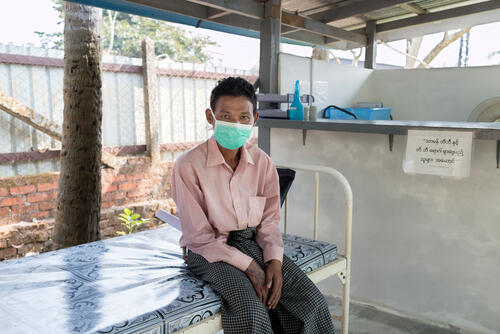
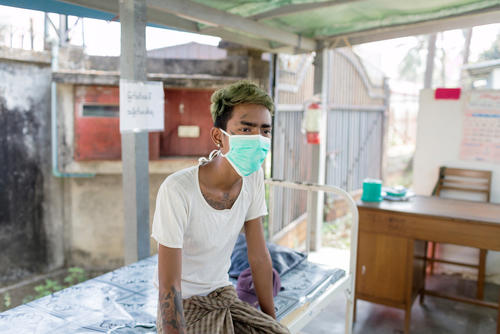
Tun Tun Oo, 40, from Myammar, inside the MSF's Insein clinic in Yangon, Myanmar.

Tun Tun Oo is 40 years old from Hlaing Tharyar. In 2017, he felt severely sick and his body temperature was very low. He went to another hospital where he discovered he had cholera, HIV, and MDR-TB. They treated him for cholera at the hospital, and then referred him to MSF clinic to receive treatment for HIV and TB. At the MSF clinic, the doctors took tests to see which drugs would be the most effective to treat his MDR-TB, and then put him on a treatment regiment that included Bedaquiline. He started to feel dramatically better after one month of treatment. After 5 months of treatment, he was able to have enough strength to go back to work as a street vendor selling dried fish and fish paste. 

Currently, he lives with his son who is 5 and a half years old. His wife and their three other children live together in a separate home. She wants him to come back, but he is having a hard time with the decision because he struggles to afford rent (MSF doctor has helped him pay rent the last 2 months). At times, he feels really upset that he didn't get a better life. Both his parents died when he was a child, and he had to take care of himself growing up. Because he grew up alone, he wishes to one day be able to afford a home where his whole family can eat around the dining table together. He knows that he has to complete his treatment so that he can start saving money and take care of his family. His son encourages him to complete the treatment plan so that "we can have more snacks to eat!"

He was excited to speak with MSF about his experience, because he "doesn't want other people to end up like him." He shares his experience with his friends and neighbours, but many do not want to speak to him. He encourages people to get tested and lets them know they can get treatment at MSF. He hopes one that that his wife and kids will come and get tested, too.
Tuberculosis

Improved treatment options recommended by the World Health Organization

MSF calls on Johnson & Johnson to make key drug bedaquiline affordable for all people who need it Press Release - 17 Aug 2018
 
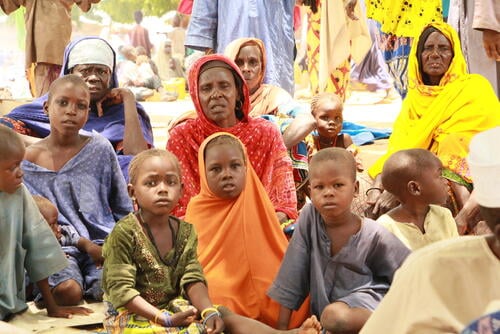
On August 16, MSF launched inpatient services for severely malnourished children under five years-old, as well as paediatric care for patients under 15 years-old with severe malaria and other diseases, in a facility with a capacity of 30 beds. The medical intervention began as a response to a lack of healthcare assistance to newly arrived displaced people in Bama. Over 1.7 million people have been displaced by the conflict between the Nigerian military and non state armed groups in northeast Nigeria.
Nigeria

Critical humanitarian situation unfolding among internally displaced people in Bama, Borno state

Médecins Sans Frontières (MSF) has started emergency nutritional and paediatric activities in Bama, Borno state, in response to a critical humanitarian situation among newly arrived internally displaced people. Press Release - 17 Aug 2018
 
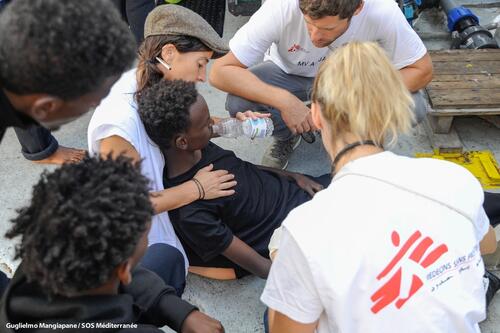
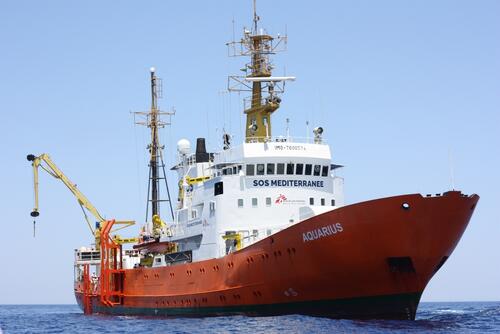
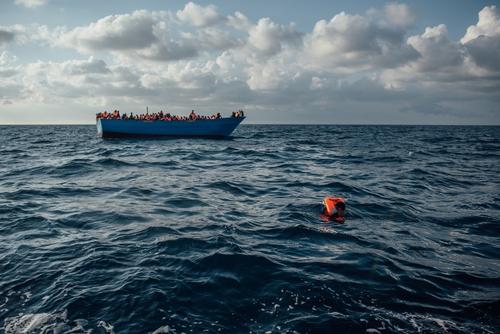
At 11:50 AM local time on Friday, 10 August 2018, 25 people were rescued in the Central Mediterranean near the Libyan coast. The rescued people were found adrift on a small wooden boat with no engine on board and were believed to have been at sea for nearly 35 hours. Just hours later, the Aquarius performed a second rescue of 116 men, women and children, including 67 unaccompanied minors, found on an overcrowded wooden boat. Those rescued originated from Somalia, Eritrea, Cameroon, Ivory Coast, Egypt, Morocco, Senegal, Togo, Ghana, Bangladesh, and Nigeria. While there were no critical medical cases among those rescued, many people were extremely weak from being out at sea on unstable boats and from their time in Libya where many say they were held in inhumane conditions.
Mediterranean migration

Aquarius calls on European governments to assign place of safety after rescues on Mediterranean

Responding to the ongoing humanitarian crisis in the Central Mediterranean, a total of 141 people were rescued on Friday by the search and rescue vessel Aquarius, chartered by SOS MEDITERRANEE and operated in partnership with Médecins Sans Frontières (MSF). Press Release - 15 Aug 2018
 
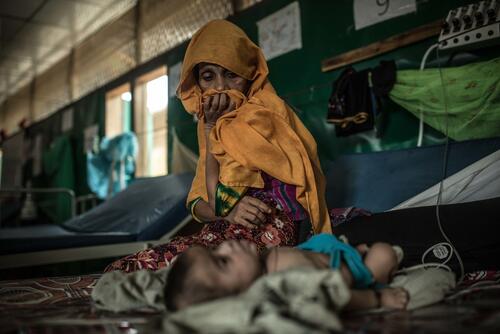
Ansar and her three-month-old son Salim Ullah inside the MSF hospital in Goyalmara.
Myanmar

Independent humanitarian agencies and access to healthcare still blocked in northern Rakhine

MSF once again requests the government grant immediate and unfettered access to northern Rakhine to all independent and impartial humanitarian actors, to ensure the health needs of the population can be evaluated and addressed. Press Release - 15 Aug 2018
 
Rescue on MV Aquarius - June 2016
Mediterranean migration

Aquarius returns to Central Mediterranean: humanitarian assistance at sea desperately needed

The rescue boat Aquarius, run by SOS MEDITERRANEE and MSF, sets sail from Marseille after an extended port call. Aquarius is heading back to the Central Mediterranean to render assistance to people in distress at sea. Press Release - 1 Aug 2018
 
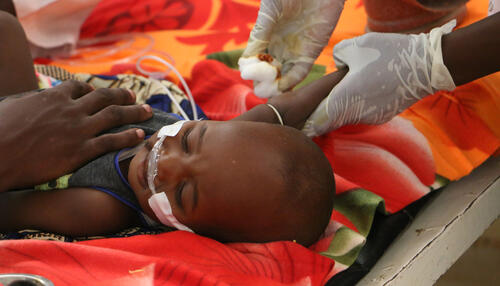
Haroon, 8 months old, is treated in in the intensive care unit so he can be stabilised, before being transferred to the therapeutic nutrition center (CNT). He shows symptoms of severe malnutrition and anaemia. His physical condition worsened because of blood loss as the result of a traditional 'scarification' ceremony, where marks are cut into the face and body to indicate social and tribal affiliations. 

Haroon had been bleeding and getting weaker for three days, before he was brought to the hospital by his mother.
A nurse is preparing the baby for a blood transfusion. Haroon will be treated in the intensive care unit for at least four days, with transfusions, antibiotics and therapeutic milk.
Chad

MSF opens emergency nutrition programme in N’Djamena

It is urgent to increase inpatient capacity to treat severely malnourished children and to provide early treatment in outpatient facilities as acute malnutrition reaches alarming proportions in N’Djamena, the capital of Chad. Press Release - 27 Jul 2018
 
Tanya is not at school, because her father cannot afford the fees. She spends a lot of time in and around the house. “When the other kids are playing outside my home, I try and use my crutches to keep up but they don’t slow down for me because I can’t walk as fast. When it happens, and they run away from me, it hurts me a lot. I start calling out to them. If they don’t come back, I go inside my home. When they run away, it’s very painful to me, sometimes it even gives me a pain in my stomach, deep down, and that’s why I end up sleeping and I will wish that my Daddy will come home and that he will be with me. When Dad comes home and I tell him what happened, he says, don’t worry about them, they are just kids playing around,” she says.
HIV/AIDS

Pfizer and GSK’s HIV/AIDS division, ViiV, prevents children with HIV from getting needed medicine

Tanya is ten years old and is unable to walk. She was diagnosed with HIV when she was just a few months old. Zimbabwe, 2016. Press Release - 23 Jul 2018
 
Thun Mina Aung, 18, from Myammar inside the MSF's Insein clinic in Yangon.

Thu Min Aung is 18 years old and lives with his aunt. Back in June 2017, he was working as an air conditioner installer in Sang Jae township when he started to feel sick. He went to a nearby clinic and they gave him medications, but the drugs did not treat his symptoms. 

Soon after, he moved to Hlaing Tharyar, where he went to another clinic and discovered that he has MDR-TB. Treatment has greatly impacted his day-to-day life. Everyday, he wakes up at 7am, eats breakfast, and takes the bus for 45 minutes to the MSF clinic to take his medication. The pills make him feel very dizzy. When he gets home from the clinic, he has to lie down and sleep for the entire afternoon. His whole life revolves around treatment right now because the side effects are very severe. He has 12 more months of this day-to-day before finishing treatment.
Tuberculosis

Last-minute pressure to drop language on protecting access to affordable medicines from TB Summit declaration negotiations

MSF's Access Campaign appeals to all countries to urgently stand up right now against bullying that aims to keep medicines out of the hands of your people who need treatment. Press Release - 20 Jul 2018
 
MSF and SOS Mediterannee Search and Rescue personnel from the vessel, Aquarius, intervene to rescue refugees and migrants from an over-crowded wooden boat, 28 December 2016, in the Mediterranean sea off the northern coast of Libya.
Mediterranean migration

Drowning skyrockets as European governments block humanitarian assistance on Central Mediterranean

In the last four weeks, the number of deaths in the Central Mediterranean has skyrocketed, with over 600 people drowned or are presumed drowned, including babies and toddlers. Press Release - 12 Jul 2018
 
Nashwan, 42, is prepared for surgery at the Médecins Sans Frontières / Doctors Without Borders (MSF) post-operative care facility in east Mosul. Nashwan is one of the many war-wounded patients still trying to recover a year after the conflict in Mosul officially ended. 

“On 11 March 2017, our neighbourhood was retaken [from the Islamic State group],” Nashwan recalls. “Two days later, we went out to buy food and we were happy. But fighting was continuing in the neighbourhoods around ours. There was a tall building nearby and there was a sniper on top. He started hunting us down. My neighbour was shot in the head and killed. My brother was shot in the leg. The sniper shot me in the back and in the leg.”

Nashwan went to several hospitals outside Mosul for treatment. He then returned to his home in west Mosul where the conflict was still raging. 

“I waited in my home for several months for the bombs to stop,” he says. “When I was at home during these seven months the pain started to grow in my leg and hip, and eventually it became unbearable. So in October 2017 I went to the general hospital in west Mosul. They did x-rays and tests and they said I needed a huge operation and they didn't have the capacity to do the operation.” 

Nashwan’s neighbours helped him pay for a private doctor to do the operation, but it was unsuccessful and Nashwan was soon in agonising pain again. He was forced to go back to the general hospital, which then referred him to MSF’s surgery and post-operative care facility in east Mosul.

“Life has been really hard. My injury has had a negative impact on my life - my family, the way I interact with my kids. I can’t play with them. I can't work and we haven’t had an income. I've been really depressed and I cannot talk to people. Even to go to the bathroom I need someone to come with me. And I need the crutches to go everywhere. It's been really hard for me. But thankfully the hardest part has passed now that I am here.” 

The MSF facility provides free surgeries, post-operative care, rehabilitation and mental healthcare, especially for war-wounded patients. MSF works closely with local health authorities to refer the most urgent patients for care.  

The facility is run by a team of 30 highly qualified international and Iraqi medical experts and has a 33-bed capacity.
Iraq

A year on from battle, Mosul’s healthcare system is still in ruins

National authorities and the international community need to urgently rebuild public health infrastructure, provide patients with access to affordable medication and ensure medial facilities are supplied with the necessary equipment. Press Release - 9 Jul 2018
Four mothers posing in a corridor of the Hospital in Bili. All four of them are staying in the hospital with their child, that's suffering from a severe case of malaria. Since the beginning of the project in 2016, the pediatric ward already treated more than 4.000 cases of complicated/severe form of malaria.
Médecins Sans Frontières (MSF)

Independent medical humanitarian assistance

We provide medical assistance to people affected by conflict, epidemics, disasters, or exclusion from healthcare. Our teams are made up of tens of thousands of health professionals, logistic and administrative staff - most of them hired locally. Our actions are guided by medical ethics and the principles of independence and impartiality. We are a non-profit, self-governed, member-based organisation.

Learn more
