



Ebola disease in DRC: find out how we're responding
Learn more
1392 Results
 
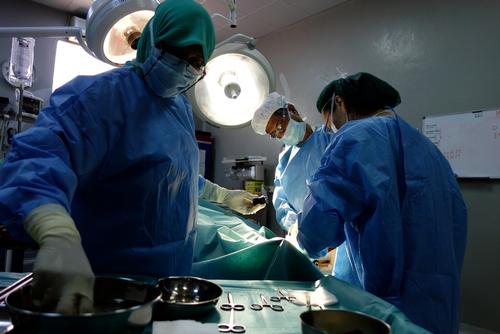
Operating theatre.
Yemen

The crisis in Yemen

First published in the International Activity Report 2015 Report - 1 Jul 2015
 
Second testimony: 
We believe that the violence will continue during Ramadan:  a ceasefire won’t be implemented unless the two warring parties respect it.
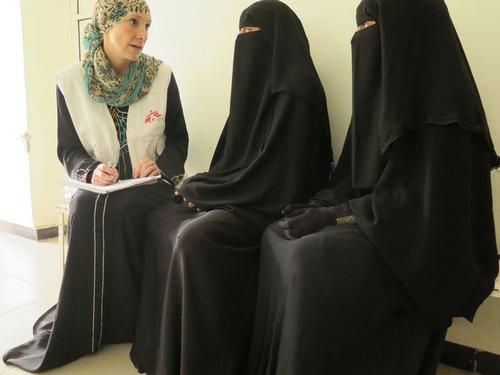
Jasmin Mohammed Ali (26) is a teacher in the primary school in Qatabah and her sisterAsia Mohammed Ali ( 25)  talk about their daily life in Qatabah since the conflict erupted. 

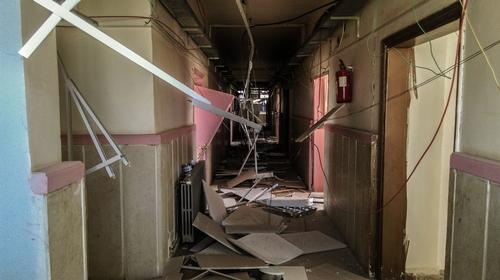
Because of the ongoing crisis, the school I work in is closed; it has been closed for 3 months. We only   finished the 1st term and had to stop during the 2nd term. I haven’t been paid for the last month.  Recently, the school (which was luckily empty at the time) was affected by the airstrikes as it is close to the central security office which was targeted; all the windows of the school were shattered into pieces. 
Since the new crisis in Yemen started things have become much harder. It is harder to get food and water. It is hard to get food as many shops have closed. On the other hand, some Yemeni families depend completely on the work in the khat (qat) market. If there is bombing or shelling close by, everyone runs away from the khat market and business is lost.  Our father and brother work in the khat market. If they cannot work in the khat market, they won’t have enough money to buy food for the family.  Prices of food, especially basic food, have increased dramatically. For an example, twenty liters of cooking oil used to be 5,000 Yemeni Rial (YER), now they have to pay 9,500 YER.  15 kg of sugar used to be 12,000 YER, now they have to pay 18,000 YER. 
Lack of water is our biggest challenge
Water represents everything and without water there is no life. There isn’t any running water anymore in Qataba as the main water facility for the town and the surrounding villages stopped working due to a fuel shortage. We have no water in our house and cannot fill up the tanks either. There is only one water well in Qataba town that has good water for drinking and is for free. If this well is not working we would walk to another well where there is the main water facility. This trip usually takes between three to four hours round trip by foot and if we go there, we cannot bring that many containers as we can only carry one container, it’s very heavy. Unfortunately, this borehole isn’t working for the moment due to the fuel issue as well.  
Meanwhile, the main well in Qataba is becoming very crowded and women in town fill their containers with a multitude of personal hoses. That would take a long time to fill up all the containers. 
We couldn’t go to the well, today, as it was too crowded. Water trucks are still available but it is only used by rich people, one water truck costs 30,000 YER for 6,000 liters and it only lasts for about 1-2 weeks depending on the size of the family. 
The impact of airstrikes 
 Airstrikes and shelling is making us terrified and we can’t sleep well. Last night, the kids were too afraid as the shelling and fighting was very close by. 
We have been thinking about fleeing Qataba, but the problem is that we are 26 family members living in one house. We don’t know where to go.
It might be better to stay in Qataba since we have a home here. We don’t own a house in any of the surrounding villages where it would be quieter. We have relatives in Damt district in Al-Dhale, which could be an option. If the situation deteriorates, half of the family might go to Damt with the other half staying in Qataba.  If the bombing and shelling continues and if the frontline moves closer, we might decide to leave. 
The holy month in Qatabah 
We never imagined that this could happen. Qataba was very peaceful and didn’t have any problems. People would come to Qataba from different districts of different governorates during the holy month of Ramadan but this year nobody will come. Qataba is perceived to be better than other districts for Ramadan because of its culture during Ramadan. The streets will be filled with markets and people.
Yemen

Testimonies from Al-Dhale

"We believe that the violence will continue during Ramadan: a ceasefire won’t be implemented unless the two warring parties respect it... We never imagined that this could happen." Voices from the Field - 29 Jun 2015
 
msf-placeholder
Yemen

Crisis update – 25 June 2015

In Yemen, MSF works in Aden, Al-Dhale’, Taiz, Sa’ada, Amran, Hajja, Ibb and Sana’a. MSF has brought into the country 105 tons of humanitarian aid to the facilities it is running and supporting in Yemen. Crisis Update - 25 Jun 2015
 
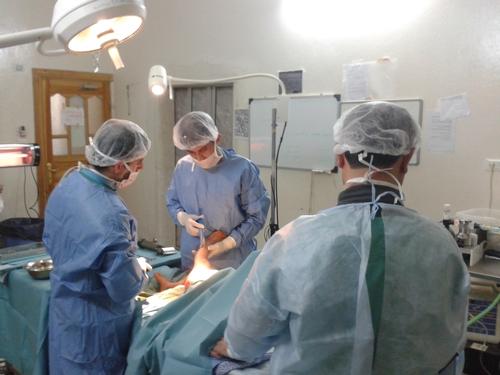
In Idlib area, MSF runs a 15 bed hospital dedicated to the treatment of burn patients.The treatment requires debridments, change of dressings done in the operating theater under anesthaesia, skin graft and physiotherapy sessions. The hospital has also an emergency room where MSF treats medical cases
Syria

Fuel shortage puts health structures at risk

Shortage of fuel is putting health structures and lives at risk. MSF has responded by providing 6,200 litres of fuel, however, this is not enough and will only have a short term impact. Press Release - 22 Jun 2015
 
The intensity and number of attacks against medical facilities in Syria is increasing.

Busra hospital, in Dara’a governorate, in the South, was destroyed after being hit by ten barrel bombs on Monday night. It is one of ten medical facilities that have been targeted in the past month. Busra hospital was the only health facility providing neonatal and dialysis services in Dara’a.
Syria

Barrage of barrel bombs destroys MSF health facility

Busra hospital, in Dara’a governorate, was destroyed after being hit by ten barrel bombs on Monday night.This aggression came only a few days after another attack on a hospital supported by MSF in Aleppo governorate, in northern Syria. Press Release - 18 Jun 2015
 
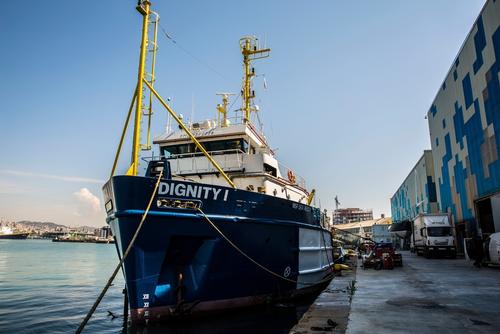
Preparations on the MSF ship Dignity I at Barcelona port.
The Dignity I has a crew of 18, including medical staff. The 50 metre-long vessel will leave the port of Barcelona on mid-June and has the capacity to carry 300 rescuees. 
A third search, rescue and medical care boat, with teams from MSF will assist people trying to reach Europe by sea in a bid to escape war, persecution and poverty at home.
Mediterranean migration

MSF bolsters operations in the Mediterranean Sea

A third search, rescue and medical care boat, with teams from MSF on board, will assist people trying to reach Europe by sea in a bid to escape war, persecution and poverty at home. Press Release - 13 Jun 2015
 
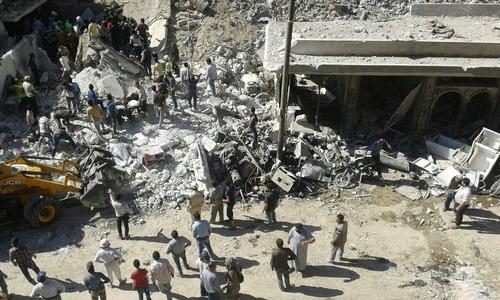
Since the clashes erupted in Aden on the 19th of March between forces loyal to president Hadi and special security forces - a rebel unit loyal to the former president Saleh - the conflict intensified in Aden and other areas in the South of Yemen, including Ad-Dhale', Lawdar and Lahj. MSF emergency surgical unit received more than 600 patients from March 19 until April 5, but it is more and more difficult for wounded to reach the hospital as roads are often blocked and ambulances stopped, attacked and highjacked.

Depuis que les combats ont éclaté le jeudi 19 mars à Aden entre les forces fidèles au président Hadi et les forces spéciales de sécurité,une unité rebelle fidèle à l'ancien président Saleh, le conflit s'est intensifié à Aden ainsi que dans d'autres zones du sud du Yémen, y compris à Ad-Dhale', Lawdar et Lahj. L'unité chirurgicale d'urgence de MSF d'Aden a reçu plus de 600 patients entre le 19 mars et le 5 avril, mais les blessés ont de plus de plus de difficultés à atteindre l'hôpital, les routes étant souvent bloquées et les ambulances attaquées, confisquées ou braquées.
Yemen

MSF receives 100 injured in one day after shelling of residential areas in Aden

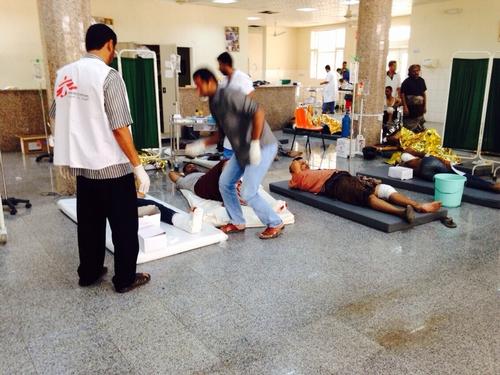
More than 100 injured, including women and children, were received by MSF in Aden yesterday as a result of heavy shelling on the Al-Basateen residential area in the city. Press Release - 11 Jun 2015
 
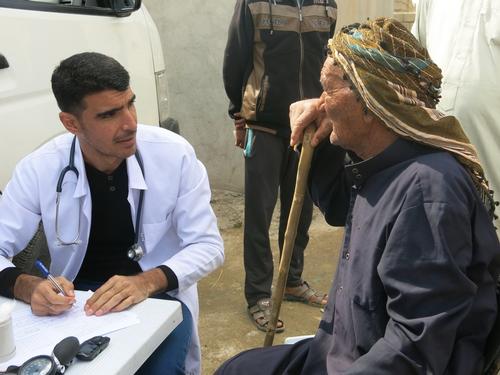
An old man has come to MSF mobile clinic in Shurawa Hama Gerib, a Kurdish village a few miles from Tuz Kurmatu now hosting 170 IDP families, because of high blood pressure: “You might not believe it, says his son who has come with him, but this man has a soft spot for women you know. Back at home in Dakuk he fell in love with a neighbour, a widow just as old as him. She is also displaced now living in in Tuz, and he calls her up every day and spends ages chatting to her on the phone. He misses her so much, not one day passes without him calling his beloved Kadjja ”..
Iraq

Increasing numbers of Iraqis in need of humanitarian assistance

“Iraq is experiencing its worst humanitarian crisis of recent decades. Thousands of people, particularly in central Iraq, are not receiving the humanitarian assistance they urgently need.” Voices from the Field - 8 Jun 2015
 
On 04 June, a missile strike hit a town centre in Idlib Governorate, northern Syria, and between 3pm and 7pm 130 wounded patients arrived at the small 12-bed facility. 80 were treated in the hospital, and 50 were referred to another medical facility as the nearest hospital became overwhelmed.  See the PR and the testimony for more info."
Syria

“Bodies were everywhere - on the tables, in the hallways, on the floor.”

An MSF-supported hospital director describes horror of a mass-casualty influx in northwestern Syria Voices from the Field - 5 Jun 2015
 
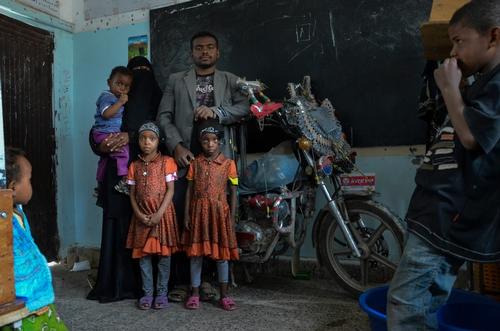
12 days ago, Mazen Abdu of Sa’ada, his wife and three children escaped Sa’ada on his motorbike. The family keeps the motorbike in the classroom where they live since they arrived Khamer.  
“When the airstrikes were so close from our house, we decided to go to a safer place and leave everything behind,” says Mazen. His only way to escape was his motorbike.
“The five of us travelled from Sa’ada to Khamer on this motorbike. We could only take 10 kilos of flower and a small blanket. Our trip from Sa’ada to Khamer was not easy. We spent two days and one night travelling. We did not have money to stay in a hotel or buy food and to crown it all, one of the motorbike’s tires was punctured. I was waiting hopelessly in the road with my family until somebody helped me fix it and we continued our way to Khamer. Some good people offered us food and hosted us in their home for the night.”
Mazen’s wife, Um Alia, said that her children were scared of the bombings that they lost their appetite and that when she tried to force her two daughters to eat when they were travelling, they both vomited. “My daughters were terrified by the sound of the bombings and were shivering.”
The family lives now in a classroom in one of Khamer schools. Some 500 IDP families live in public places and some of them live in tents.
“We left everything behind; our home, our neighbors, our life. In fact, I doubt there is life in Sa’ada and I still ignore what happened to our house.”
Yemen

Testimonies from displaced people in Khamer

There has been an influx of IDPs from Sa’ada to Khamer, fleeing their homes due to the deteriorating situation and airstrikes in Sa’ada governorate. Many have been living with families in Khamer or in rented houses, while some occupy public places such as schools, and others live in tents on the outskirts of the town. Voices from the Field - 3 Jun 2015
Four mothers posing in a corridor of the Hospital in Bili. All four of them are staying in the hospital with their child, that's suffering from a severe case of malaria. Since the beginning of the project in 2016, the pediatric ward already treated more than 4.000 cases of complicated/severe form of malaria.
Médecins Sans Frontières (MSF)

Independent medical humanitarian assistance

We provide medical assistance to people affected by conflict, epidemics, disasters, or exclusion from healthcare. Our teams are made up of tens of thousands of health professionals, logistic and administrative staff - most of them hired locally. Our actions are guided by medical ethics and the principles of independence and impartiality. We are a non-profit, self-governed, member-based organisation.

Learn more