



Ebola disease in DRC: find out how we're responding
Learn more
1390 Results
 
msf-placeholder
Tunisia

Fishermen receive training in saving lives at sea

“Tragedies at sea will continue to regularly occur as people are desperate to flee to Europe” says Wiet Vandormael, MSF’s training coordinator “Search and rescue helps save lives but is not a long-term solution. The European Union needs to create safe and legal ways for people to reach Europe so that they don’t have to risk their lives during the journey.” Project Update - 1 Sep 2015
 
msf-placeholder
Tunisia

Testimonies from fishermen receiving training in saving lives at sea

In order to increase the fishermen’s capacity to carry out rescues at sea, Médecins Sans Frontières (MSF) has carried out a six-day training with 116 local fishermen in the town of Zarzis. Voices from the Field - 31 Aug 2015
 
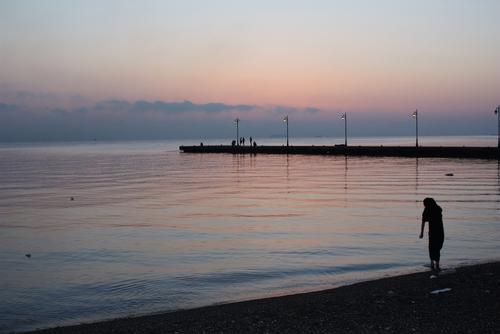
A woman refugee washes in the sea as day breaks in the early morning on the island of Kos, Greece. Refugees, mainly from Syria have been arribving in Kos having made the treacherous crossing from Turkey by boat.
Refugees, IDPs and people on the move

Refugees in Kos stuck in appalling conditions

Between January and July this year, 18,600 refugees arrived on the Greek island Kos by boat from Turkey. The majority are fleeing war and violence in Syria, but many also come from Afghanistan, Iraq, Iran and Pakistan. Project Update - 26 Aug 2015
 
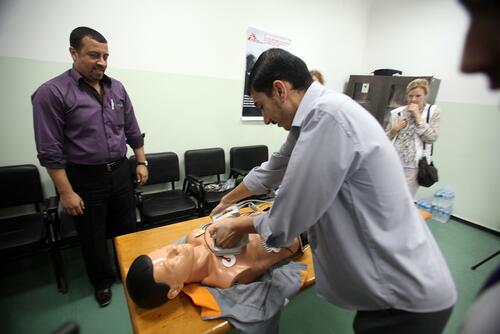
Intensive Care training, Al Shifa hospital, Gaza. The objective of the "Intensive Care" project is to support and train Gazaoui medical staff to treat patients in intensive care situations. *** Local Caption *** The blockade, set up when Hamas came to power in Gaza in June 2007, imposes tight restrictions on people’s movements and access to goods. In addition to its economic impact, with the rise in unemployment and poverty, the blockade also affects the health sector.

. In January 2011, following a series of assessments implemented in partnership with the Ministry of Health, MSF decided to set up an intensive care programme with several facets.
Although the medical system in Gaza is functional, the support and training that medical staff need to treat patients in intensive care situations has now become an issue that MSF wishes to tackle.


In addition to the training courses for Gazan doctors offered at the Al Shifa hospital, MSF will be sending specialist medical equipment technicians to the Nasser de Khan Younis hospital in southern Gaza. They will provide the hospital with technical support so that it can optimise its use of intensive care equipment. An MSF nurse has been giving staff at the Nasser hospital intensive care training since March 2013, using a bedside teaching approach. MSF also plans to develop its intensive care support programme by offering physiotherapy training in the near future.
Palestine

Delivering training to healthcare workers stuck in Gaza

“The nurses were really enthusiastic, they were very grateful to have the opportunity to develop their intensive care skills," says Rochelle DeLacey, an MSF intensive care nurse working in Gaza." Their only other option really was to Google ‘intensive care’ because they don’t have any other access to training.” Voices from the Field - 26 Aug 2015
 
msf-placeholder
Syria

MSF treats patients with symptoms of exposure to chemical agents

"The patients’ clinical symptoms, the way these symptoms changed over time, and the patients’ testimony about the circumstances of the poisoning all point to exposure to a chemical agent,” Pablo Marco, MSF’s programme manager in Syria. Press Release - 25 Aug 2015
 
msf-placeholder
Yemen

At least 65 civilians killed in coalition airstrikes and heavy fighting in Taiz

“At least 65 civilians in the province of Taiz, Yemen have been killed in Saudi led air strikes today, including 17 people from one family,” says Salah Dongu’du, MSF's Project Coordinator, about the current situation in Taiz, Yemen. “The deaths occurred when the strikes hit civilian homes in the area. Those who survived the bombings are searching through the rubble with their bare hands in the hope of finding survivors, as well as the bodies of victims of the attack. Many others are believed to have been injured or killed in the past week in air strikes, shelling and fighting in densely populated areas." Statement - 21 Aug 2015
 
msf-placeholder
Lebanon

Heat wave adds to the woes of Syrian refugees in Bekaa Valley

In Lebanon’s Bekaa Valley, temperatures have reached as high as 42 degrees. The heat isn’t just bringing discomfort; it’s bringing sickness. “We provide medicine and our health promotion teams explain how to reduce the spread of infection, but we can’t change the underlying cause of these problems, which are poor hygiene and precarious living conditions,” says Dr. Wael Harb, head of MSF's medical activities in the Bekaa. Project Update - 20 Aug 2015
 
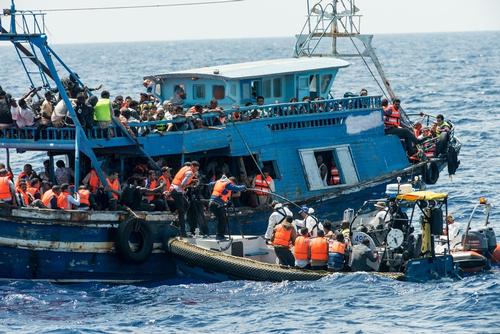
On the morning of 26 August,  the MY Phoenix, jointly operated by MSF and MOAS was asked to standby as the Swedish coast guard ship, Poseidon, rescued an estimated 450 people from a wooden boat. The MOAS crew handed out life jackets and the MSF medics were asked to assist directly on board as there were many critical cases. Dr Simon Bryant and nurse Mary-Jo Frawley went into the hull of the boat, where they were literally lifting people’s heads out of the water to check if they were alive. A critical patient suffering from suspected fuel inhalation was stabilized in the MSF clinic onboard the Phoenix and medevac'ed via helicopter for further treatment on land.
At that point a second wooden boat carrying 550 people appeared and the MOAS search and rescue team immediately commenced rescued operations. More than 415 people were brought on the MY Phoenix, bringing the boat to capacity the remained 125 people were taken on board the Poseidon. Whilst this rescue was still underway, a rubber dinghy with an estimated 100 people on board arrived on the scene. The MOAS crew transferred the men, women and children on board to an Italian naval vessel, which was also on the scene.
“ The deaths of these 52 people today show that search and rescue is just a bandaid. It is merely a temporary solution to Europe’s failures, and not even a truly effective one.  Despite the increase in SAR efforts since late April, the death count still keeps mounting.  The only way to actually put an end to these avoidable tragedies is to create safe and legal ways for people to migrate or seek asylum in Europe. People's desperation to flee and survive forces them into taking these dangerous boats, into the hands of people who profit from their willingness to risk it all in the search of safety of Europe. Today, just like yesterday, Europe’s policy makers have blood on their hands. It is time for a change, a radical rethink and we need it now” -  Will Turner – MSF Emergency Coordinator on the MY Phoenix
Mediterranean migration

Proactive search and rescue operations essential life-saver

“Increasingly, we see that we are required to carry out multiple rescues from multiple boats within a matter of hours”, said Lindis Hurum, MSF Emergency Coordinator on board of the Bourbon Argos. “Our teams have also encountered boats with people who had already died from dehydration or asphyxiation during the journey. To me this suggests that despite the EU response supposedly being ‘bigger and better’ than last year, there are not enough boats available and in the right spot to adequately respond to the needs of those crossing the Mediterranean.” Project Update - 20 Aug 2015
 
msf-placeholder
Project Update

A month in focus: August 2015

Ebola: a hope-bringing vaccine; Lebanon: Lives ruined by the conflict; Tanzania: Cholera, a new threat to Burundian refugees; Malawi: In the over-populated prisons; Antivenom serums: In worrying shortage; Yemen: "You come and do the work!".

Project Update - 17 Aug 2015
 
msf-placeholder
Syria

Airstrikes on nine hospitals in Idlib province, 11 civilians killed and 31 wounded

“These recent attacks are a clear violation of International Humanitarian Law, which prohibits military attacks on hospitals," says Sylvain Groulx, MSF's Head of Mission for Syria. "Airstrikes are capable of targeting specific buildings and these hospitals are known locations. They must be respected as neutral spaces where civilians can safely access their right to healthcare services. Civilians continue to suffer the daily brunt of this war with a massive number of deaths and injuries.” Statement - 14 Aug 2015
Four mothers posing in a corridor of the Hospital in Bili. All four of them are staying in the hospital with their child, that's suffering from a severe case of malaria. Since the beginning of the project in 2016, the pediatric ward already treated more than 4.000 cases of complicated/severe form of malaria.
Médecins Sans Frontières (MSF)

Independent medical humanitarian assistance

We provide medical assistance to people affected by conflict, epidemics, disasters, or exclusion from healthcare. Our teams are made up of tens of thousands of health professionals, logistic and administrative staff - most of them hired locally. Our actions are guided by medical ethics and the principles of independence and impartiality. We are a non-profit, self-governed, member-based organisation.

Learn more