



Ebola disease in DRC: find out how we're responding
Learn more
1390 Results
 
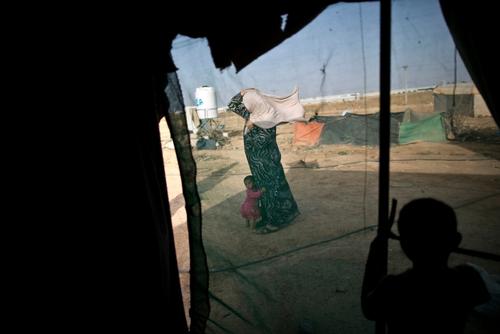
A Syrian refugee woman holds on to her headscarf against the wind while she and her daughter stand outside their tent at an informal tented settlement near the Syrian border on the outskirts of Mafraq, Jordan.
Syria

Voices from the Berm

Voices from the Field - 30 Jun 2016
 
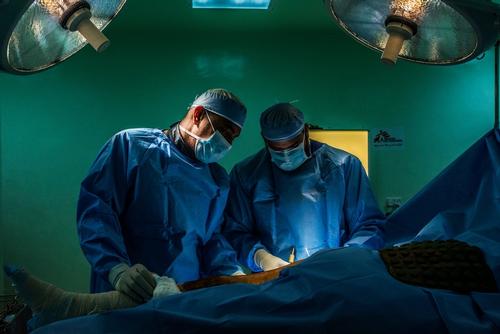
A surgery at MSF´s Al Salamah hospital in Azaz district in northern Syria. The 52 bed hospital includes an ER, an operating theatre,outpatient and inpatient services, including maternity care. It is the largest directly run MSF facility still inside Syria, managed by nearly 150 Syrian staff. Azaz district has seen new waves of displaced people arrive in recent months, and now an estimated 100,000 people are trapped in the area between shifting frontlines and the closed Turkish border. MSF teams travel out to displaced persons camps and surrounding areas to bring back patients, and MSF also provides distributions of emergency relief items. In May the hospital was forced to close when frontlines came too close, since June it has reopened only for emergency cases and surgeries.
Syria

MSF staff on working at Al Salamah hospital, Azaz

“I had the opportunity to work in Germany but I refused,” says Thurayia Zein Al Abideen, a paediatrician at MSF’s Al Salamah hospital in Azaz district, northern Syria. “I want to work in Syria, because people need us and we are facing a huge shortage of doctors.” Voices from the Field - 23 Jun 2016
 
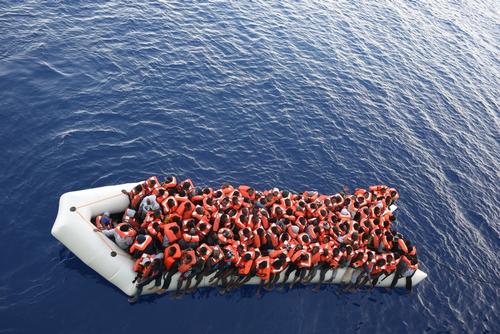
08 June. Three boats containing approximately 150 people each were rescued in the Mediterranean Sea by the Bourbon Argos and taken to Sicily, Italy.
Mediterranean migration

EU Migration Crisis Update - June 2016

Since 1 January 2016, 200,000 people have arrived on European shores by sea. The great part of them arrived through the Aegean Sea before the closure of the so called Balkan road and around 50,000 arrived in Italy through the dangerous Central Mediterranean route. At least 50,000 are stuck in Greece after the closure of the Balkan route, with the extremely dangerous Central Mediterranean becoming one of the few remaining opportunities to reach Europe for thousands of people. Crisis Update - 17 Jun 2016
 
msf-placeholder
Yemen

Treating gunshot, grenade and mine injuries in Aden

“This was the first time I was confronted with injuries caused by gunshots, grenades and mines – and they were often horrific injures,” reflects Helmut Shoengen, an anaesthetist/doctor who recently returned from working in Aden, Yemen with Médecins Sans Frontières (MSF). Voices from the Field - 15 Jun 2016
 
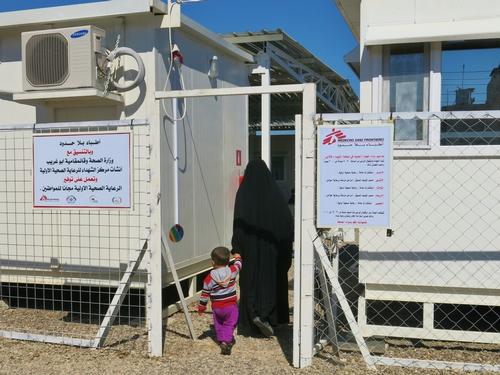
In January 2016 MSF opened a PHCC in Al Shuada, a very poor neighbourhood in the district of Abu Graib, west of Baghdad. 
In the first month 4.000 consultations were carried out by our medical team.
The organisation offers medical services in 3 other locations in the district. Another mobile team is active in camps close to Bzibiz bridge on the border with Anbar.
In Baghdad OCG employs 72 national staff 13 expatriate staff
Iraq

There is a lack of humanitarian actors in Baghdad area

By Robert Onus, field coordinator for the MSF project in Abou Ghraib, Baghdad Voices from the Field - 10 Jun 2016
 
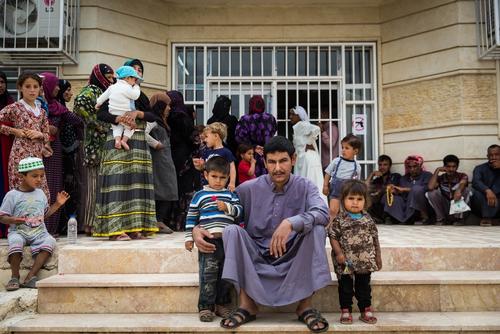
Makhmood is a taxi driver. He had brought his wife to the clinic in Hutheima who is complaining of strong headaches. "We went to
Dohuk to see a specialist, he says. She had a scan and was given medication but it didn't work. It's not easy to
go to Dohuk, you need a referral and permission from the police unless it's an emergency.
We asked the only local doctor for a referral and were granted one. Then we went to the police and
we got permission in a few hours. The journey to dohuk was smooth and we had no problems at the
checkpoints".
Iraq

I left all my memories in Mosul

"People started to flee. I didn’t know what to do: I was torn between the need to get my family to a safe place and my commitment to the hospital. It was a time of great uncertainty," says Baroj, assistant coordinator of MSF’s project in Ninewa, Iraq. Voices from the Field - 10 Jun 2016
Four mothers posing in a corridor of the Hospital in Bili. All four of them are staying in the hospital with their child, that's suffering from a severe case of malaria. Since the beginning of the project in 2016, the pediatric ward already treated more than 4.000 cases of complicated/severe form of malaria.
Médecins Sans Frontières (MSF)

Independent medical humanitarian assistance

We provide medical assistance to people affected by conflict, epidemics, disasters, or exclusion from healthcare. Our teams are made up of tens of thousands of health professionals, logistic and administrative staff - most of them hired locally. Our actions are guided by medical ethics and the principles of independence and impartiality. We are a non-profit, self-governed, member-based organisation.

Learn more