



Ebola disease in DRC: find out how we're responding
Learn more
1390 Results
 
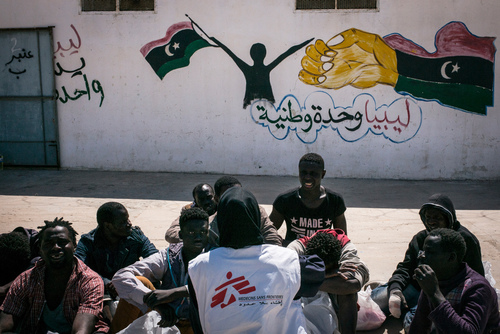
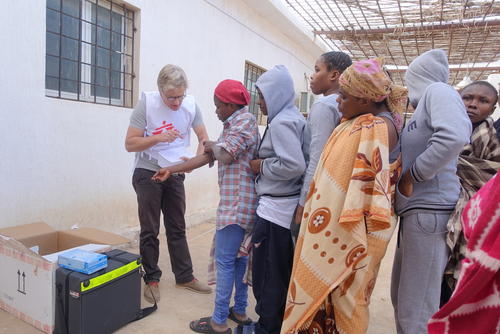
MSF staff member talks to men detained in Abu Salim detention centre, in Tripoli, Libya.
Libya

MSF continues to provide medical care to migrants and refugees detained in Tripoli

Médecins Sans Frontières (MSF) continued to provide lifesaving and primary healthcare to refugees and migrants detained in the capital Tripoli during the first quarter of 2017. More than 4,000 medical consultations took place in seven different detention centres nominally under the control of the Directorate for Combating Illegal Migration (DCIM). Project Update - 19 May 2017
 
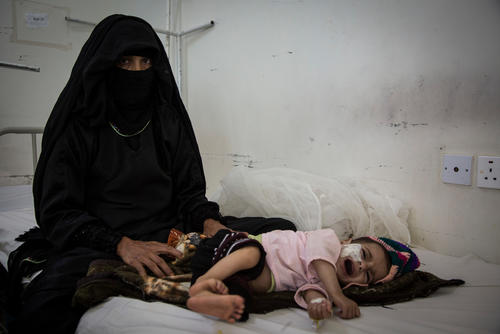
Besam’s child is 7 months old. She brought him to the health center because he keeps vomiting and has diarrhea and fever.  The child is malnurished and according to the doctor, such cases happen very often: « mothers stop breastfeeding and replace their milk with powder one but the water isn’t clean and the children get sick. We have to cure the sickness and they get immediately healthy again ».
Yemen

MSF calls for increased response to cholera outbreak

"We are very concerned that the disease will continue to spread and become out of control." Press Release - 9 May 2017
 
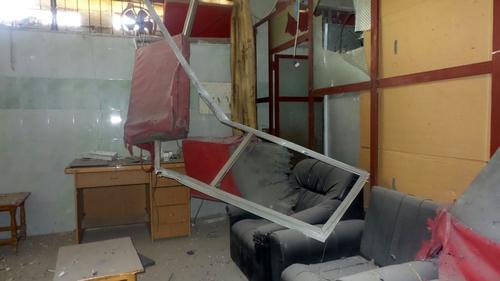
The strike on Tafas field hospital, some 12 km from the Jordanian border, took place on the night of 5 February. It caused partial damage to the hospital building, and put its heavily-used ambulance service out of action. In fear for their lives, more than 20,000 people from Tafas town fled to the surrounding countryside. The hospital is the latest medical facility to be hit in a series of airstrikes in southern Syria, which have been escalating over the past two months.
Syria

"MSF adapts to respond to the needs of a war-afflicted population"

Omar Obeid has been working as Project Coordinator for an MSF South Syria project, managing it remotely for the last 14 months. Over the past few weeks, fighting has intensified in southern Syria, as opposing forces contest to retake the city of Dara’a. As bombings and aerial attacks in Eastern Dara’a increased, hospitals and medical structures in the area have been forced to announce their closure to avoid being targeted Voices from the Field - 8 May 2017
 
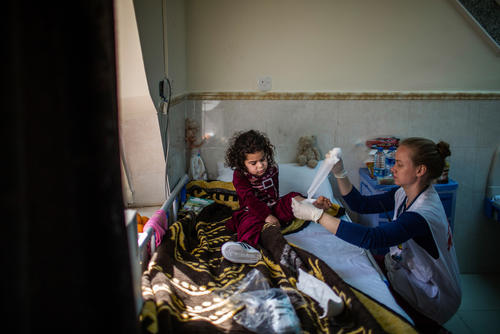
MSF staff member Patricia, changes 5 year old Faten's bandages. She was injured when she was playing in a garden. At the Medecins Sans Frontieres (MSF) Post Op Hospital South of Mosul, Iraq. 

Told by her father:

“When our neighbourhood in West Mosul was retaken by the Iraqi army we went back to our house. Faten was playing in the garden when a mortar bomb fell in the garden and exploded. Faten was injured in the leg by shrapnel from the bomb. First we took her to MSF in Hammam Al Alil where she received the first aid. From there she was referred to another field hospital in Bartella for further treatment. Now she is here in the post-operative ward in Hamdanyia hospital. Every day the staff here clean her wounds and puts new bandages on. Faten is a brave girl, she likes to play and laugh butt she misses her brothers and sisters at home and at night she cries. All her 7 siblings are doing well, praise to God”.
Iraq

Crisis update Mosul - May 2017

“Most hospitals in Mosul have been damaged or destroyed.” Crisis Update - 8 May 2017
 
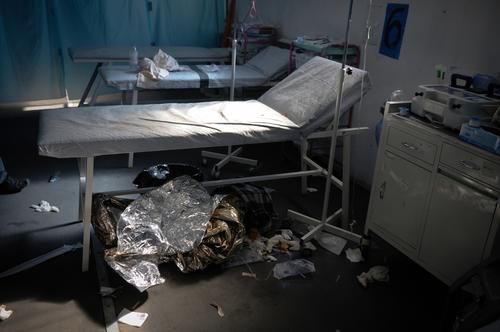
In the ER section of an MSF hospital in Syria, the aftermath of an emergency case, where the patient was stabilised and then immediately rushed into surgery.
Syria

MSF condemns incursion by armed men into supported hospitals in East Ghouta

Reports from doctors MSF supports in the area outline grave incidents on 29 and 30 April in which armed groups showed absolutely no consideration for the special protected status of patients, medical facilities and health workers. Statement - 1 May 2017
 
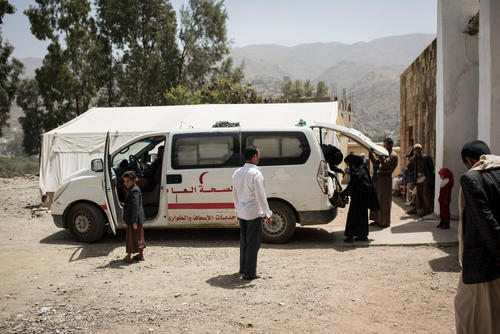
An ambulance awaits at the entrance of the Haydan hospital. A pregnant woman who had arrived with complication is being referred to the main hospital in Sa’ada city.
Yemen

MSF statement at Geneva donor conference

A pledging conference for Yemen is being held in Geneva, providing the opportunity to highlight the risk of a health system collapse in Yemen, the key health needs, and the urge to handle them. Statement - 25 Apr 2017
 
Almost all of the roughly 40 female inmates had medical complaints. More than half complained about scabies, followed by general body pain, often associated with mental trauma. They said the group left Nigeria with 120 people but many got separated by force during the journey.
Libya

From Misrata to Tripoli, a first-hand account from Dr Tankred Stoebe

The fighting continues in Libya, a country fragmented by a multitude of power centres. Doctor Tankred Stoebe spent the month of January in the country coordinating a medical assessment that took him from Misrata to Tripoli. Voices from the Field - 24 Apr 2017
 
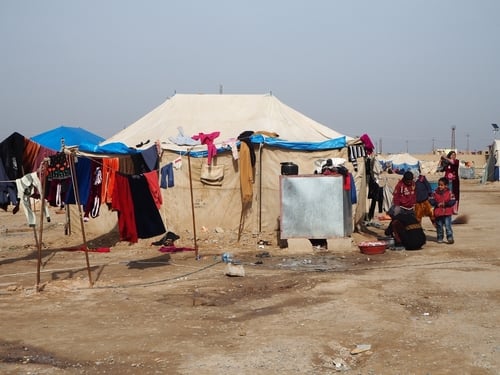
The transit camp in Al-Hajjaj Silo is a site where people undergo security screening before being moved to regular IDP camps or, if they obtain a sponsorship, to be accommodated in the host community. However, several families have lived here for months. MSF brings a weekly mobile clinic with doctors and nurses to the site. The team provide primary health care with special focus on chronic diseases, mother and child care as well as mental health support.
Iraq

“We walked all night, staying away from roads for fear of being caught”

Al Alam camp, near Tikrit, is home to about 8,000 women, children and men who have been displaced from their homes to the north by the ongoing conflict. Project Update - 11 Apr 2017
 
During the distribution, there was bombing nearby. MSF teams say children have become accustomed to the violence.
 ¨The strangest thing is that people are adapting to the violence. We saw children looking up at the sky, watching the airplanes as they bombed Dara´a City. It is really strange,¨ an MSF pharmacist said.
Syria

A family returns to a village battered by war

Mohammed Ali Aboud speaks about his family's plight and the daily difficulties they endure. Voices from the Field - 11 Apr 2017
 
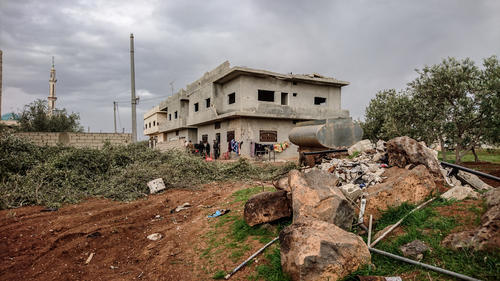
The village of Al Nuaymah was once home to 10,000 people. During the past six years of war, many families left, but without resources or safer options to live, they returned to the village.
 
Virtually the entire town relies on some degree of humanitarian aid for survival. Many structures house more than one family, often with young children. Some have relied on aid for more than five years.
Syria

Instability in the south

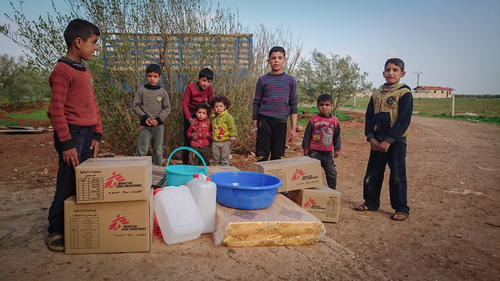
MSF recently responded to this crisis with an emergency distribution of 893 kits of essential relief items, distributed to families in two areas. Project Update - 11 Apr 2017
Four mothers posing in a corridor of the Hospital in Bili. All four of them are staying in the hospital with their child, that's suffering from a severe case of malaria. Since the beginning of the project in 2016, the pediatric ward already treated more than 4.000 cases of complicated/severe form of malaria.
Médecins Sans Frontières (MSF)

Independent medical humanitarian assistance

We provide medical assistance to people affected by conflict, epidemics, disasters, or exclusion from healthcare. Our teams are made up of tens of thousands of health professionals, logistic and administrative staff - most of them hired locally. Our actions are guided by medical ethics and the principles of independence and impartiality. We are a non-profit, self-governed, member-based organisation.

Learn more