



Ebola disease in DRC: find out how we're responding
Learn more
1390 Results
 
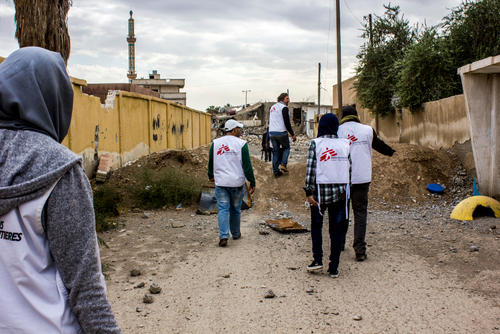
MSF teams assessing the medical and humanitarian needs in Al Mishlab. east of Raqqa. 2 November. “When we first visited Mishlab, east of Raqqa, it was a ghost town, but on our latest visit, some people had returned to check on their houses, Some found their homes in ruins; others found dead bodies and explosive devices in their houses, gardens and in the streets.” says Craig Kenzie, leader of MSF’s Raqqa response team
Syria

Booby-traps and landmines in Raqqa

Six weeks after fighting subsided in Raqqa city in Syria and surrounding villages, former residents are returning home to find their houses in ruins and their streets and fields littered with unexploded remnants of war, including booby-traps, landmines, ammunition and rockets.
Voices from the Field - 30 Nov 2017
 
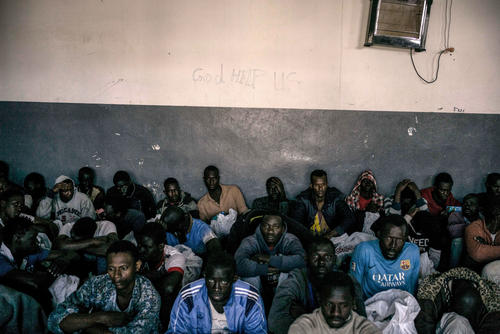
Men detained in Abu Salim detention centre. Detainees spend days and months in Libyan detention centres, without knowing when they will be released.
Libya

When France becomes accomplice to the very crimes it condemns

All these people who find themselves trapped in the Libyan snare, which was partly set by France and the European Union, must be afforded all possible means of escape. Opinion - 30 Nov 2017
 
A burnt skeleton of wood and metal is all that remains of the pediatric ward at Al Khansaa hospital in Mosul, northern Iraq. The hospital suffered severe damage when Mosul was retaken from Islamic State group in 2016 and 2017. Sixty percent of the hospital remains destroyed.  
 
The healthcare system in Mosul is still in tatters following months of conflict. Hospitals and clinics were bombed and now only a handful are left to service a large city.     
  
MSF has been working at Al Khansaa hospital to rebuild the emergency room, paediatric in-patient facilities, a nutrition unit and the intensive care unit (ICU).
Iraq

Crisis update – November 2017

More than 2.2 million people have now returned home but years of conflict have severely impacted the health sector and the needs are great. Crisis Update - 30 Nov 2017
 
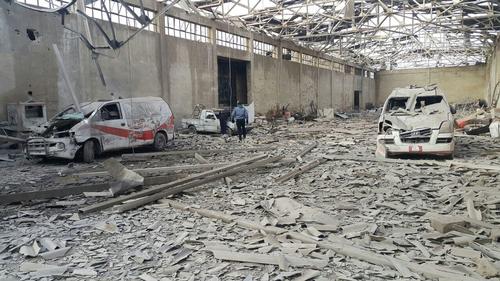
The last two functional ambulances in Al-Marj neighbourhood (in the East Ghouta besieged area near Damascus) were destroyed beyond repair in an aerial bomb attack on Monday 05 December 2016. They were parked in the hospital’s warehouse/garage, very near to the makeshift hospital’s location. Two hospital cars, used to transporting supplies and medical personnel, were also destroyed in the blast. The lack of ambulances will have an impact on the ability to quickly treat wounded when there is bombing or shelling in the area, but above all it will affect the capacity to refer the most sick patients to larger secondary referral hospitals. The makeshift hospital in Al-Marj is not equipped for complex or long-term in-patient hospital care, and this could have a big impact on the ability to refer patients for appropriate secondary care.
Syria

Medical services stretched beyond limit after shelling in East Ghouta

MSF calls for due precautions to be taken by all belligerents, in accordance with International Humanitarian Law, to avoid hitting civilians and civilian infrastructure including hospitals and residential areas. Statement - 27 Nov 2017
 
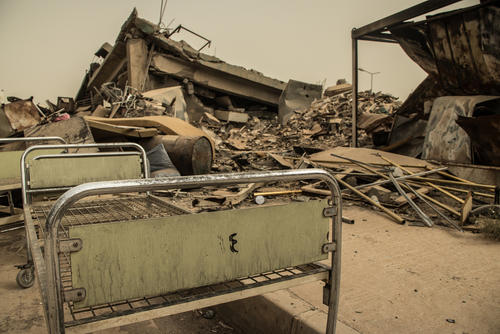
Old hospital beds lay abandoned in the grounds of Al Khansaa hospital in East Mosul, northern Iraq. The hospital suffered severe damage when Mosul was retaken from the Islamic State group in 2016 and 2017. Sixty percent of the hospital remains destroyed.  
 
The healthcare system in Mosul is still in tatters following months of conflict. Hospitals and clinics were bombed and now only a handful are left to service a large city.     
  
MSF has been working at Al Khansaa hospital to rebuild the emergency room, paediatric in-patient facilities, a nutrition unit and the intensive care unit (ICU).
Iraq

From chaos to the provision of care

It is crucially important for this work to continue. The rebuilding of essential medical services is of life-saving significance during this phase of Mosul's post-war recovery. Voices from the Field - 23 Nov 2017
 
msf-placeholder
Syria

MSF teams respond to car explosion in Al-Hasakah, north-east Syria

MSF teams responded over the weekend to a mass casualty incident after a car exploded late on Friday near Al-Hasakah, in north-east Syria, killing and injuring people fleeing the fighting in Deir ez-Zor. Statement - 20 Nov 2017
 
¨David Noguera, President of MSF Spain, meets with people who live in a camp for internally displaced people near Abs, Yemen. Most were driven from their homes by the war, and have lived in the camp for more than two years without sufficient shelter, access to water, or proper healthcare.¨
Yemen

Misery deepens as borders close

"Coalition leaders must immediately grant unhindered access to and within Yemen, so that humanitarian assistance can reach those most in need." Op-Ed - 20 Nov 2017
 
Mohammad Ahmed, Doctor, Rural Hospital in Abs
Yemen

MSF statement on Saudi-led coalition blockage

"Yemenis are already struggling with massive increases in food, water and fuel costs, as well as access to medical care" Statement - 17 Nov 2017
 
Tabqa, Syria, September 2017. Taqba Hospital.
The city was taken control end of April by the Syrian Democratic Army, an Kuridish-Arabo alliance support by the international coalition. During the fight, the ISIS fighters were taking refuge inside.

Tabqa, Syrie, septembre 2017. Hôpital de Tabqa. La ville a été prise fin avril par les Forces Démocratiques Syriennes (FDS), une alliance de combattants kurdes et arabes soutenue par la coalition internationale. Lors des combats, les soldats du groupe Etat islamique se sont retranchés à l'intérieur de l'hôpital.
Syria

“During the battle for Raqqa, nobody cared about the civilians”

"People described how many inhabitants who were forced to go out into the street to find water ended up wounded or dead." Voices from the Field - 15 Nov 2017
 
Babucar Njie, 25, Gambia

I left Gambia due to the conditions at home. I went from Senegal to Mali, then to Burkina Faso, then Niger. 

From Niger some  smugglers brought us to  Algeria. There we were taken to a house and told we had to  pay 15,000 in Gambian money [approx 300 euros]. They made us call our family to send the money. Some of my Gambian brothers they knew a way to escape so I followed them and we made it to Tamanrasset [in Algeria]. There we were kidnapped again, and again we had the same problem; they wanted money. This time we had no way to escape so my family had to pay. 

They beat people if they don’t call their family. If your parents don’t pay they beat you and call them so they can hear the way you’re crying. After that, I was taken to Sabratah, in Libya: that place is more wicked than any other place. They didn’t even give us proper water to drink and the Libyans were  rude. Sometimes they would go and drink [alcohol] and come and start beating everybody.

I was living in a connection house with two or three hundreds people. It was horrible, there was no window and we slept on the floor. I had to work to receive food, then my parents sent the money for the boat.  One morning they said, “Your boat is ready.” When I saw it, it was a plastic boat and I thought, ‘I’m not getting in this,’ but there are guys with guns so you just go. There’s no way back. We were packed into it, the fuel was making everyone sick. The boat was going up and down some people were crying, at any minute we could have died. 

For us Europe is better than everything. There is hope there, but I have a younger brother and if he wants to come this way I will tell him no. If I had known all I had to pass through I would have stayed in Gambia.
Mediterranean migration

"The Crossing", night portraits on the rescue boat Prudence

"The Crossing" is a photographic project by Andrew McConnell/Panos Pictures based on night portraits and testimonies from people rescued by the search and rescue Prudence boat in international Mediterranean Sea waters in July 2017. Photo Story - 15 Nov 2017
Four mothers posing in a corridor of the Hospital in Bili. All four of them are staying in the hospital with their child, that's suffering from a severe case of malaria. Since the beginning of the project in 2016, the pediatric ward already treated more than 4.000 cases of complicated/severe form of malaria.
Médecins Sans Frontières (MSF)

Independent medical humanitarian assistance

We provide medical assistance to people affected by conflict, epidemics, disasters, or exclusion from healthcare. Our teams are made up of tens of thousands of health professionals, logistic and administrative staff - most of them hired locally. Our actions are guided by medical ethics and the principles of independence and impartiality. We are a non-profit, self-governed, member-based organisation.

Learn more
