




Ebola disease in DRC: find out how we're responding
Learn more
1758 Results
 
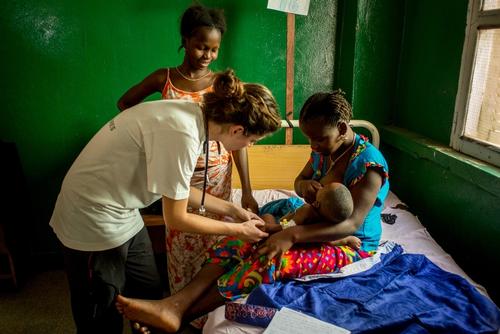
With the aim of improving medical care to help reduce the mortality rate among children under five years old, MSF launched a paediatric project in the region of Bafata in central Guinea- Bissau in November 2014. MSF is working in the paediatric department of the Bafata regional hospital, the referral centre for the entire region, where more than 180,000 people live, and in several health centres in the area.
Child health

"Transferring medicine from rich countries to poor countries without adapting it does not always work"

Interview with Daniel Martínez, paediatrics specialist. Voices from the Field - 22 Sep 2016
 
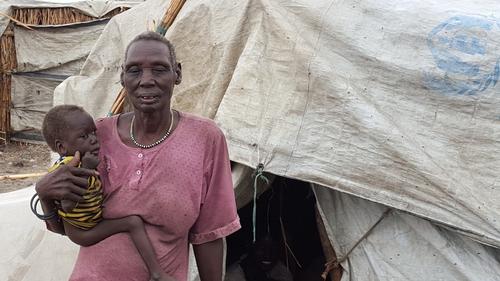
She’s standing there with her bare feet in the mud. She’s gently carrying her last granddaughter in her arms. The little one suffers from a severe disability. Nantiek is tired but she speaks with confidence and strong words. She’s been through so much difficulty since her, and her family fled from their village next to Leer, around 120 km away.
South Sudan

Grandma Nantiek in Bentiu Protection of Civilians camp

“Our house was looted, our cattle were looted, we had to flee, and we couldn’t stay. We left everything behind,” says Nantiek, repeating the story of hundreds of families. Voices from the Field - 19 Sep 2016
 
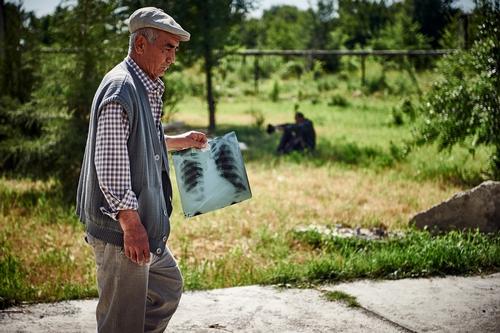
TB-cabinets are  important for an effective walk-in treatment. Here ambulatory treatment, psychosocial counselling for patients and their families, and social packages (nutritional support, hygiene kits and transport money) are provided to help patients adhere to treatment.
Mamasaly Mamatbakiev with his x-ray picture.
Access to Healthcare

Global commitments to stop killer diseases put to the test – lives are hanging in the balance

Falling short of the Global Fund’s modest pledging target would not only seriously undermine progress, but also be costly, both financially and in human lives. Project Update - 16 Sep 2016
 
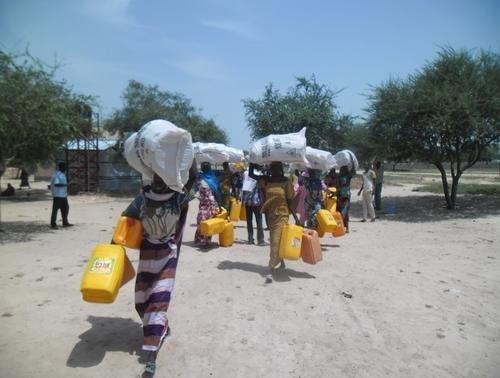
More than 200 families from Nigeria and Chad have reached the town of Toumour, located in east Diffa region, in recent days fleeing violence and hunger in their hometowns. 77 of the families newly arrived in Toumour lived in very poor conditions, without enough food and any good. To alleviate this situation, an MSF team has distributed NFI kits for these 77 families.
Niger

MSF assists hundreds of newly displaced people in eastern Diffa

“Given the critical situation in the areas of Nigeria and Chad that border Niger, it is likely that Toumour will continue to receive more refugees in such a precarious condition as this last group,” explains Youssouf Demdelé, MSF’s deputy head of mission in Niger. Project Update - 9 Sep 2016
 
There are an estimated 15,000 people in Bama camp – most of these people are women and children under the age of five. People are living inside a camp surrounded by the Nigerian army. Boko Haram fighters are stationed a few killometres away from Bama camp, the town is empty, and it is like a ghost town. The only people who remain in Bama are inside the camp. 

We returned to Bama on August 17th to carry out our emergency response. We reached a total number of 3,293 children under the age of five. We treated 513 malnourished children (4.2% have severe malnutrition and 10.9% have moderate malnutrition).  
Our operational aim was to reduce morbidity and mortality among children under the age of five by providing treatment and food for one month.
We took Non Food Items (mosquito nets, soap), therapeutic food for malnourished children (plumpy nut) and a food blanket ration targeting malnourished children’s household (oil, emergency food, rations and beans). 
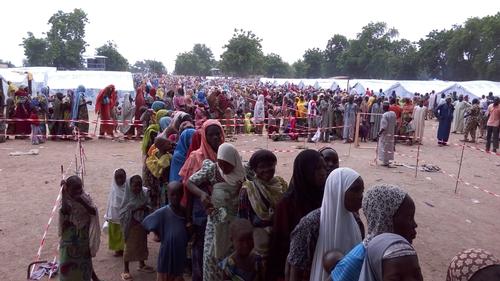
We started our distribution at 7am and there were people as far we could see. There were lines and lines of women and children. We screened the children for malnutrition as we distributed the items. 
Our operation strategy is to return to Bama every month for the next two months. 

There is an Outpatient clinic run by the Ministry of Health and UNICEF but very few patients go to the clinic because there are not enough medicines there. In addition the Nigerian Air Force opened few days ago an hospital in front of the camp’s entrance. 

Most people in the camp live in make shift corrugated iron shelters – with sheets of metal not offering much protection against the rain or elements. 
Now some people have plastic sheeting on their shelters and tents but there are no windows so it’s very hot inside these shelters and they’re not sustainable. There is also an issue around water. There isn’t enough water for the number of people in the camp. here is nine bore holes in the camp and only seven are functioning, this is not covering the needs of the 15,000 people in the camp.
Nigeria

Malnutrition is the biggest problem in Bama

Interview with MSF project coordinator Hakim Khaldi Voices from the Field - 7 Sep 2016
 
msf-placeholder
South Sudan

Patient story - Nyajuba

Nya is one of the 201 patients who received surgery from MSF following the recent clashes in South Sudan, 54 of which were major operations. Voices from the Field - 5 Sep 2016
 
MSF providing individual mental health support for victims of floods in Abalack, Niger.
Niger

Floods leave hundreds of families homeless with increased risk of disease

“We see that the families in this area, who are already have very little, have now lost everything. Despite the presence of government health facilities, many parents do not have the money for treatment for such illnesses as respiratory infections, diarrhoea and skin diseases,” said Adolphe Masudi, MSF project manager for this intervention. Project Update - 26 Aug 2016
 
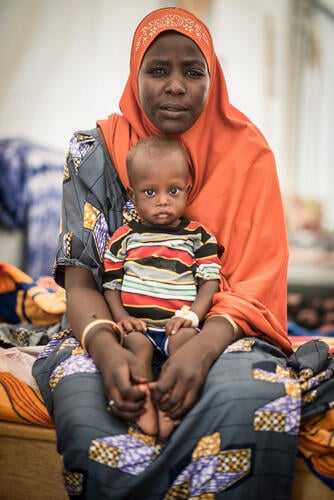
Fanne holds her 8-month old son Mallum Abba. He weighs 5,4 kg and is receiving treatment for malnutrition at MSF's inpatient therapeutic feeding centre in Ngala.
Nigeria

Video: Testimonies from displaced women in Maiduguri, Nigeria

Voices from the Field - 23 Aug 2016
 
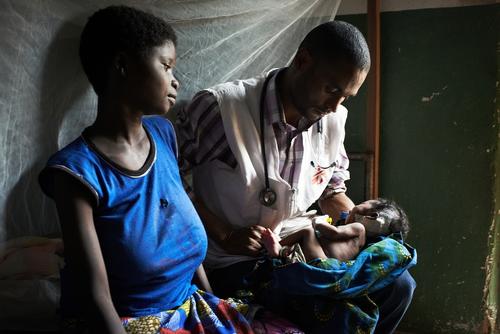
Muenge Kifeta sits with her 1 month old daughter who is checked up by MSF doctor Alexander Akili in the maternity ward at the government hospital in the village of Shamwana, Katanga, Democratic Republic of Congo on September 21, 2013. The baby has a serious neo-natal infection but will recover after ongoing observation at the hospital. She traveled 35km from a nearby village in an MSF mobile unit.
Democratic Republic of Congo

After ten years, Shamwana project is closed

Press Release - 16 Aug 2016
 
53 year old Jean-Pièrre in Zemio in the far southeast of the Central African Republic. Jean-Pièrre is from the Democratic Republic of the Congo. After the war in Congo in 2012, Jean-Pièrre was in bad health. He was tired and weak, unable to work. He knew he needed to be tested for HIV, but the closest testing center in Congo was over 400 kilometers away. That’s when he decided to come to Zémio, which, at 132 kilometers away, was much closer but across the border in the Central African Republic. His brother carried him across the border on a bike for 5 days. When he arrived at MSF’s clinic in Zemio, he was diagnosed with and began treatment for HIV.
Central African Republic

MSF nurse speaks with patients from HIV programme in Zémio

In these two stories, Keri Geiger, an MSF nurse in Zémio, speaks with two patients from the HIV programme. Jean Pierre, while gravely ill, was carried on a bike by his brother for more than 130 kilometres to the centre, over the border from Congo. Gisele was one of MSF’s first patients in Zémio. Project Update - 12 Aug 2016
Four mothers posing in a corridor of the Hospital in Bili. All four of them are staying in the hospital with their child, that's suffering from a severe case of malaria. Since the beginning of the project in 2016, the pediatric ward already treated more than 4.000 cases of complicated/severe form of malaria.
Médecins Sans Frontières (MSF)

Independent medical humanitarian assistance

We provide medical assistance to people affected by conflict, epidemics, disasters, or exclusion from healthcare. Our teams are made up of tens of thousands of health professionals, logistic and administrative staff - most of them hired locally. Our actions are guided by medical ethics and the principles of independence and impartiality. We are a non-profit, self-governed, member-based organisation.

Learn more