



Ebola disease in DRC: find out how we're responding
Learn more
123 Results
 
msf-placeholder
Nigeria

MSF supports awareness of sexual violence in Port Harcourt

In early 2015, MSF opened the first comprehensive programme dedicated to survivors of sexual violence in Port Harcourt, Nigeria. Voices from the Field - 5 Feb 2017
 
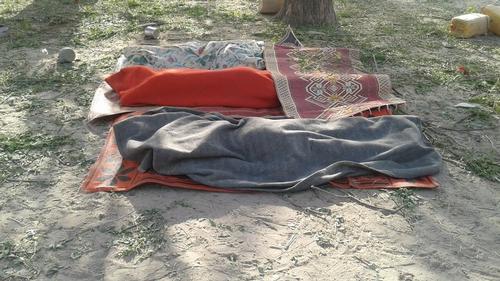
A bombing by the Nigerian Army has occurred in an internally displaced person camps in Rann, Nigeria. MSF teams have seen 120 wounded and at least 50 dead following the bombing. Teams are trying to provide emergency first aid in its facility and are stabilizing patients to evacuate wounded. We are asking the authorities to put all measures in place in order to facilitate the emergency evacuation of wounded (by air and land). Our medical and surgical teams in Cameroon and Chad are ready to treat wounded patients.
Nigeria

“I can’t find the words to describe what I saw in Rann”

What the survivors of the bombing have lived through is so hard, so violent. Rann was their safe haven. The army that was meant to protect them bombed them instead. We have to remain at their side. Voices from the Field - 19 Jan 2017
 
Maira Modu, 30, pictured here with the youngest of her six children Falmata Ari, 1,  fled her home in Bama one year ago, and now lives in a camp on the outskirts of Maiduguri. They were one of 500 families to receive food from MSF on December 14, 2016.
Nigeria

Food distribution in Maiduguri, northeastern Nigeria

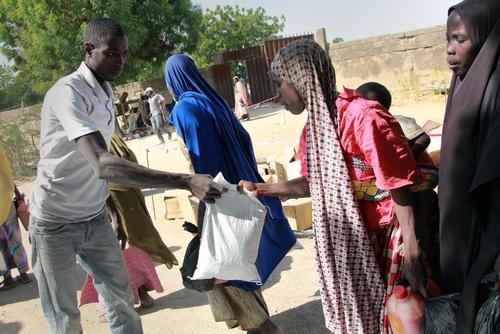
Around one million people who fled violence and insecurity in Borno state are now living in Maiduguri, the largest city in northeastern Nigeria. Photo Story - 6 Jan 2017
 
MSF distributed food to 500 families in Maiduguri on December 14, 2016. Each family receives enough food for two weeks; 25 kilograms of millet, five kilograms of beans and five litres of palm oil. The ration also includes eight bars of soap.
Nigeria

Food distribution in Maiduguri

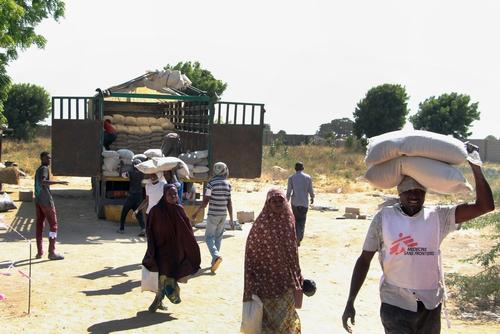
Over the past three months, our teams have distributed 810 tonnes of food in Maiduguri, northeastern Nigeria, which is enough to feed 26,000 families for two weeks. Project Update - 5 Jan 2017
 
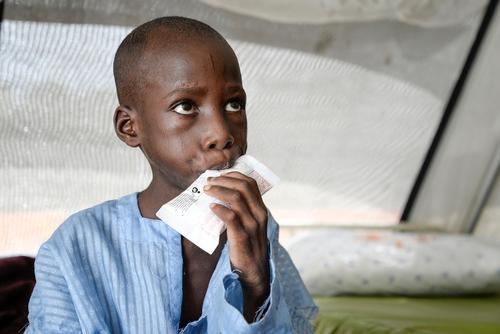
Bintou Kadiri, 8 years. It weighs 12.8 kg. His father is a farmer. His family lived in Kattere but she fled to Gajigana four months ago. Since one year, Boko Haram men came regularly to their villages to loot, but they never attacked the village. Therefore, people didn’t leave and the army is not present in the village. Boko Haram took their cows and 20 goats, together with food and money. In Gajigana, they live with relatives. Bintou is suffering from severe acute malnutrition (marasmus) and acute gastroenteritis, hypoglycemia and dehydration. He was hospitalized for two days to nutritional treatment center of Gwange in Maiduguri. The family left him with what remained of food, they had grown. But these reserves are coming to an end.
Nigeria

I kept telling the team “it’s all about food”

Voices from the Field - 11 Nov 2016
 
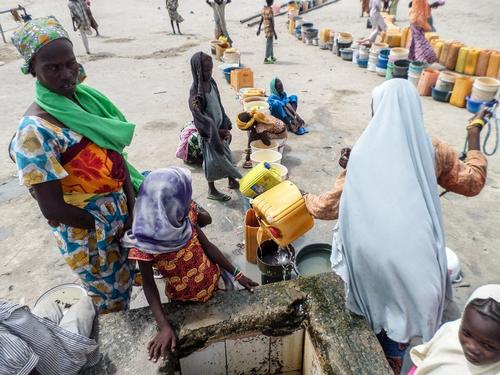
People in the camp reported having less than half a litre of water per person per day.
Nigeria

Disastrous living conditions more deadly than violence

Conflict-affected populations in Borno state need emergency food aid now Press Release - 28 Sep 2016
 
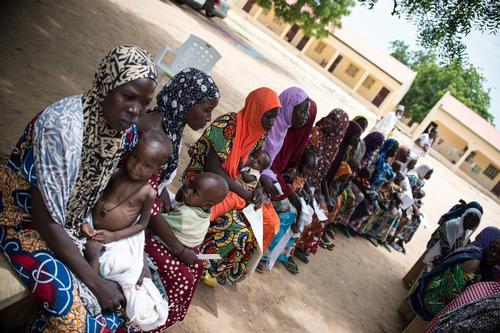
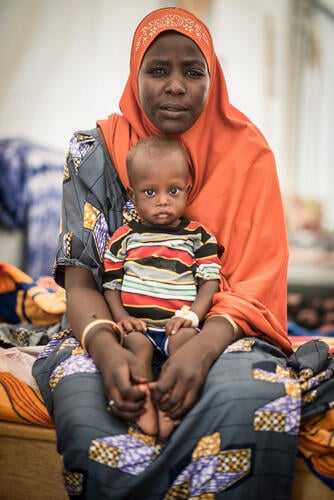
Mother and child waiting for screening at MSF Clinic (ATFC). Mothers often do not know their child is malnourished but will come for other disease as the child gets weak and sick. Most children are IDP's living with host communities. MSF treats both IDP's and locals. Bencheikh Borno state
Nigeria

Treating malnourished children in Beni Shiekh, Nigeria

Child malnutrition is one of the main problems in Nigeria's Borno state, where MSF is running nutrition programmes. Thousands of people in the northeast of the country have been displaced by violence and conflict. In Beni Shiekh alone, around 30 to 40 per cent of the population (roughly 33,000 people) is displaced, but the figure could be much higher. Photo Story - 24 Sep 2016
 
With the aim of improving medical care to help reduce the mortality rate among children under five years old, MSF launched a paediatric project in the region of Bafata in central Guinea- Bissau in November 2014. MSF is working in the paediatric department of the Bafata regional hospital, the referral centre for the entire region, where more than 180,000 people live, and in several health centres in the area.
Child health

"Transferring medicine from rich countries to poor countries without adapting it does not always work"

Interview with Daniel Martínez, paediatrics specialist. Voices from the Field - 22 Sep 2016
 
There are an estimated 15,000 people in Bama camp – most of these people are women and children under the age of five. People are living inside a camp surrounded by the Nigerian army. Boko Haram fighters are stationed a few killometres away from Bama camp, the town is empty, and it is like a ghost town. The only people who remain in Bama are inside the camp. 

We returned to Bama on August 17th to carry out our emergency response. We reached a total number of 3,293 children under the age of five. We treated 513 malnourished children (4.2% have severe malnutrition and 10.9% have moderate malnutrition).  
Our operational aim was to reduce morbidity and mortality among children under the age of five by providing treatment and food for one month.
We took Non Food Items (mosquito nets, soap), therapeutic food for malnourished children (plumpy nut) and a food blanket ration targeting malnourished children’s household (oil, emergency food, rations and beans). 
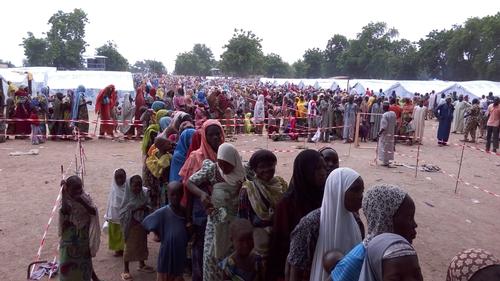
We started our distribution at 7am and there were people as far we could see. There were lines and lines of women and children. We screened the children for malnutrition as we distributed the items. 
Our operation strategy is to return to Bama every month for the next two months. 

There is an Outpatient clinic run by the Ministry of Health and UNICEF but very few patients go to the clinic because there are not enough medicines there. In addition the Nigerian Air Force opened few days ago an hospital in front of the camp’s entrance. 

Most people in the camp live in make shift corrugated iron shelters – with sheets of metal not offering much protection against the rain or elements. 
Now some people have plastic sheeting on their shelters and tents but there are no windows so it’s very hot inside these shelters and they’re not sustainable. There is also an issue around water. There isn’t enough water for the number of people in the camp. here is nine bore holes in the camp and only seven are functioning, this is not covering the needs of the 15,000 people in the camp.
Nigeria

Malnutrition is the biggest problem in Bama

Interview with MSF project coordinator Hakim Khaldi Voices from the Field - 7 Sep 2016
 
Fanne holds her 8-month old son Mallum Abba. He weighs 5,4 kg and is receiving treatment for malnutrition at MSF's inpatient therapeutic feeding centre in Ngala.
Nigeria

Video: Testimonies from displaced women in Maiduguri, Nigeria

Voices from the Field - 23 Aug 2016
Four mothers posing in a corridor of the Hospital in Bili. All four of them are staying in the hospital with their child, that's suffering from a severe case of malaria. Since the beginning of the project in 2016, the pediatric ward already treated more than 4.000 cases of complicated/severe form of malaria.
Médecins Sans Frontières (MSF)

Independent medical humanitarian assistance

We provide medical assistance to people affected by conflict, epidemics, disasters, or exclusion from healthcare. Our teams are made up of tens of thousands of health professionals, logistic and administrative staff - most of them hired locally. Our actions are guided by medical ethics and the principles of independence and impartiality. We are a non-profit, self-governed, member-based organisation.

Learn more