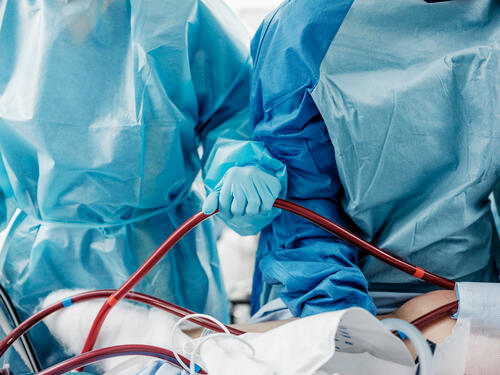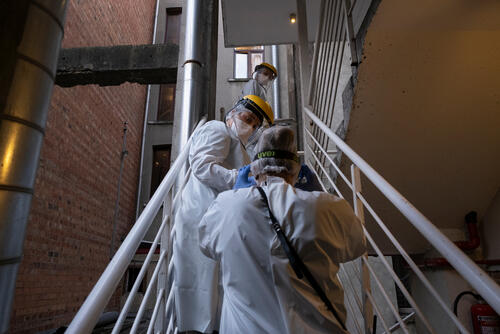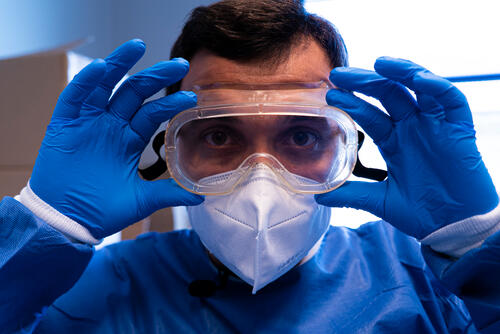
Gennaro is a specialist of water and sanitation. In the hospital, one of the key aims of his daily job is to protect hospital staff from being infected with the virus. Before going in a covid ward, he’s wearing a personal protective equipment for protecting himself and the colleagues of a risk of infection.
Gennaro, an MSF water and sanitation specialist, adjusts his goggles before entering into a ward treating people with COVID-19. Lodi province, Italy, April 2020.
© Davide Arcuri

A year of a pandemic: our response to COVID-19 in pictures

Gennaro, an MSF water and sanitation specialist, adjusts his goggles before entering into a ward treating people with COVID-19. Lodi province, Italy, April 2020.
© Davide Arcuri
Ebola disease in DRC: find out how we're responding
Learn more

On 11 March 2020, the World Health Organization declared the outbreak of the new coronavirus, COVID-19, a worldwide pandemic. Since January 2020, MSF teams around the world have been responding to the COVID-19 pandemic, in both countries where we've previously worked, and those we haven't had to work in before. Meanwhile, we have also ensured people still continue to have access to healthcare.

Over the course of a year of a pandemic, MSF teams have worked hard in response in over 80 countries; here's our work in pictures.

Find out more on how we're responding to the pandemic.
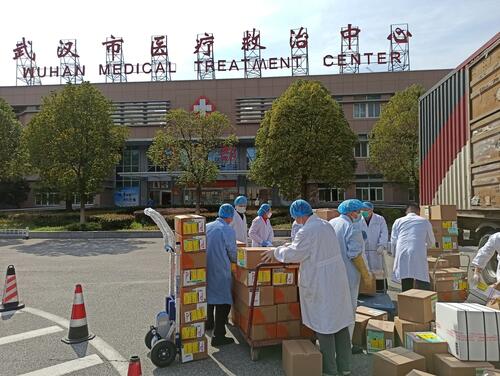
MSF donated 3.5 tonnes of personal protective equipment to health workers at the Wuhan Jinyintan Hospital in Hubei province. Wuhan Jinyintan Hospital is one of the designated hospitals providing treatment to COVID-19 patients, especially those in severe and critical conditions.
MSF donates 3.5 tonnes of personal protective equipment to health workers at the Wuhan Jinyintan Hospital. Wuhan, China, February 2020.
MSF
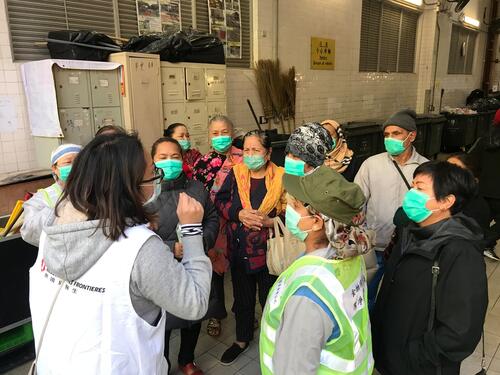
MSF in Hong Kong has reached out to different vulnerable groups for face-to-face health promotion sessions on COVID-19, including the ethnic minorities and the socio-economically disadvantaged such as street cleaners, visually impaired people, who are less likely to have access to important medical information.
MSF staff undertake awareness-raising sessions on COVID-19 for groups of vulnerable people, including refugees and socio-economically disadvantaged people. Hong Kong, February 2020.
MSF
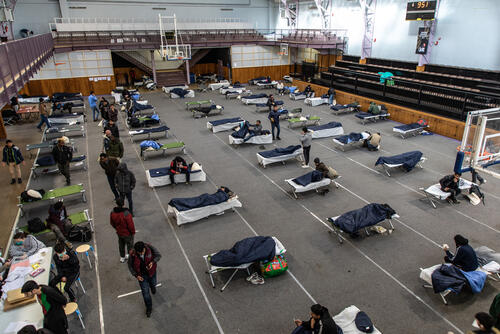
MSF started activities linked to COVID 19 in France, focusing on vulnerable people living in the streets, such as migrants. On March 24th, 700 people were evacuated from a camp in Aubervilliers near Paris, where they were living in precarious conditions. They were dispatched on various emergency shelters located in Paris and Ile de France. MSF teams are deployed in some of these shelters to evaluate their health and identify potential COVID 19 cases.
MSF teams identify potential COVID-19 cases and evaluate the health of 700 people who were evacuated from a camp in Aubervilliers, near Paris, to various emergency shelters. France, March 2020.
Agnes Varraine-Leca/MSF
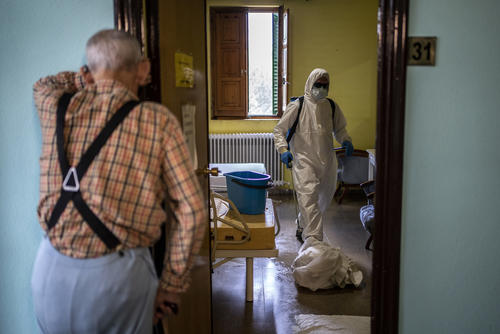
MSF acompaña a voluntarios de los bomberos para desinfección de espacios, establecimiento de circuitos y traslado de pacientes en función de las zonas designadas por su status sanitario en la Residencia Nuestra Señora de las Mercedes de El Royo (Soria).
An elderly man watches as an MSF staff member disinfect his room in the Nuestra Señora de las Mercedes nursing home residence in El Royo, Soria province. Spain, April 2020.
Olmo Calvo/MSF
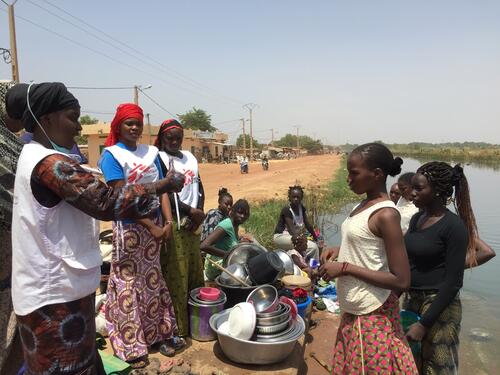
Nafisatou, an MSF health promoter, shows a group of young girls who to wash their hands properly to protect themselves from COVID-19.
Nafisatou, an MSF health promoter in Niono, shows a group of young girls who to wash their hands properly to protect themselves from COVID-19. Mali, May 2020.
MSF/Lamine Keita
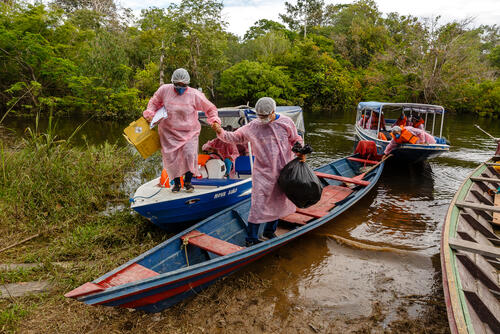
MSF and municipal health system's staff arrives at a community on lake Mirini. The teams leave the vessel of the primary healthcare boat  to carry out routine screening and vaccination from house to house.
In the Amazonas Forest, some communities are best reached by boat. A combined team of local and MSF health workers unpack their equipment carry out routine screening from house to house. Brazil, July 2020.
Diego Baravelli
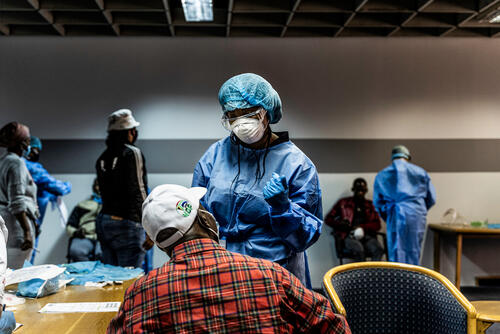
A health worker prepares to swab a patient during a mass COVID-19 screening and testing event held in Johannesburg, South Africa where MSF contact tracers assisted with training, monitoring and conducting tests.
South Africa - An MSF health worker prepares to swab a patient for a coronavirus test during a mass COVID-19 screening and testing event held in Johannesburg. May 2020.
Tadeu Andre/MSF
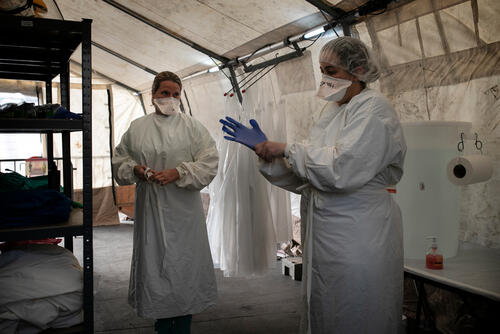
Julie (left), a former MSF field nurse and now volunteering in the Covid-19 project in Tour and Taxis, and Houria (MSF health promoter), getting dressed with protective equipment before entering into the patients area.
Belgium - Julie (left), a former MSF field nurse and now volunteering with MSF, and Houria, an MSF health promoter, get dressed in protective equipment before entering into the patient area of the COVID-19 treatment facility for vulnerable people in the Tour & Taxis area of Brussels. May 2020.
Albert Masias/MSF
Switzerland, May 2, 2020. MSF helping the local association La Caravane de solidarité for a food distribution in Geneva. MSf volunteers meet the beneficiaries to complete an anonymous questionnaire about their needs. © Nora Teylouni / MSF
Switzerland - MSF staff meet beneficiaries of a local food distribution caravan for vulnerable people in Geneva, and survey them anonymously about their needs. May 2020.
© MSF/Nora Teylouni
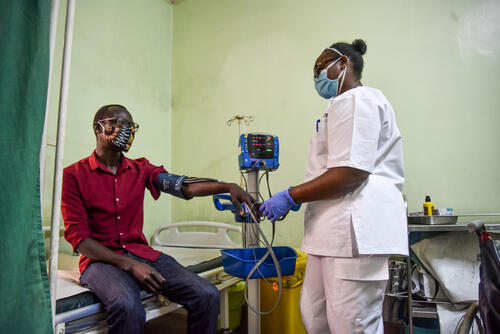
Faith Njeri Kariuki, an EMT at MSF's Lavender House - which also houses the Trauma Room - in Mathare, checking the vitals of a patient
Kenya - Faith Njeri Kariuki, an emergency medical technician at MSF's medical care and trauma room centre, Lavender House - checking the vitals of a patient. Nairobi, May 2020.
Paul Odongo/MSF
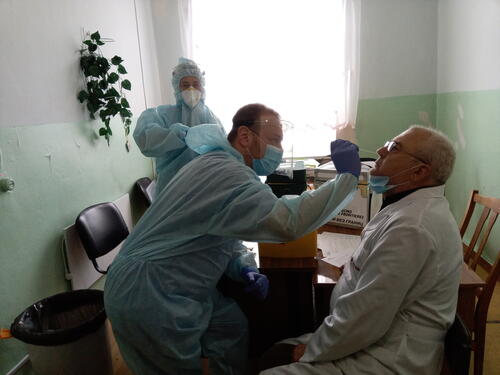
MSF mobile team collects samples of healthcare workers at Krasnohorivka hospital, in Eastern Ukraine, to test for COVID-19.
Ukraine - An MSF mobile team collects samples from healthcare workers to test for COVID-19, at Krasnohorivka hospital, in eastern Ukraine. May 2020.
Katerina Stepanina/MSF
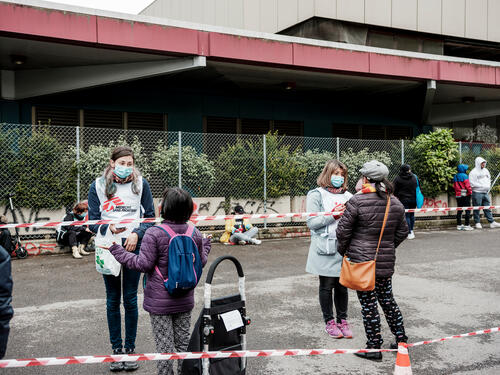
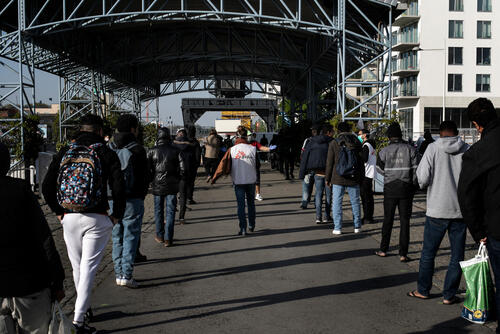
Around 300 hundred people from with social exclusion risk (including homeless population, migrants and asylum seekers) attending the food and hygiene kits distribution supported by MSF, Croix Rouge Belgique and Platerforme Citoyenne. Three times a day Croix Rouge Belgique and Plateforme Citoyenne distribut food for these population. MSF is supporting the distribution and participating with a health promotion team sensitizing about  water and sanitation measures.
Belgium - People who are at risk of social exclusion risk - those who are homeless, migrants and asylum seekers - line up to receive food and hygiene kits distributed by MSF, the Belgian Red Cross and local organisation Plateforme Citoyenne. MSF teams are supporting the distribution and a health promotion team raises awareness about hygiene and water and sanitation measures. April 2020.
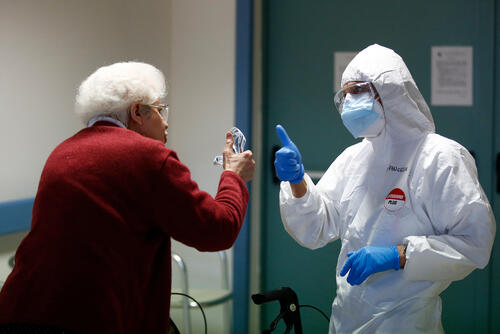
Covid-19 epidemic has drastically changed life inside nursing homes. For weeks, guests have not been able to receive visits from loved ones for safety reasons: the staff have also become their family.
Italy - An MSF staff member shares a thumbs up with the resident of a nursing home in the country's central eastern Marche region, where our staff are providing medical care and implementing infection prevention and control measures. April 2020.
MSF/Vincenzo Livieri
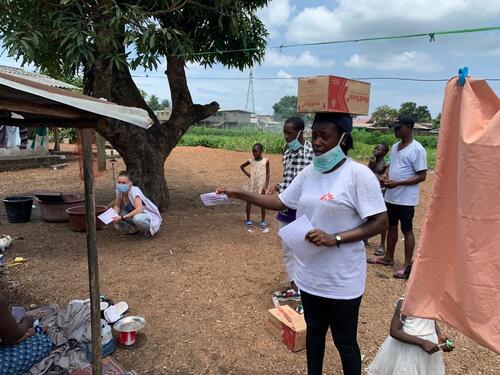
MSF staff and volunteers carry out a COVID-19 hygiene awareness campaign and distribute soap to households in Logan Town, near the capital city, Monrovia. MSF is urging people to stay at home and practice social distancing to prevent the spread of the coronavirus through the community.

Location: Logan Town, Monrovia, Liberia
Liberia - An MSF staff member hands out soap and information leaflets on how to prevent COVID-19 to households in Logan Town, near the capital city, Monrovia. April 2020.
Ruud van der Linden/MSF
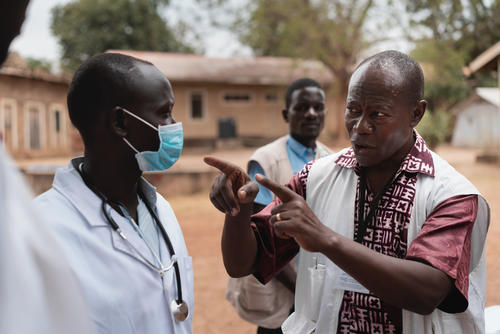
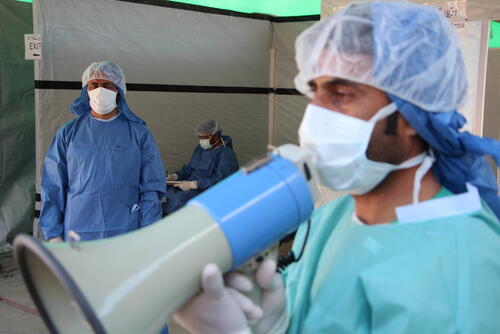
Adrien Mahama – watsan coordinator for MSF in South Sudan – illustrates the correct use of masks during an infection prevention and control training for the staff of the Al Sabah hospital in Juba. MSF is carrying on trainings to support the Ministry of Health in preparation for the arrival of eventual COVID-19 patients.
South Sudan - Water and sanitation coordinator Adrien Mahama illustrates the correct use of masks during an infection prevention and control training for the staff of the Al-Sabah hospital in Juba. MSF is conducting training to support the Ministry of Health in preparation for the arrival of COVID-19 patients. April 2020.
Gabriele François Casini/MSF
n Lesbos MSF teams have started to operate an inpatient medical unit near Moria camp  for patients who present symptoms similar to COVID-19 and potential positive cases that might be detected. So far there is no confirmed case of COVID-19 in the camp of Moria but the aim of this centre is to facilitate the early detection of potential positive COVID-19 cases, the isolation, medical monitoring and treatment of those with mild symptoms. The early detection and isolation of COVID-19 positive cases can significantly minimize the spread of the virus, reduce mortality and the burden from the public healthcare system in the island. All severe/critical cases will be referred to the hospital for further treatment, according to the national protocols. This medical unit is contributing to the efforts of National Public Health Organisation (NPHO) and other authorities to COVID-19 response in Moria. We also provide support and training on the triage system of the National Public Health Organisation (NPHO) who is responsible for the COVID-19 triage and case management.
MSF staff prepares a COVID-19 facility on the island of Lesbos, near the refugee camp of Moria, to be ready for an outbreak of the disease amongst this very vulnerable people. Greece, May 2020.
Anna Pantelia/MSF
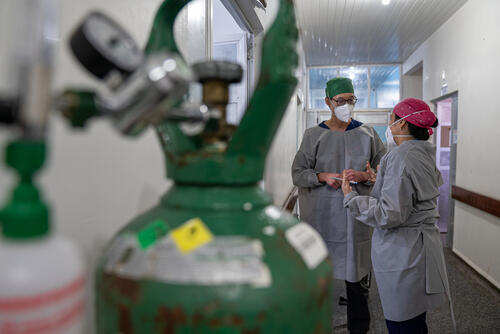
two workers at Al-Sahul COVID-19 centre are trying to carry the oxygen bottle in order to transfer it to inside the ICU,  provide oxygen for COVID-19 patients it's  a long and exhausting job.

 “I never before considered how many litres of oxygen a cylinder holds and how many cylinders a patient needs. In Ibb I quickly learned that a patient with moderate to severe COVID-19 symptoms needs about 6 cylinders a day. Any interruption in the provision of oxygen can be deadly.” Said Cristina nurse activity manager for MSF in Al-Sahul COVID-19 treatment centre.
Workers at Al-Sahul COVID-19 treatment centre, Ibb governorate, carry an oxygen cylinder to the intensive care unit. A patient with moderate to severe COVID-19 symptoms needs around six cylinders a day and any interruption in the provision of oxygen can be deadly. Yemen, July 2020.
MSF/Majd Aljunaid
Norrulah Nasrat, MSF’s nurse collecting saliva from Mohammadin, a COVID-19 suspected patient in MSF’s COVID-19 Treatment Centre.
MSF nurse Norrulah Nasrat collects a sample from Mohammadin, a COVID-19 suspected patient, in MSF’s COVID-19 Treatment Centre in Herat. Afghanistan, January 2021.
Waseem Muhammadi/MSF
Switzerland, COVID-19 response in Intensive care unit of HUG. April 14, 2020. ©Nora Teylouni / MSF
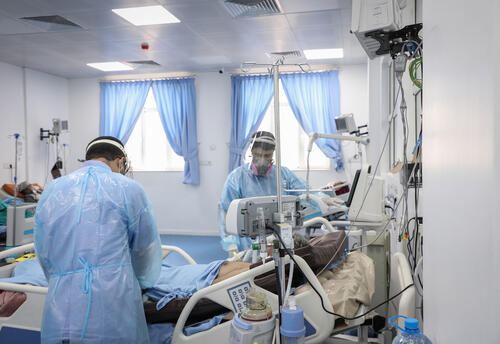
In the intensive care unit of Geneva’s university hospital, where MSF supported the medical response to COVID-19. The focus was on managing patients with the new coronavirus and organising medical teams and services in the hospital. Switzerland, April 2020.
© Nora Teylouni/MSF

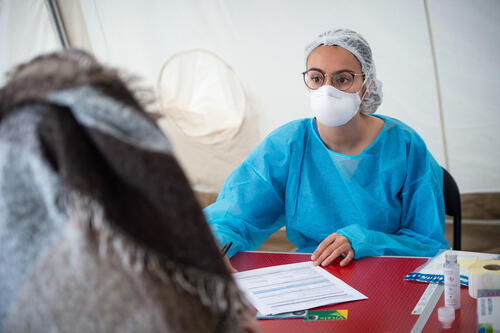
Dr Helene Muller and registered nurse Buhle Nkomonde both worked in the MSF COVID-19 Field Hospital in Khayelitsha, in Cape Town, before coming to Mbongolwane in KwaZulu-Natal, where their COVID-19 expertise was well employed in the screening and testing tent outside the District Hospital.
Dr Helene Muller and nurse Buhle Nkomonde have both worked with MSF in Khayelitsha and in Mbongolwane, in South Africa. In Khayelitsha, in Cape Town, they worked in MF’s COVID-19 field hospital; in Mbongolwane in KwaZulu-Natal, they helped with screening and testing for the District Hospital. South Africa, August 2020.
Chris Allan
MSF provides support to two centres set up in north Marseille to test and refer people testing positive for coronavirus. People in north Marseille represent around 55% of the city’s population. 450,000 inhabitants, but regrettably who benefit from only 28% of Marseille’s medical services. 

These testing and referral centres are intended for local people living in or near districts in north Marseille, regardless of whether they’re entitled to state-funded medical care. The aim is to reduce as much as we can the obstacles for people suspected of having the virus so that they can be tested as quickly as possible, receive optimum treatment and subsequently be provided support.
 
People coming to these centres are first seen by a team of paramedics who check and assess the severity of their symptoms. Before being tested, they’re given a medical consultation to evaluate any potential risk factors and/or underlying health conditions.
France - An MSF nurse assesses a local woman for a possible case of coronavirus at a support centre in north Marseille, where there is a lack of testing and referral centres. April 2020.
CLEMENT MAHOUDEAU/MSF
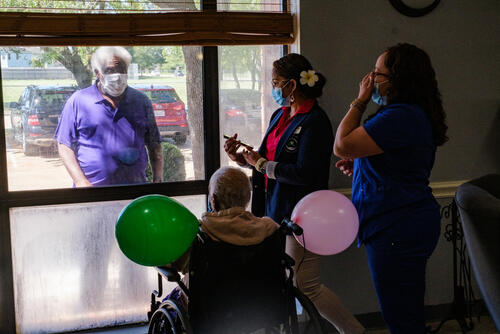
A resident was visited by a family member for her birthday at Focused Care at Beechnut, a long term care facility in Houston, Texas. During COVID-19, visitors must stand outside on the other side of a window and communicate by phone with the resident. MSF conducted infection prevention and control (IPC) training and mental health and wellness training with medical and non-medical staff at Beechnut and other nursing homes in Houston during the summer and fall of 2020.
A resident at Focused Care at Beechnut, a long-term care facility in Houston in the USA, is visited by family for her birthday. The family must stand outside, on the other side of a window, and communicate by phone with the resident. MSF conducted infection prevention and control training and mental health and wellness training at Beechnut and other nursing homes in Houston. United States, September 2020.
Christopher Lee
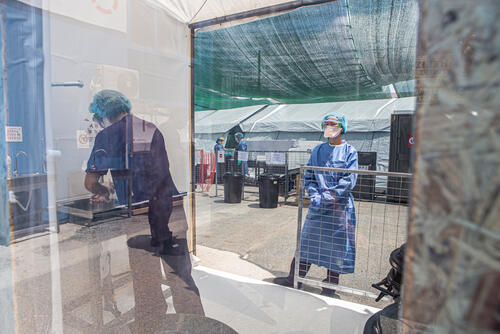
A health promoter advises people to keep a distance of at least 1.5m between each other and to wash their hands at the handwashing points as they enter Timergara DHQ hospital, Lower Dir. About 1,000 people pass through the screening set-up installed by MSF every day.
Pakistan - An MSF health promoter advises people to keep a distance of at least 1.5 metres between each other and to wash their hands at the handwashing points as they enter Timergara DHQ hospital, in Lower Dir district. MSF staff installed a COVID-19 screening point at the entrance to the hospital, in Pakistan's north, through which about 1,000 people pass every day. April 2020.
© Nasir Ghafoor
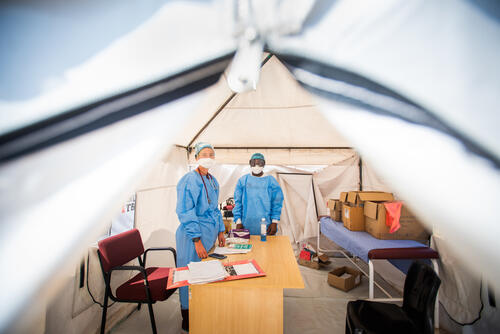
Medical staff talks with a patient and walking during the medical round in the isolation area of the medical center.
MSF staff adjust their protective equipment in a medical facility we’ve set-up for homeless people to isolate if they have COVID-19 or are at high risk of being infected. Brussels, Belgium, November 2020.
Albert Masias/MSF
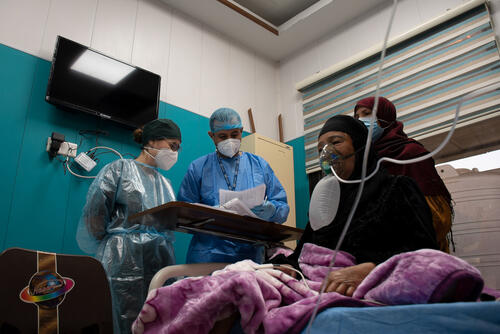
A COVID-19 patient receiving oxygen therapy while admitted at the MSF run inpatient ward of the Al-Shifaa 13 COVID-19 ward in Al-Kindi Hospital, Baghdad. MSF nurses checking up on the condition of the patient and giving instructions to the caretaker about how to support the patient -her mother- and assist her.
An elderly woman with COVID-19 receives oxygen therapy at the COVID-19 centre at Al-Kindi Hospital. Iraq, February 2021.
Hassan Kamal Al-Deen/MSF