


In the West Bank, Palestine, decades of Israeli restrictions and deadly violence have shaped Palestinians' daily lives and their access to essential services. The situation has worsened since the all-out war in Gaza began in 2023. A total of 1,109 Palestinians – at least 243 of them children – have been killed by Israeli forces and settlers in the West Bank and East Jerusalem, to date.1 Seventy-four people have been killed this year alone.
In Nablus, where Médecins Sans Frontières (MSF) provides mental health care, women describe the hardships of their daily lives, and particularly the obstacles to accessing care. This has only become more difficult since the Israeli authorities decided to deny registration to numerous international humanitarian organisations, including MSF.
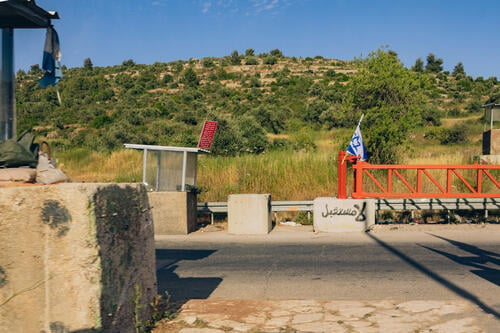
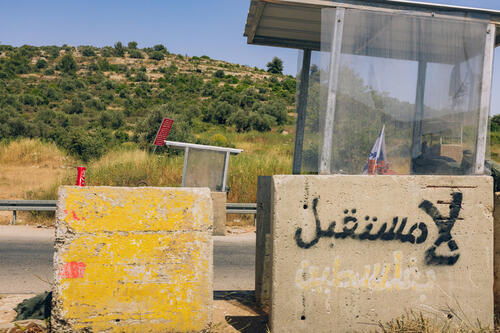
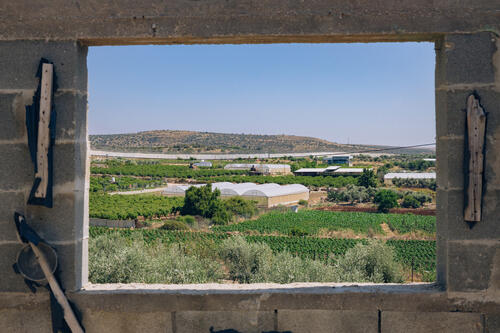
In 2011, Rana's two-year-old daughter, who had disabilities, fell ill. The family lived in Azzoun Atma and had no car. No taxis were running. The village, an enclave in the Qalqilya governorate hemmed in by settlements and separation walls, has only one entrance: a gate that the Israeli army opens for only a few hours a day. That night, it was closed.
“My daughter died because we could not leave,” says Rana. “We had to wait for morning, for the gate to open and for a taxi to take her to hospital. What I went through, many Palestinian mothers have been through.”
“I do not want to believe there is a place anywhere in the world where people suffer more than here,” she says.
Rana has five living children, including a baby who is a few months old. Two of her daughters, twins, have severe disabilities. On her wedding day, in 2004, the family home was partly demolished by the Israeli army. More than 20 years on, she and her family are still rebuilding it, room by room, as their means allow.
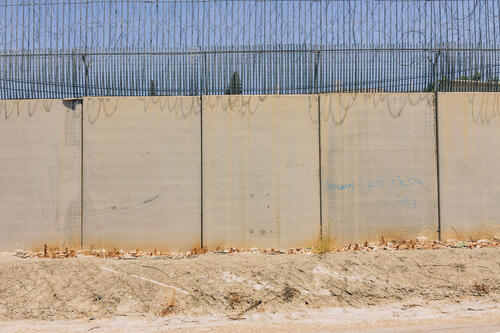
From her windows, “the first thing you see is the wall. Then the settlements,” she says. Two Israeli settlements border Azzoun Atma: Sha’arei Tikva and Oranit. Both are illegal under international law. The route of the separation wall between these settlements and Azzoun Atma has turned the village into a dead end.
A few months ago, about to give birth, Rana had to bring herself to take the road at night.
“I first went to Qalqilya,” she recounts. “They wrote me a referral letter saying I had to go to Nablus. But it was night-time. My husband and I thought about it for a long time, and in the end, we took the risk.”
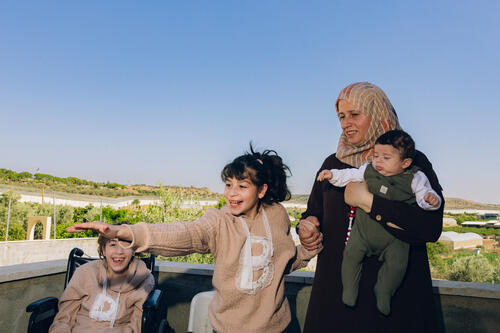
She was afraid, for herself and for her unborn child. This time, all went well. “The greatest achievement, these days, is getting home safe and sound,” she says.
The teams of MSF, who have worked in the West Bank for decades, share this assessment, as Filipe Ribeiro, MSF head of mission, points out: “When Palestinians in the West Bank leave home in the morning, they do not know whether they will be able to get back that evening, because of the checkpoints.”
“Anyone can be arrested and held in administrative detention by the Israeli army for months or years,” he says. “Add to that the fear of an attack by settlers or of a military operation by the Israeli army.”
As of December 2025, OCHA documented 925 movement obstacles that permanently or intermittently restrict the movement of 3.4 million Palestinians across the West Bank, including East Jerusalem.2 Settler violence, in particular, has changed scale: at least 3,088 attacks were recorded over 2023 to 2025, compared with around 1,860 over 2021 to 2023, according to the Office of the United Nations High Commissioner for Human Rights.3
Rana’s case, of having lost her daughter, is far from isolated.
“We are facing a system of obstruction to care: checkpoints multiplying, ambulances delayed or blocked, medical transport targeted, hospitals encircled, treatments interrupted. The denial of care is not collateral damage, it is a way of operating,” says Ribeiro.
With the Israeli authorities’ refusal to register 37 international humanitarian organisations, including MSF, in early 2026, our work has become more difficult.
“In concrete terms, it means we are no longer allowed to call the Israeli military authorities that control the West Bank to coordinate the movements of our teams,” says Ribeiro. “This poses real security problems. We are never certain that the protection our teams are entitled to, as humanitarian workers, is respected when they leave Nablus.”



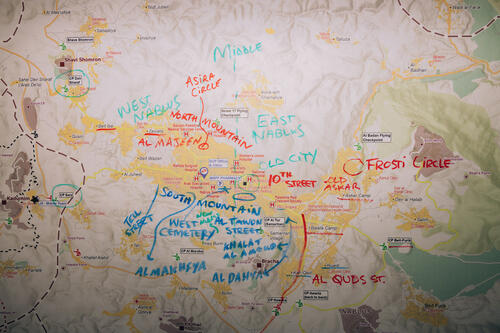

It is now impossible for MSF to send international staff to Palestine. The Palestinian teams in the West Bank are nonetheless supported remotely from Amman, in Jordan.
Unable to guarantee the safety of our teams outside the city, we have concentrated all our activities in the single clinic in Nablus, where patients are seen in person. We have had to suspend all mobile activities, notably in Qalqilya and Tubas. If Rana wants a mental health consultation, she has to make the journey from Azzoun Atma to Nablus, a particularly difficult undertaking.
“Mental health work is done face to face. Not over the phone,” says Shorouq Al-Madmooj, a social worker who has worked with MSF for 22 years. “We want our patients to come to Nablus to receive care, because they need it. But at the same time, we do not want to put them in danger.”
What Shouruq has observed among MSF’s patients, over the years, is an erosion.
“The problems people used to face were much simpler,” she explains. “Today, the difficulties are far more complex. For children as much as for adults.”
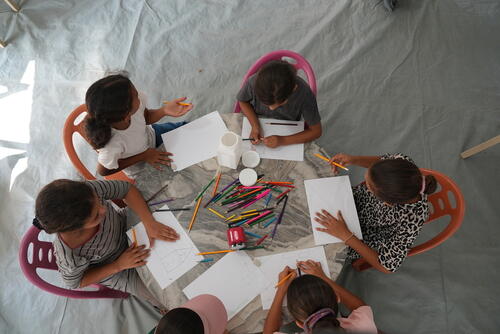
Psychological conditions are appearing at an ever-earlier age. In the youngest, they take the form of bed-wetting or hyperactivity, driven by “the anxiety of military incursions”.
“Sadly, death has become an ordinary thing in our region. We do not know what tomorrow will bring,” says Al-Madmooj.
Mariam comes from Nur Shams camp, in Tulkarem, in the northern West Bank, and the road from there to Nablus, she says, is “difficult, full of detours, very long, exhausting”. She recently emerged from a long period of depression.
“After the war began [the Israeli offensive on Gaza in 2023], I felt the urge to change something, to do something I was capable of,” she says.
She took one training course after another: first aid, first responder, advanced first aid, then an emergency medical services exam sat alongside nursing students, with a high score. She ended up accompanying the ambulances during incursions into the camp, to help the wounded.
“Even with our vests, there was no protection for paramedics, journalists or anyone else,” says Mariam. “People were being killed in their own homes, simply for looking out of a window.”
Mariam, a patient and first responder from Nur Shams refugee camp
“Even with our vests, there was no protection for paramedics, journalists or anyone else... People were being killed in their own homes, simply for looking out of a window.”
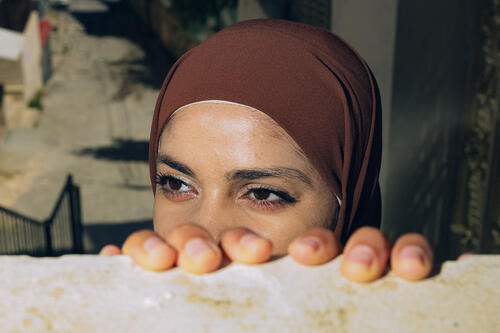
On 21 January 2025, two days after a ceasefire took effect in Gaza, the Israeli army launched the military operation “Iron Wall” in the West Bank. The first incursion was on Jenin camp, then Tulkarem, and finally Nur Shams, on 9 February. Within weeks, almost all the inhabitants in the camps were displaced. Mariam was one of them. Sheltering for a time in Bal’a, a nearby village, she learned one day that soldiers had taken over her family’s home and declared it a military zone.
“All at once, I realised I had nowhere to go,” says Mariam.
A year after the operation began, the camps were still occupied, Israeli forces were stationed inside and demolition orders continued. According to satellite imagery analysed by the UN, about 35 per cent of Nur Shams had been destroyed as early as May 2025.4 When Mariam was able to return, she found her house badly damaged but still standing, unlike her sister’s, who now lives with her.
“There is no camp anymore,” she says. “It has become a cemetery, because so many people lost their loved ones there. I feel as if the smell of blood is still there.”
Mariam’s story is not only one of displacement and violence. It is a fragment of a policy that can be read at the scale of the whole territory. Since January 2025, more than 33,000 people have been displaced from the Jenin, Tulkarem and Nur Shams camps and their surroundings, according to UNRWA.5 And 2025 was a record year for settlement building: 86 new outposts, 54 officially approved settlements, and nearly 28,000 housing units authorised, according to the Israeli NGO Peace Now.6
“It is a deliberate policy of confining people and of territorial fragmentation,” says Ribeiro. “The aim is to make a two-state solution impossible, that is, to prevent any territorial, social, economic or cultural continuity of the West Bank and of Palestine in general.”
It is a deliberate policy of confining people and of territorial fragmentation... The aim is to make a two-state solution impossible, that is, to prevent any territorial, social, economic or cultural continuity of the West Bank and of Palestine in general.Filipe Ribeiro, MSF head of mission
This policy has daily consequences for Rana, who has to give up many medical appointments, but also more ordinary outings.
“Before, we used to come to Nablus every week,” says Rana. “Now, maybe once a year. We could run into settlers, and they could throw stones at us.”
Palestine
MSF calls for protection of Palestinian communities after Israeli settlers injured staff member
Statement
19 Oct 2026
Gaza-Israel war
MSF urges release of detained Palestinian medics in Israel as World Medical Association begins General Assembly
Opinion
6 Oct 2026