


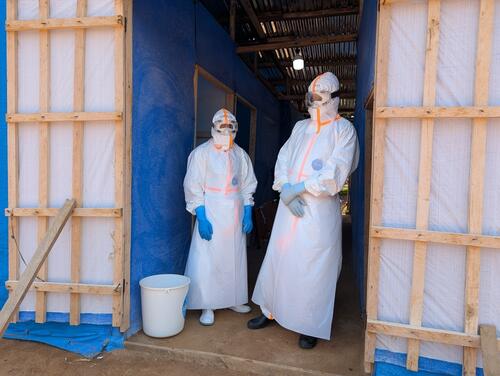
In northeastern Democratic Republic of Congo (DRC), Médecins Sans Frontières (MSF) is expanding our response to the Ebola disease outbreak, as it spreads from the remote town of Nia Nia, in Ituri province, to Kisangani, the busy capital of neighbouring Tshopo province.
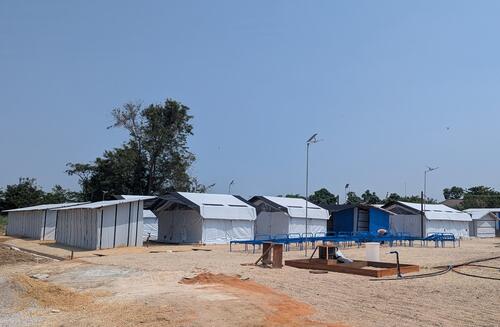
In Kisangani, MSF has been running the Ebola treatment centre (ETC) at Hôpital du Cinquantenaire, in collaboration with the Ministry of Health, since the end of June. In the first week of September, patients were transferred to a new 22-bed ETC, built and run by MSF, increasing treatment capacity in Kisangani.
In Nia Nia, MSF teams started working alongside the Ministry of Health at the ETC in the local hospital in early August. This week, MSF opened a new 50-bed ETC next to the hospital, further expanding access to Ebola care in the area.
The two locations are closely connected. Nia Nia is situated in an area with significant movement of people and goods between Ituri, Tshopo and Haut-Uele provinces. Since the first cases were reported there, people infected in or linked to Nia Nia have travelled to other areas, including Kisangani. Thirteen of the 14 positive cases recorded in Kisangani as of 1 September had an epidemiological link to Nia Nia.
Responding where the outbreak is spreading
Nia Nia has become a major focus of the outbreak in southern Ituri. The town recorded its first cases at the end of June, but the response has faced significant challenges, including limited access to healthcare, gaps in infection prevention and control, and fear and misinformation within the community.
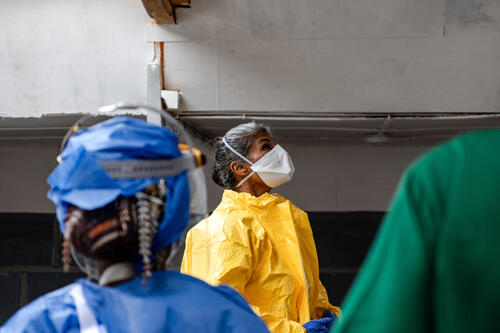
MSF teams began working in Nia Nia in early August. As of 1 September, the Nia Nia ETC had admitted 85 people with symptoms matching Ebola. Of these, 59 were confirmed Ebola cases, including 15 patients who died. MSF opened a 50-bed ETC next to the existing facility, with 16 beds for suspected cases and 34 for confirmed cases, this week. The new centre is designed to provide safer and more effective care, with the protocols and bio-safety measures needed to treat patients with Ebola.
“In an Ebola treatment centre, what we can do is care for the individual patient, but epidemics are stopped in the community,” says Miriam Alia, MSF medical coordinator.
In an Ebola treatment centre, what we can do is care for the individual patient, but epidemics are stopped in the community.am Alia, MSF medical coordinator
When fear prevents people from seeking care
During the first weeks of the outbreak in Nia Nia, fewer patients were reaching the ETC than the number of confirmed deaths reported in the community. Many people remained at home rather than seeking care.
There are now signs of change. More people are reaching the treatment centre alive, giving them the opportunity to receive early, supportive treatment.
“Three weeks ago, we started receiving patients rather than only alerts about deaths in the community,” says Alia. “This is a major change because it means people are coming to the ETC earlier, when they develop symptoms.”
From the beginning, the response in Nia Nia has faced strong resistance, with rumours and misinformation fuelling fear. These have included claims that Ebola did not exist or that medical staff were bringing the disease into communities. Health workers were threatened, and an earlier treatment centre in the region was attacked and destroyed on 30 June.
“I didn’t believe that Ebola existed,” says Maurice, a recovered Ebola patient who was treated by MSF in Kisangani. “But when I was tested and found out that I had Ebola, that’s when I understood that it exists. But people still say that Ebola isn’t real. In my neighbourhood, in people’s homes, that’s what I used to hear.”
I didn’t believe that Ebola existed. But when I was tested and found out that I had Ebola, that’s when I understood that it exists.Maurice, a recovered Ebola patient
MSF teams are working with community leaders, health workers and other local organisations to understand concerns, address misinformation, and build acceptance of the response.
“During Ebola outbreaks, we used to talk about two epidemics: the epidemic itself, and the epidemic of fear,” says Alia. “Now we have a third one: the epidemic of misinformation.”
From Nia-Nia to Kisangani
The link between Nia Nia and Kisangani shows why containing the outbreak in hard-to-reach areas is critical.
“In the past month, two other people were infected in Kisangani after coming into contact with a body that had arrived from Nia Nia,” says Amy Low, MSF project medical adviser in Kisangani.
Also in the past week, three patients with an epidemiological link to Nia Nia died at the MSF-supported ETC in Kisangani.
MSF is expanding our capacity in both locations. But treatment centres alone cannot stop Ebola. Surveillance, testing, contact tracing, infection prevention and control, early isolation, treatment and community engagement all need to work together to reduce transmission and ensure that communities, such as Nia Nia, are not left behind.
DRC Ebola outbreaks
Ebola disease outbreak spreads like a megafire in North Kivu as new hotspots multiply
Project Update
5 Oct 2026
Democratic Republic of Congo
MSF staff member tests positive for Ebola disease and is medically evacuated
Statement
1 Oct 2026
DRC Ebola outbreaks
What will it take to end the Ebola disease outbreak in Democratic Republic of Congo?
Project Update
30 Sep 2026