
Democratic Republic of Congo (DRC) is experiencing the largest and deadliest Ebola disease outbreak in its history. According to Ministry of Health figures, in nearly six months since it was declared, almost 11,000 people have been infected and more than 5,300 have died as a result. The real figures are likely higher.
People working on the frontlines of an Ebola response operate in challenging environments. Some have lost loved ones, family members, or colleagues.
Ebola responders are not immune to the disease. While the risk of contracting the virus in Ebola treatment centres is generally limited thanks to strict infection prevention measures, most responders come from communities affected by the outbreak, where a risk of transmission in everyday life exists.
Even tiny levels exposure to the Bundibugyo virus, which is spread through bodily fluids, can cause infection — and the mortality rate is close to 50 per cent.
Nationwide, hundreds of frontline responders have been infected, and dozens have died, according to official figures. People working for or with Médecins Sans Frontières (MSF) have not been spared. Since the declaration of the outbreak, out of the 2,900 people working for or financially supported in their work by MSF, 29 were infected, most likely within communities, and three died.
Despite the challenges, thousands of frontline workers remain determined to help bring the epidemic under control and save lives. Each has their own story.
Dr Sylvain Radjabu Lubangi, medical doctor
Dr Sylvain Radjabu Lubangi, medical doctor
“When I look at my patients, I see myself.”

Dr Sylvain Radjabu Lubangi used to work in MSF’s Elikya Ebola treatment centre (ETC) in Bunia, Ituri province, which has since been closed. There, he entered the high-risk zone each day, for months, to care for patients with Ebola.
Having survived the disease himself, he knows how frightening it can be.
“When I learned that I was positive, I was in shock,” he says. “At the beginning of the outbreak, many people were dying. I thought I was going to die too.”
Dr Lubangi contracted the virus before joining the MSF-run treatment centre. Admitted to this facility, he learned that other health workers had died in the region.
“That was very hard,” he says. “I was afraid. I kept thinking maybe I would be next.”
But he found the strength to fight.
“I told myself Ebola is a disease like others - you can receive care and recover,” says Dr Lubangi. “I had to stay strong mentally.”
After recovering, Dr Lubangi chose to return to the frontline.
“Now, when I see patients, I see myself,” he says. “I know the fear, the pain, and the uncertainty. That gives me even more empathy, and more strength to help them.”
He hopes his story will encourage others diagnosed with the virus.
“Do not lose hope,” he says. “I know it is possible to recover, because I recovered.”
Dr Carla Schwanfelder, paediatrician
Dr Carla Schwanfelder, paediatrician
“They can seem fine one day and the next day they are dead.”

Dr Carla Schwanfelder is a trained paediatrician from Germany, working at MSF’s ETC in Mongbwalu, Ituri province, where the outbreak began.
While children represent a minority of patients seen at this facility, they represent a larger proportion of patients who die from the disease.
“Most of the children we treat who test positive die,” she explains. “They are among the groups most vulnerable to this disease, alongside the elderly and pregnant mothers.”
The abruptness of some child deaths adds to the distress of working at the ETC.
“They can seem fine one day – eating and playing – and the next day they are dead,” says Dr Schwanfelder. “It is no longer surprising, but it is deeply sad. When we see them deteriorating, there is not much we can do.”
“It is also difficult to see children losing half their families to the disease,” she says.
Seeing children recover provides a dose of relief to the team.
“When they are beginning to get better, we have fun,” she says. “We fist bump through the plastic screen designed to stop infection. They laugh and we laugh with them.”
Dr Schwanfelder is currently on her second Ebola assignment in Mongbwalu.
“I can’t sit at home and watch from afar when I know I have skills I can use to help,” she says.
Dieudonné Tchuma Longa, health promoter
Dieudonné Tchuma Longa, health promoter
“People listen to me. I know what it is like to suffer from Ebola.”

Dieudonné Tchuma Longa works as a health promoter with MSF in Mongbwalu, raising awareness in communities about the dangers of Ebola disease and advising people how to stay safe.
“We go door to door, organise community meetings, and speak with religious and other community leaders,” he says. “We explain that Ebola is real and that people should seek care as soon as symptoms appear.”
Since July, Dieudonné has lost eight members of his family to Ebola, including his father and son. He believes he was infected at his father’s funeral, and that he later transmitted the virus to his wife. Both were treated in an ETC for more than two weeks before recovering.
“One night in the ETC, three people died in the beds around me,” he says. “Bodies can’t be evacuated at night. It was really scary.”
“Now it is easier to do my job,” says Dieudonné. “I can tell people about my first-hand experience of the disease. People listen to me. I know what it is like to suffer from Ebola. Explaining the seriousness of this outbreak is vital if we are to save lives.”
“I still pray for my family,” he says.
Charlotte Borive, mental health officer
Charlotte Borive, mental health officer
“We share our feelings with each other to lighten the load.”

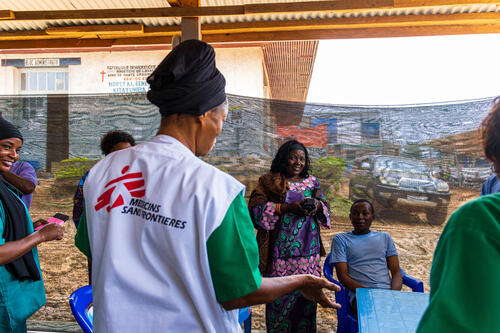
Charlotte Borive provides mental health support to patients at the ETC in Mongbwalu.
“Most of my job is about identifying the needs of patients and helping them overcome their fear of the treatment centre,” she says.
“People are scared of being isolated, they are scared of Ebola, and they are scared of people in personal protective equipment (PPE),” says Charlotte. “It is not something they are used to. The first step is to explain to patients why MSF is here and how we can help them.”
“After speaking with patients, I refer them either to one of the psychologists working here, or to the health promotion team,” she says.
Charlotte says that the death of health workers in Mongbwalu has been difficult for the team to handle.
“It really impacted us. These are people who wanted to help the community,” she says. “To work through this sadness, we had to get even closer in our collaboration as a team. We share our feelings with each other to lighten the load.”
Alice Alyerunga, nurse
Alice Alyerunga, nurse
“Every night, my heart was bleeding for our patients.”

Alice Alyerunga is a nursing supervisor from Bunia, working at MSF’s ETC in Mongbwalu. Although she has worked with us for the past 12 years, she has never wrestled with an emergency on this scale.
“It is the most stressful intervention I have been a part of,” says Alice. “At the beginning, it was catastrophic. We had no survivors for three weeks. Around 100 people died. Every night, my heart was bleeding for our patients.
“When we had our first survivor, it was a joyous moment.
“As frontline health workers, we face high levels of exposure, even with PPE. This means that it can be frightening to work here, but we are motivated by our mission to save lives and break the chains of transmission.
“My family and daughter encouraged me to go and help patients. They gave me their blessing. My friends are scared for me, but I tell them that I am taking measures to protect myself.”
Richard Kasereka, ambulance driver
Richard Kasereka, ambulance driver
“Sometimes they are dead by the time they arrive.”

Richard Kasereka is an ambulance driver, initially from Goma, North Kivu province, working at MSF’s ETC in Mongbwalu, where the outbreak began.
“We have picked up a lot of patients here,” he says. “In bad cases, there is a lot of blood, diarrhoea, and vomiting. It is risky because these fluids are highly infectious. Sometimes the person is nearly dead already when we pick them up. Sometimes they are dead by the time they arrive.”
These scenes can be upsetting for staff.
“It is not easy. But this work demands that we adapt,” says Richard.
“We are here to save lives and I prepare myself mentally and physically, by doing everything possible to protect myself,” he says. “I respect the protocols, wash my hands a lot, and use gel. In my community, I try to raise awareness of these measures and explain how serious this disease is.”
Samson Balidja, head of mission adviser
Samson Balidja, head of mission adviser
“To save lives, we need to earn the trust of the community.”

Samson Balidja grew up in Ituri province. Today, as MSF's head of mission adviser in Bunia, he helps us navigate the security and humanitarian challenges of working in his home province.
Around a dozen active armed groups operate in the area, making humanitarian access difficult and complicating the Ebola response.
“During clashes, people flee in every direction,” he says. “This disrupts prevention measures, facilitates the spread of the disease, and prevents us from accessing affected areas.”
Alongside insecurity, MSF teams also face deep distrust. Samson was among the first MSF staff to arrive in Mongbwalu.
“We were threatened, and a group of youths set fire to a tent we had set up next to the hospital to receive patients,” he recalls. “They didn’t believe Ebola was serious. They thought NGOs had created it to make money.”
More recently, Samson and other colleagues were attacked while assessing health needs in another part of the province where Ebola cases had been detected.
“They threatened us, saying we would not make it out alive,” he says.
Despite this, Samson remains resolute.
“To save lives, we need to earn the trust of the community,” he says. “We need to reinforce community engagement, help communities understand why we are there, and work alongside them.”
Judith Mudjagani, nurse
Judith Mudjagani, nurse
“If we fail to act, a single case can wipe out a whole village.”

Judith Mudjagani is a nurse in Bunia who joined MSF’s Ebola response in May. She worked in the Elikya ETC in Bunia, Ituri province, until the closure of the facility at the end of October.
In Ituri, the virus is thought to have been spreading for months before the outbreak was officially declared. Prior to joining MSF, Judith was working in a local maternity clinic without adequate protective equipment.
“For months before the outbreak was declared, we were treating sick patients without proper protection,” she says. “In early June, I tested positive for Ebola. I’m sure it was because I had been working without protection.”
Judith recovered, but the experience left her deeply shaken: “It was frightening. I know other health workers who have died.”
She says one of the hardest parts of the job is wearing PPE: “It’s heavy, hot, and hard to breathe in.”
She is driven by a strong sense of duty.
“If we don’t isolate and treat patients, a single case can wipe out an entire village,” she says. “But if we keep going, I’m optimistic that we can defeat this epidemic.”
Adelard Kasereka Kasisivahwa, water, sanitation and hygiene supervisor
Adelard Kasereka Kasisivahwa, water, sanitation and hygiene supervisor
“We cannot save everyone. And it weighs on us all.”

Adelard Kasereka Kasisivahwa is from Butembo, North Kivu province. As MSF’s water, sanitation and hygiene supervisor at the city’s hospital, he leads and trains around 60 colleagues who are charged with cleaning wards and creating a safe environment for staff, patients, and the community.
When a patient dies, his team helps prepare the body – which is highly infectious – for safe burial. Transparent windows in the morgue tent allow families to watch the preparations.
“Families need to see what we are doing and be part of saying goodbye,” he says.
For his colleagues, the process can be hard to bear.
“For many, this is their first encounter with serious illness and death,” says Adelard. “Sometimes I need to comfort my colleagues. As MSF, we do everything we can, but we cannot save everyone. And it weighs on us all.”
Adelard also worked on the Ebola response in 2018, and when the most recent outbreak was declared, he was determined to help again. Stories of survival keep him going.
“When someone recovers and thanks us for being there, it warms the heart,” he says.
Vivuya Kavira Mwenga, nurse
Vivuya Kavira Mwenga, nurse
“When someone walks out alive, it is a great joy.”

Vivuya Kavira Mwenga is a nurse at MSF’s ETC in Beni, North Kivu province. The wards are nearly full.
When patients arrive, her team isolates them, monitors them closely and treats their symptoms. There is not yet a specific approved treatment for the Bundibugyo virus responsible for the current outbreak.
“We cannot cure Ebola caused by the Bundibugyo virus yet, but we can treat the symptoms,” she says. “Coming early, before complications develop, gives patients a better chance.”
What keeps her going is seeing patients recover.
“When someone walks out alive, it is a great joy,” says Vivuya. “That is what we want for every patient.”
Kass Kalume, community engagement supervisor
Kass Kalume, community engagement supervisor
“We listen, then we tell them the truth.”

Kass Kalume is responsible for community engagement at MSF’s ETC in Beni. He joined the response in August 2026.
His job is to inform patients, families and visitors about Ebola and how to protect themselves — and to tackle the rumours that can spread fear.
“Some people say our ETC is a morgue — that no one leaves alive,” he says. “Others say we inject people to make them weak.”
The most difficult moments occur when a patient dies. Mourning can turn into anger, and sometimes into threats and accusations against MSF staff. Kass and his colleagues respond to disinformation with facts.
“When families accuse us of causing the death, we listen, then we tell them the truth: it is the virus that kills,” he says.
Despite the pressure, Kass keeps going.
“I am here to help save lives,” he says. “When a patient recovers and the family sings and dances, it makes us happy.”
Rachel Mbuto, infection prevention and control supervisor
Rachel Mbuto, infection prevention and control supervisor
“I am a health worker. When we take an oath, we cannot give up.”

Rachel Mbuto is MSF’s infection prevention and control supervisor in Butembo, North Kivu province. She joined three months ago — her first MSF assignment.
She leads 20 people responsible for keeping the ETC safe and limiting the risk of infection within it.
“My job is to make sure everyone follows the protocols,” she says. “One mistake can put everyone at risk.”
Rachel checks that staff are properly dressed before entering the high-risk zone, that equipment is disinfected, and that waste is handled safely.
She worked in the 2018–19 Ebola response. When the disease returned, she did not hesitate to join the response.
“I know the context is dangerous, but I am a health worker,” says Rachel. “When we take an oath, we cannot give up.”

DRC Ebola outbreaks
Broader use of ERVEBO® vaccine could help protect people from Bundibugyo Ebola outbreak today
Press Release
10 Nov 2026
Democratic Republic of Congo
Harmful, restrictive measures obstruct care for sexual violence survivors in North Kivu province
Press Release
2 Nov 2026
DRC Ebola outbreaks
Providing mental health support to Ebola disease patients and their loved ones
Project Update
28 Oct 2026