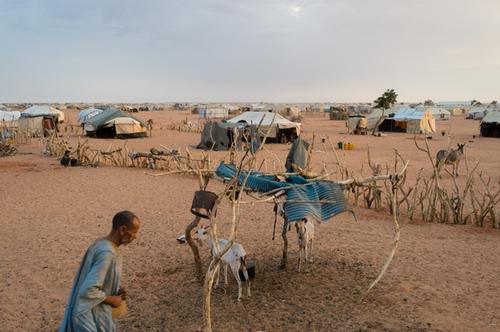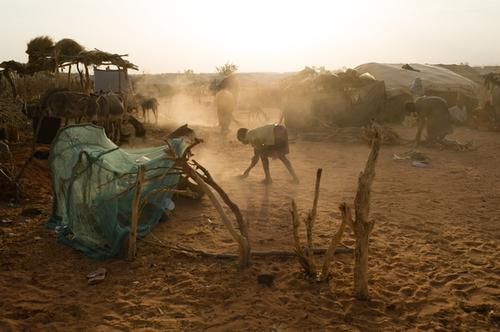
A girl and her mother sweep the area around their tent at the Mbera camp for Malian refugees in Mauritania on 3 March 2013.

As of January 2012, the Malian crisis has resulted in population movements. Nearly 150,000 refugees now live in refugee camps in Burkina Faso, Mauritania and Niger, where MSF teams are providing maternal, primary and secondary health care. Since the beginning of 2013, MSF has recorded nearly 12,000 consultations and 5,000 vaccinations in these three countries. Mauritania is the country with the largest number of refugees.  Mbera camp nearly 70,000 refugees who have fled for fear of reprisals or lack of access to food since the beginning of the conflict. In February 2013, the border post of Fassala (Mauritania) recorded an average of 300 arrivals per day. They are mostly women and children from Timbuktu, Lere, Goundam Larnab and Nianfuke. These Malian refugees continue to live in precarious conditions with no future prospects.
A girl and her mother sweep the area around their tent at the Mbera camp in Mauritania, where MSF is providing healthcare for Malian refugees fleeing conflict.
© Nyani Quarmyne

Deadly clashes in Timbuktu

A girl and her mother sweep the area around their tent at the Mbera camp in Mauritania, where MSF is providing healthcare for Malian refugees fleeing conflict.
© Nyani Quarmyne
Ebola disease in DRC: find out how we're responding
Learn more

4 April 2013 ­— Following deadly clashes in Timbuktu, Mali on 30 -31 March, Médecins Sans Frontières (MSF) teams working in the city’s hospital treated 21 wounded people, including 11 civilians, two of whom died.

Sporadic clashes between soldiers and armed groups prevent residents from travelling within Timbuktu, and people have reportedly died from their injuries because of their inability to reach health facilities due to the fighting.  MSF calls on all warring parties to respect civilian populations and to facilitate access to medical facilities.

For more than one year, MSF teams have been providing medical care, including surgery, to patients and wounded persons associated with all parties to the conflict. In recent months, MSF has admitted approximately 40 patients and performed an average of 15 operations per week at the Timbuktu hospital.

In addition to its work in Timbuktu, MSF is treating malnutrition and malaria in four district health centres and at Niafounké Hospital. To address the medical needs related to the conflict in the northern part of the country, MSF is working in Gao, Ansongo, Douentza, Konna, and Boré, and with Malian refugees in Mauritania, Niger and Burkina Faso.  MSF is also providing paediatric care in a hospital and in five treatment centers in Koutiala district in the south of Mali.