


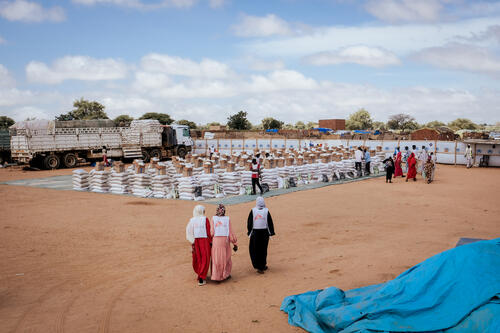
Activity highlights
This data groups together direct, remote support, and coordination activities. These highlights give an overview of most MSF activities but cannot be considered complete or exhaustive.

17,071,300
17,071,3

3,588,200
3,588,2

2,941,600
2,941,6

2,106,800
2,106,8

1,772,100
1,772,1

653,300
653,3

615,200
615,2

548,400
548,4

405,000
405,

213,700
213,7

148,900
148,9

146,500
146,5
82,800
82,8

39,400
39,4

30,400
30,4
14,800
14,8
2,280
2,28

1,300
1,3
Facts and figures
MSF is an international, independent, private, and non-profit organisation. Currently, there are 24 sections and 19 branch offices around the world.
Additional satellite offices exist to support our work, mainly for logistics, supply, and epidemiology. These satellites provide specific activities for the benefit of the MSF movement and/or MSF entities, such as humanitarian relief supplies, epidemiological and medical research, IT services, fundraising, facility management, and research on humanitarian and social action. As these entities are controlled by MSF, they are included in the scope of the MSF International Financial Report and the figures presented here.
The figures presented below describe MSF’s finances on a combined international level. This means that they add up the finances of all sections after eliminating all transactions and balances between MSF entities. The 2025 combined international figures have been prepared in accordance with Swiss GAAP FER/RPC. The figures have been audited by the accounting firm of Ernst & Young.
The figures presented here are for the 2025 calendar year. All amounts are presented in millions of euros.
Note: rounding may result in apparent inconsistencies in totals.
Where did the money come from?
MSF’s revenue in 2025 exceeded €2.6 billion. The breakdown of income by source has remained stable. Income increased by €248 million, or 10 per cent over 2024.
More than 7.5 million private donors
As part of MSF’s effort to guarantee its independence and strengthen the organisation’s link with society, we strive to maintain a high level of private income. In 2025, 98 per cent of MSF’s operating income came from private sources.
More than 7.5 million individual donors and private foundations worldwide made this possible. Public institutional agencies providing funding to MSF included, among others, the governments of Canada and Switzerland; the Global Fund to Fight AIDS, Tuberculosis and Malaria; Unitaid; and national health institutes, research organisations, regional councils, and municipalities of France, Luxembourg and Switzerland.
Where did the money go?
Programme expenditure by continent
CONTEXTS OF INTERVENTION
Largest country programmes by programme expenditure
The total budget for our programmes in these 10 countries was 957 million, 60.6 per cent of MSF’s programme expenses in 2025.
LARGEST COUNTRY PROGRAMMES BY NUMBER OF OUTPATIENT CONSULTATIONS
How was the money spent?
Total expenditure
Social mission - 79% of total expenditure
Programme expenses by nature
The largest category of expenses is dedicated to Personnel costs: 51% of expenditure comprises all costs related to locally hired and international staff (including salaries, social charges, plane tickets, insurance, accommodation, etc).
The Medical and nutrition category includes drugs and medical equipment, vaccines, hospitalisation fees and therapeutic food. The delivery of these supplies is included in the category of “Travel and transportation”.
Logistics and sanitation comprise building materials and equipment for health centres, water and sanitation and logistical supplies.
Other expenses includes grants to external partners and taxes.
Human resources statistics
LARGEST COUNTRY PROGRAMMES BY NUMBER OF LOCALLY HIRED STAFF
Staff positions
Notes on tables and graphs
Programme expenses represent expenses incurred in the field, or by headquarters on behalf of the field. All expenses are allocated in line with the main activities performed by MSF according to the full cost method. Therefore, all expense categories include salaries, medical costs, logistics and transport costs, other direct costs.
Staff numbers represent the number of full-time equivalent positions averaged out across the year. Field positions include programme and programme support staff.
*Southwest Asia refers to the region more commonly known as the Middle East.