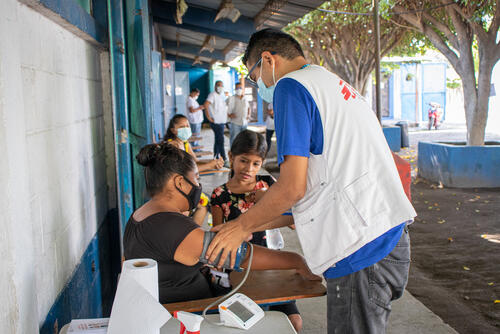
To identify chronic kidney disease of non-traditional origin (CKDnt), also called as Mesoamerican endemic Nephropathy (MeN), MSF provides screening (rapid and laboratory tests), diagnostics and direct medical attention to the population in the communities and health centers in the municipalities of La Gomera, La Democracia and Sipacate. The services are aimed at people exposed to risk factors, such as sugar cane workers and populations living near the plantations.

Guatemala

To identify chronic kidney disease of non-traditional origin , also called as Mesoamerican Endemic Nephropathy, MSF provides screening, diagnostic,s and direct medical attention to the communities and health centers in the municipalities of La Gomera, La Democracia and Sipacate. Guatemala, June 2022.
© Arlette Blanco/MSF
Ebola disease in DRC: find out how we're responding
Learn more

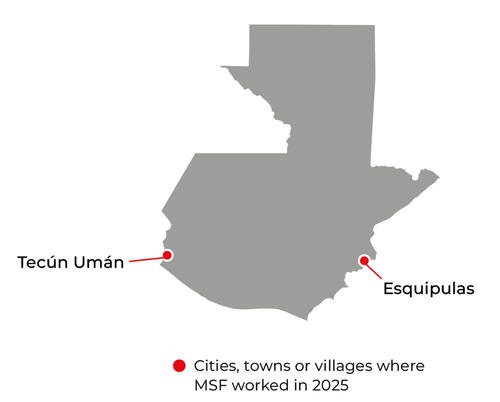
From 2021 until June 2025, MSF ran a project focused on care for migrants in Ciudad Tecún Umán, a city close to the border with Mexico, and Esquipulas, a municipality close to the border with Honduras. The services we provided included general medical and psychological care. Through this project, which we closed due to the impacts of the United States government’s migration policies, we provided care to over 238,000 people. We have intermittently worked in Guatemala since 1984.

Our activities in 2024 in Guatemala

Data and information from the International Activity Report 2024

MSF in Guatemala in 2024 Many people pass through Guatemala while journeying up Central America. Médecins Sans Frontières (MSF) runs projects at two border points, offering vital medical and psychological assistance to people on the move.
Country map for the IAR 2024.
© MSF

MSF is running medical activites in Esquipulas, on the border with Honduras, and Tecún Umán, on the border with Mexico. Our teams provide essential services including nutrition support, sexual and reproductive healthcare, care for non-communicable diseases (NCDs), diagnosis and treatment of high-risk communicable diseases, and psychosocial and basic psychiatric care.  

Our clinics remain strategically located, serving not only as medical care points but also as safe spaces where people can rest, access showers and toilets, and use the internet to contact their families.  

Health promoters are key members of our teams in both projects. Their work is crucial in understanding people’s needs and connecting them to the right services – for example, identifying cases of sexual violence and ensuring that victims and survivors receive the necessary medical care and emotional support. They also guide people on where to find assistance and how to access MSF clinics along their journey.

Mental health teams and health promoters run both group and individual sessions, where they identify people with prior diagnoses of NCDs or psychiatric conditions, and refer them for treatment. Our team in Danlí, Honduras, also refers patients with these conditions to our nearest project in Esquipulas.

In addition to these activities, we provide staff training at both locations to support partner organisations and the Ministry of Health – for example, training health centre staff to identify psychological disorders. 


In 2024

Guatemala

Language
English