


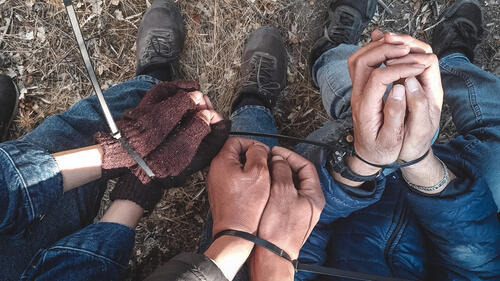
- Médecins Sans Frontières calls on the Greek authorities to investigate reports of hundreds of missing migrants and allegations of people being threatened, abducted, and ill-treated.
- The Greek authorities must implement safe and dignified reception conditions for migrants on Lesbos, and end the arbitrary detention of unregistered new arrivals.
Athens, Brussels - Médecins Sans Frontières (MSF) expresses serious concerns over the continuous deterioration of the situation for migrants and refugees on the Greek island of Lesbos, where there have been numerous allegations/reports of exposure to violence, such as abductions and pushbacks, detention and deprivation of food and shelter.
MSF calls on Greek authorities to investigate reports of hundreds of missing migrants – assumed to be forcibly pushed back to sea – and to implement safe and dignified reception conditions for those who remain on the island.
Reports of missing people
MSF teams working on Lesbos are alerted by the United Nations refugee agency (UNHCR) and other actors when migrants arrive on Lesbos and need urgent medical treatment.
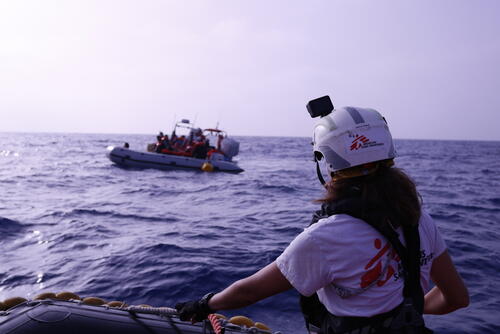
“Since we started providing emergency medical assistance to people arriving by boat to Lesbos in June 2022, we have been unable to find approximately 940 people who were never found at the reported location,” says Nihal Osman, MSF project coordinator in Lesbos.
Patients complain about the frustration related to the reduction of food. The ministry is using food as leverage to force people to leave the facility.Nihal Osman, MSF project coordinator in Lesbos
Several patients have told MSF staff about being traumatically intercepted and forcibly pushed back to sea on previous attempts to reach Greece.
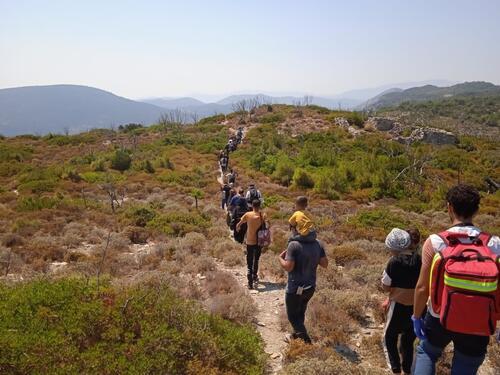
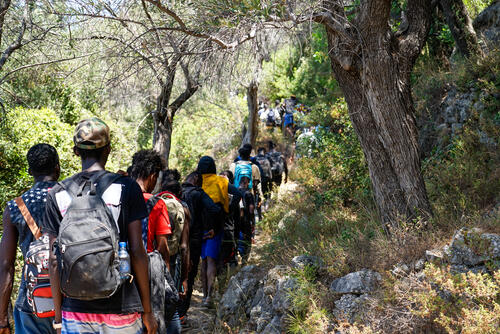
“When we are alerted of newly arrived people in urgent need of medical assistance, we spend hours – sometimes days – looking for them as they are often hiding in forests,” says Osman.
People we find have told us about encountering masked men posing as doctors to gain their trust, or as recently reported in The New York Times article, even as MSF staff.
“If this is confirmed, it is unacceptable and a serious manipulation of humanitarian aid,” says Osman.
In some instances, MSF teams have encountered unidentifiable vehicles without plates in locations near our interventions, often driven by individuals with black covers on their faces. Humanitarian assistance for new arrivals is seriously reduced due to fears of criminalisation. MSF is now the only independent organisation providing support to migrants arriving on Lesbos.
Cruel deterrence tactics
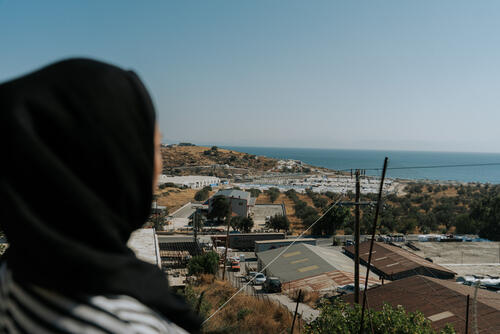
Migrants and asylum seekers arriving to Lesbos are sent to two centres according to the location of arrival: Mavrovouni and Megala Therma. In Mavrovouni, one of several EU-funded Closed Controlled Access Centres (CCAC), up to 2,700 people have been accommodated in 2023.
CCACs were marketed as an improvement in living conditions for migrants but were designed to severely restrict people’s movement and keep them contained in prison-like facilities. On 17 May, Greek authorities stopped providing food to recognised refugees and people who are denied international protection, announcing plans to evict them.
Furthermore, children belonging to families who were denied international protection have been stripped of their social security numbers, making them ineligible to receive basic vaccinations, violating their rights.
“Tensions have risen in the CCAC as a result,” says Osman. “Patients complain about the humiliation they suffer standing in line for hours, and the frustration related to the reduction of food. The ministry is using food as leverage to force people to leave the facility.”
MSF condemns the use of deprivation to force people out of the facility. “Stripping hundreds of people of their basic rights, including access to food and shelter, with no alternatives could have serious consequences on people’s physical and mental health,” says Osman.
Megala Therma camp is emblematic of the cruel and dysfunctional approach adopted in CCACs, supported by EU member states and funded by the European Commission.Nihal Osman, MSF project coordinator in Lesbos
Arbitrary detention
In Megala Therma, on the northern coast of Lesbos, where our teams have been providing healthcare since 2020, the situation is alarming. Formerly a government COVID-19 quarantine centre, the facility now houses migrants before they are transferred to the Mavrovouni CCAC.
People in Megala Therma are not registered and are arbitrarily detained for days, in some cases for more than two weeks, before being transferred to the CCAC of Mavrovouni. Living conditions in Megala Therma are dire. People are put into overcrowded Refugee Housing Units that have no beds – sometimes 14 people are squeezed into a unit with space for five.
All people, including children, are housed together, irrespective of their vulnerabilities without consideration for safety and protection procedures. The facility is also isolated, making it considerably difficult for medical actors to access the facility to respond to medical emergencies.
MSF doctors visit twice a week, but if medical emergencies occur on any other day, no one is on site to respond, and it would take an ambulance more than an hour to reach the patient.
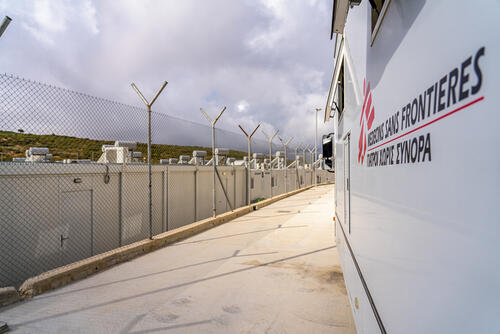
“Megala Therma camp is emblematic of the cruel and dysfunctional approach adopted in CCACs, supported by EU member states and funded by the European Commission. We have extensively criticised and denounced these harsh policies,” says Osman.
MSF calls on the Greek authorities and the European Commission:
- For an immediate investigation into allegations of people being threatened, abducted, and ill-treated by unidentified masked people who are systematically engaging in pushbacks and endangering people’s lives on land and at sea.
- To end the arbitrary detention of unregistered new arrivals in Megala Therma, ensuring their prompt access to registration and identification, dignified reception conditions and proximity to basic services.
- To ensure quality, timely medical care, including emergency medical care in the dedicated reception facilities. People’s legal status must not lead to the exclusion of vital services such as food, shelter and healthcare. Access to healthcare, protection and humanitarian assistance needs to be granted to all new arrivals seeking protection in Greece, in line with the EU reception directive.
Since 2021 on Samos and 2022 on Lesbos, MSF has been providing emergency medical assistance to people arriving by boat on the islands. Our activities include general healthcare, treatment for chronic diseases, sexual and reproductive healthcare, individual and group clinical psychological care, as well as psychiatric care, alongside socio-legal support. Health education and awareness raising is done with a team of health promotors both inside the clinics as well as in camps and in the street.
Greece
Asylum seekers in Greece report being beaten, strip-searched and sent back to sea
Press Release
2 Nov 2023
Greece
In plain sight: the human cost of migration policies and violent practices at Greek sea borders
Report
2 Nov 2023
Greece
EU migration policies are once again killing people as they search for safety
Press Release
30 Jun 2023