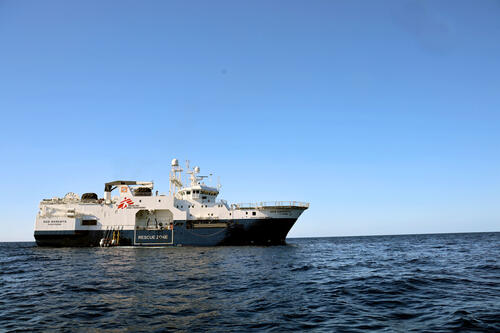
The European Commission has still not provided a final decision or indicated what action it will take, three years after Médecins Sans Frontières (MSF), the Association for Juridical Studies on Immigration (ASGI), EMERGENCY, Oxfam Italia, and SOS Humanity submitted complaints concerning Italy’s rules on civilian search and rescue activities. On the anniversary of the complaint, MSF is reiterating our call for the Commission to provide a decision.
The complaint concerns Italian Decree-Law 1/2023, known as the Piantedosi decree, as well as Italy’s practice of assigning distant ports to rescue ships, and the abusive use of Port State Control inspections. These measures continue to obstruct lifesaving search and rescue operations in the central Mediterranean Sea. Distant port assignments force rescue ships to spend less time in the search and rescue area and delay survivors’ access to essential services on land. Between January 2023 and December 2024, MSF’s rescue vessel Geo Barents was forced to navigate an additional 64,966 kilometres and spent 163 extra days at sea.
The Piantedosi decree imposes a series of restrictive rules that, in practice, place operational constraints on civilian rescue activities. Organisations that do not comply risk fines, detention, or even confiscation of their vessels. Since 2023, NGO rescue ships have been detained on 43 occasions, amounting to over 1,100 imposed days of detention. Yet these sanctions have repeatedly failed to stand up in court; to date, none of the 43 sanctions imposed have been confirmed by a final court judgement.
Italy must stop obstructing lifesaving search and rescue work, and the European Commission must finally act.Julie Melichar, MSF search and rescue representative
While the Commission delays, people continue to die at sea. By the end of July 2026, almost 1,500 people were feared dead or missing in the central Mediterranean, after 1,745 deaths in 2025. The central Mediterranean remains the world’s deadliest migration route, with more than 26,700 people dead or missing since 2014, according to the International Organization for Migration.
“Behind these numbers are people —men, women and children— who have the right to be rescued,” says Julie Melichar, MSF search and rescue representative. “These policies have repeatedly failed to stand up in Italian courts when sanctions against rescue organisations are challenged.”
“Italy must stop obstructing lifesaving search and rescue work, and the European Commission must finally act,” says Melichar.
These policies and practices are not in line with EU member states’ obligations under European and international maritime and human rights laws. They endanger the lives of people on the move and undermine the work of organisations trying to save lives at sea. The European Commission cannot continue to look away.
Mediterranean migration
Italian court dismisses case against MSF search and rescue staff after nearly nine-year-long criminal proceedings
Press Release
8 Jul 2026