With the Syria crisis entering its ninth year in 2019, Jordan is hosting around 1.3 million Syrians of which 670,000 are registered as refugees.

With the arrival of winter, the suffering is renewed for Syrian refugees, let alone for those suffering from life-long diseases. Adding to this, winter is a season of additional torment that they still cannot avoid.

NCDs is one of the main health problems affecting Syrian and Jordanian population; it is estimated NCDs to account for 78% of all death in Jordan. Heart disease has become a leading threat to the health of the Jordanian population, with 41.5% of deaths last year 37% of them were related to heart disease.

Death due to NCDs is mainly due to complications of uncontrolled other Chronic Diseases like Diabetes and Hypertension. The lack of follow-up, diagnostics and clinical investigations, health awareness and high cost of secondary and tertiary health care like cardiac interventions are also significant reasons.( e.g.: Catheterization may reach 5000 JDs/7000 USD, excluding Hospital fees).

Like most of NCDs, the difficult economic conditions make life harder for those affected. The NCDs care and management is expensive in general and requires long term medications and regular follow ups, not a lot of patients have the financial ability to afford the treatment. It affects the access of medicines for patients. As a result, MSF intervened and operated two clinics in northern Jordan in Irbid governorate to respond to the NCDs needs between Syrian refugees and vulnerable Jordanians. MSF is helping both in Irbid governorate by providing these life-saving medications and follow up consultations free of charge.

At both clinics, MSF currently has cohort of 5500 patients out of which 3,639 are Syrian refugees and 1,619 are vulnerable Jordanian in the NCD program, out of which Type I Diabetes: 163 and Type II Diabetes: 3251, Hypertension: 3,773, Asthma 453, and Cardiovascular 1406. Many patients have more than one of these diseases.

MSF teams provide medical and mental healthcare,  including psychosocial support, physiotherapy and health promotion, and home visits to patients unable to visit the clinics due to mobility constrains.

MSF contribution doesn’t stop at providing health care to Syrian refugees. MSF believes that increasing patient’s familiarity about NCDs is important, given the lifelong nature of these diseases.

Some of the NCDs services available are provided with some cost taken from the patients. For many Syrian patients that cost is not affordable and would require a global support from donors and agencies to have affordable access to NCD treatment and health care.
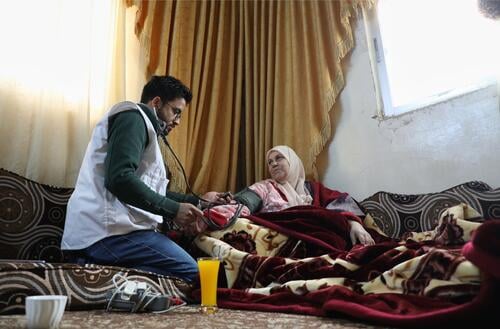
MSF Nurse Hussam Masadeh checks over a Jordanian woman living with diabetes during a home visit in Irbid governorate. Jordan, January 2020.
© MSF/Mohammed Sanabani

Eight reasons why diabetes is a humanitarian emergency

MSF Nurse Hussam Masadeh checks over a Jordanian woman living with diabetes during a home visit in Irbid governorate. Jordan, January 2020.
© MSF/Mohammed Sanabani
Ebola disease in DRC: find out how we're responding
Learn more

To many people, diabetes is a common long-term condition. In fact, most of us will know at least one person living with the illness. We may have also heard of insulin: a simple but lifesaving drug.

However, when conflict, displacement or even corporate practices leave a diabetic patient cut off from care, this everyday condition can fast become complicated and life-threatening.

Why does MSF work on diabetes?

Diabetes is a chronic disease that occurs when the body cannot produce enough insulin – a hormone that regulates the levels of glucose (sugar) in our blood. Without regular treatment, with oral tablets or injections of insulin, these higher levels of blood sugar can eventually lead to heart disease and kidney failure, as well as nerve damage and blindness.

An estimated 463 million people are living with diabetes worldwide, a figure that has nearly doubled in the last 30 years. Worryingly, cases are rising much faster in low-income and middle-income countries – including regions where people are living through insecurity or other healthcare crises.

In particular, access to insulin is a challenge. This means that in countless communities, people living with diabetes who require insulin face obstacles in receiving the medicines and care they need to stay healthy.
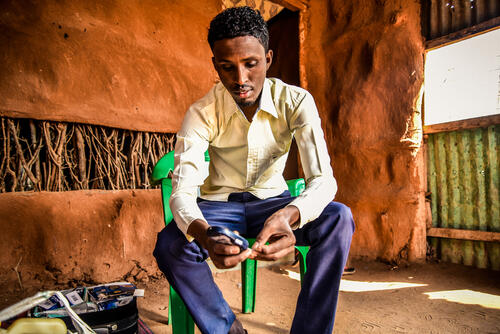
Mohamed is well dressed, and speaks fluent English. He is a teacher in a primary school in Dagahaley, where he teaches Science in the two highest classes. When he started, he could teach all subjects, based on the gaps. 

Mohamed came to Dadaab in 1992 with his mother, fleeing violence in Somalia. He went through his schooling in the camp, and is now pursing a bachelor’s degree in education at a local univesity, sponsored by one of the agencies in the camp. He has been married for eight years and has four children, all who were born in the camp. 

He married when he was joining form one. He was 15 years old then and the wife was 18. “My mother was very sick and had no one to take care of her. I needed to concentrate on my studies to have a better future and my sister was too young at that time,” he says. “She cared for my mum very well and we’ve not had any issues.”

His father was resettled to the US and has been supporting them. “How?” I ask. “My father has another wife, whom he was resettled with, my mother was the second wife. His first wife has a disability, and the resettlement was processed on those grounds,” he says.

They were also in the resettlement pipeline and were to join the father, “but then Trump happened.”

Journey with Diabetes
 “I used to play soccer, but I stopped  in 2014 as I would get exhausted. I started passing urine frequently and lost weight: from 68kgs to 35,” he says. 

When he went to Nairobi in 2016 to visit his uncle, he went to a health facility where his blood sugar was tested and found to be high. They gave him some medication that he took for a month then he came back to Dadaab.

“I went to the hospital and my treatment was changed. Said (previous MSF HIM Supervisor) was good. He trained me a lot to be how I am today. I don’t even feel like I am diabetic. He taught me how to inject, how to understand hyper and hypoglycemia. I always wish him a successful life in future.

When he was in Nairobi, his uncle would buy him the insulin he needed, whose cost he cannot remember. “At that time, I was using a different insulin that I had to take three times a day. This new one I use twice in a day,” he says, “the doctor here plans the schedules for us, like myself I go for review every 21 days, when they also replenish our supplies. The insulin in the bottle is usually enough for 21 days,” he says.

Mohamed says the portable cooling box is the good, even better than a refrigerator he used before. “When you use a refrigerator, sometimes it gets too cold that when you inject, it makes you cringe a bit,” he says. “I carry mine even to class and it does not bother anyone. People know that diabetes is not contagious, and once something can’t be transmitted, then people don’t get too concerned.”

It was pretty hard for me to go to the hospital every morning and evening because of my classes, only Saturdays worked better for me until we were trained. He says the complexity he finds with the regimen is that he has to wait for at least 30 minutes after taking insulin to eat. “This means that I never plan for early morning classes, but the school administration allows me to report at 8:30 am and the first class does not start until 9:00 am,” he says.

Interpreting glucometer results is quite easy. It works very fast and makes a beep when it’s ready. I know what range is supposed to be high or low. He understands hypoglycemia, and for a moment, he explains to us what it means. “The last time I experienced it was during Ramadhan when we usually fast. The best way is to carry sweets in the pocket but only eat when you feel hypoglycemia kicking in. It also happens when I travel or when I walk too long,” he says.

He says being a refugee presents many challenges in his life, but he feels contented with what he gets, despite the shortage. “When you’re a refugee, you can’t get everything you need. When I was a child, life was difficult but the camp has really developed over time, even the market. Travel is also difficult as movement is restricted. I find it quite difficult when I have to go to the university for my classes.”
Mohamed Hussein Bule, a 27-year-old refugee who lives with Type 1 diabetes, checks his blood sugar levels. Dagahaley refugee camp, Kenya, September 2019.
Paul Odongo/MSF

A humanitarian emergency

Here are eight reasons why, in many places, diabetes is a healthcare emergency:

1 – Invisible illness

Despite diabetes being a growing issue worldwide, it’s thought that the diagnosis rates among people living through humanitarian crises are actually very low. So, when you consider that cases of diabetes are rising fastest in low-income countries, the number of people living with a completely untreated condition could be stark.

2 – Travel can be dangerous

For people living with diabetes in conflict zones or regions suffering from insecurity, making regular trips to healthcare centres to collect insulin or receive treatment can be extremely dangerous – particularly when many patients may not have access to transport.

3 – Insulin isn’t always available

In remote and rural places, or regions with limited access to resources, a medical centre itself may not have a reliable supply of insulin, meaning some patients end up rationing their supply or even going without, risking consequences for their health or even death.

4 – Big Pharma prices

Just three companies – Novo Nordisk, Eli Lilly and Sanofi – control 90 per cent of the entire insulin market. These pharmaceutical corporations set prices high which significantly impact patients and healthcare organisations all over the world. However, there are several companies working with the World Health Organization to produce generic versions of insulin that could be much cheaper and so much more widely available.
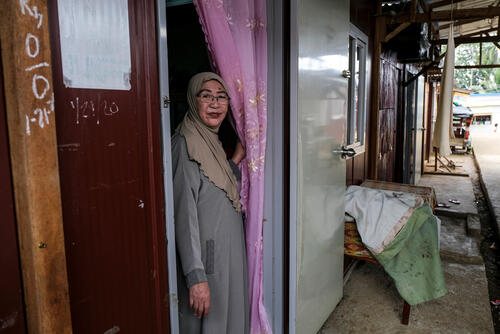
Marawi City, Lanao del Sur -Sobaida Comadug, 60, a former resident of ground zero, is monitored for diabetes, hypertension, asthma, and arthritis at the local health office in Sagonsongan district near the temporary shelters. Her husband was sick and dependent on oxygen the day the siege broke out. They tried rescuing him the next day but he passed on and had to be buried under their house at MAA (Most Affected Area). 

"I am Sobaida Mamaunte Comadug. I am 60 years old. I was born in Marinaut, Marawi City. Now, because of the siege, I am living in Block 8, Lot 7, Area 4, Temporary Shelter. I was one of the first people approved to have a shelter here in Area 4 (Sagonsongan Temporary Shelter). 

Before the siege, my husband was a commandant at the University Training Center, at the same time, he also work in Ninoy Aquino College Foundation, as a teacher. Most of our income came from him. I used to have a small grocery, in front of our house. And some of my children - I have 2 sons and 5 daughters - are already working, so they would help out with the expenses at home.

It was May 23, 3 o’clock in the afternoon when the local groups affiliated to IS came out from our area in Marinaut. There were so many of them, like black lice walking on our street. There were gun fires all over the place. 

That day, my husband had just been discharged from the hospital for home medication. Two of my daughters just arrived home to refill the oxygen tank he used. They were evacuating the area. I think we were the only ones left in Marinaut because I couldn't leave my husband behind. And some of my children did not make it back home yet. But the following day, he heard that they were about to bomb the area soon. But my husband, as a former military, expressively refuse to leave his house. Meanwhile, one of my grandson had a terrible asthma attack. We needed to rush to the hospital. But transportation was not easy to found and roads were partially blocked by local groups affiliated to IS. Eventually we could reach Iligan to bring the child to the hospital. 

My husband was left behind with relatives and I was thinking to go back the next day with a car to pick them up. But the following day, we've been informed that my husband passed away. We were hysterical after hearing the news; with no way to return because of heavy bombings on the area. And any of our connections allowed us to have him transported to Iligan for a burial neither. There was nothing we could do but bury him inside the house. 
Although I had a vacant lot, they couldn't even bury him outside the house because the government forces were using drones and might suspect us as being ISIS. 

We stayed in Iligan for less than a year, before being transferred to Sagonsongan. It was one of the first shelters to be built. The chairman was surprised we wanted to go back there. But even if the house is smaller, the climate in Marawi is much more compatible for my health. 

I attended one of the meeting for health issues. I was lucky to be here on a Thursday, the day they open the clinic. I learned that they offer their services here in Sagonsongan. I met a doctor here, Dr. Lucy Dela Cruz, who continues to see me today. She follows my diabetes, cholesterol, high blood, and asthma. They prescribed the same treatment and the diagnostic is the same. So where should I go further where I need to buy the medicines. Here everything is free and I can consult more often. 

But here in Sagonsongan, the problem is the water supply. It's harder for us to cook healthy food. We are far from stores selling fruits and delicious vegetables. Even if we insist on buying vegetables when we have money, we still don't have clean water to wash them. And we have to be wise with spending now because we, IDPs, don't receive any relief goods from the government. So our only option now is buying ready-to-eat meals sold here. 

Besides the house is small but we are only four living inside. Even though we have the impression to sleep upright. My neighbors? They need to take turn to sleep. From the kitchen all the way to their bedroom, the floor is occupied by people sleeping. 

We are deeply hurt by what the government did to us. After initially giving us P73,000 (1337 euros) we no longer get any support. Water supply is operational but sometimes only 30 minutes a day and the pressure is weak. Some residents here use pump, so of course we're left with small amounts of water. We have many water drums but often we can't even fill them up. We can't wash our clothes properly. Electricity is fine even if the bill keeps on increasing. My own monthly bill alone reached over P11,000 (200 euros). But I don't pay. The government is supposed to pay. We know that a lot of foreign countries pledged donations for us but we don’t know what happened to this money.  

We want to go back home. The government is making promises about the rehabilitation of our homes. But they don't put water or power supply where we used to live. So we can't go back there. We could set up tents or makeshift houses on our own lot, rather than living in these shelters, which are build only for 5 years. Do you think the government will build an ever-lasting shelter? No. How will we be able to renovate our house if there is no water for the cement? No electricity for the carpentry works. They are planning to build halls, parks and markets. But they don't prioritize IDPs. Who will they build all these premises for? Foreigners? We will never sell our land to anybody."
Sobaida Comadug, who is displaced because of armed insurgents and living with diabetes, stands in the doorway of the health clinic in Sagonsongan district. Marawi City, Lanao del Sur, Philippines, January 2020.
Veejay Villafranca

5 – Food insecurity

A fundamental part of managing diabetes is also managing diet and therefore blood sugar. However, when food may be scarce, or events such as conflict have caused the cost of everyday staples to rise – for example in Yemen – then maintaining regular meal times and reliable portions can become incredibly difficult.

6 – Needles, syringes and waste

Along with access to insulin itself, the problem of finding and affording the bundle of tools required – like needles, syringes and monitoring devices – can be challenging. Even with a reliable supply, keeping these vital items clean, and disposing of them safely, is also difficult – especially for patients who have been forced from their homes or now live in refugee or displaced people’s camps.

7 – The fridge myth

In many places, daily temperatures can far exceed the recommended storage range for insulin. Normally, insulin is stored in a fridge, but this is an issue when a person doesn’t have one – either due to poverty, limited power or because they have been forced from home. Instead, patients will often make multiple journeys a day to reach a healthcare clinic, costing time, money and potentially their safety. However, from experience, we know simple alternative storage solutions (such as basic clay pots) can provide a way of maintaining cool and stable temperatures to store insulin for some time.

8 – The cycle of complications

When a person living through a humanitarian crisis is unable to manage their diabetes, the long-term risk of serious complications – including kidney failure, heart disease and vision loss – rise significantly. And, when such conditions reach the point of needing urgent medical attention, the availability of specialised and emergency care may not be easy to access. Leaving diabetes untreated becomes a vicious cycle, resulting in more complicated conditions that need more advanced treatments, but are even less likely to be available in the middle of a humanitarian crisis.