Drucille eating porridge in Paoua Hospital. In addition to her treatment, Drucille also needs to follow a very strict low sugar diet. « I do not drink juices and sweetened coffee and I do not eat biscuits and sweets. If there is too much sugar in the mush, I cannot eat it either. Even bananas are dangerous. I can only eat bitter and sour food. I cannot touch sweet things » said Drucille.

In Paoua, a city of the Central African Republic (CAR) close to the border with Chad and Cameroon and home to 17,000 inhabitants, MSF team has built a special bond with Drucille, a nine year old girl who has spent most of her days at the MSF-supported hospital over the past six years. Drucille has been diagnosed with type 1 diabetes and needs daily treatment. She is a patient followed up by the clinic for chronic diseases set up by MSF in partnership with local health authorities at Paoua hospital.
Nine-year-old Drucille eats porridge as part of her treatment to control her diabetes. Paoua, Central African Republic (CAR), October 2020.
© Seigneur Yves Wilikoesse/MSF

No fridge, no problem, to store insulin for people with diabetes

Nine-year-old Drucille eats porridge as part of her treatment to control her diabetes. Paoua, Central African Republic (CAR), October 2020.
© Seigneur Yves Wilikoesse/MSF
Ebola disease in DRC: find out how we're responding
Learn more

Seeking to explore ways to improve diabetes care in resource-poor settings, a joint study by Médecins Sans Frontières (MSF) and University of Geneva, published in the journal PLOS ONE, has demonstrated that a range of insulins can be stored at temperatures ranging between 25-37 degrees Celsius for a four-week period of use. This study confirms the possibility for people living with diabetes in similar temperature conditions to be able to use insulin, for a period of up to four weeks, even in the absence of access to refrigeration.

Strict storage recommendations for insulin are difficult to follow in tropical regions and even more challenging in conflict and humanitarian emergency settings, adding an extra burden for people managing their diabetes.  
 
“For far too long, we were unable to send people with diabetes back to their homes with insulin due to its cold storage requirements,” says Dr Philippa Boulle, MSF non-communicable diseases adviser. “Some of these people were travelling long distances daily and some even relocated to get their insulin injections at the clinic.”

“People with diabetes in resource-limited and humanitarian settings will now be able to inject themselves in their homes, greatly improving the significant disruption to their lives from having to attend hospital for twice-daily injections,” Dr Boulle adds.

Mohamed Hussein Bule, person living with diabetes “I went to the hospital and my treatment was changed... they trained me a lot to be how I am today. I don’t even feel like I am diabetic.”
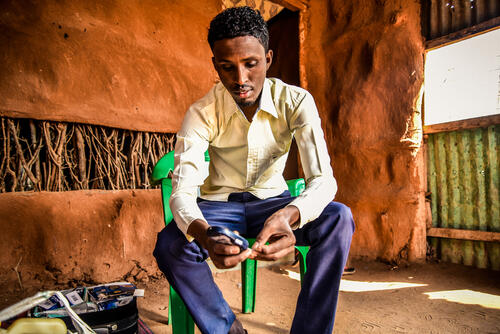
Mohamed is well dressed, and speaks fluent English. He is a teacher in a primary school in Dagahaley, where he teaches Science in the two highest classes. When he started, he could teach all subjects, based on the gaps. 

Mohamed came to Dadaab in 1992 with his mother, fleeing violence in Somalia. He went through his schooling in the camp, and is now pursing a bachelor’s degree in education at a local univesity, sponsored by one of the agencies in the camp. He has been married for eight years and has four children, all who were born in the camp. 

He married when he was joining form one. He was 15 years old then and the wife was 18. “My mother was very sick and had no one to take care of her. I needed to concentrate on my studies to have a better future and my sister was too young at that time,” he says. “She cared for my mum very well and we’ve not had any issues.”

His father was resettled to the US and has been supporting them. “How?” I ask. “My father has another wife, whom he was resettled with, my mother was the second wife. His first wife has a disability, and the resettlement was processed on those grounds,” he says.

They were also in the resettlement pipeline and were to join the father, “but then Trump happened.”

Journey with Diabetes
 “I used to play soccer, but I stopped  in 2014 as I would get exhausted. I started passing urine frequently and lost weight: from 68kgs to 35,” he says. 

When he went to Nairobi in 2016 to visit his uncle, he went to a health facility where his blood sugar was tested and found to be high. They gave him some medication that he took for a month then he came back to Dadaab.

“I went to the hospital and my treatment was changed. Said (previous MSF HIM Supervisor) was good. He trained me a lot to be how I am today. I don’t even feel like I am diabetic. He taught me how to inject, how to understand hyper and hypoglycemia. I always wish him a successful life in future.

When he was in Nairobi, his uncle would buy him the insulin he needed, whose cost he cannot remember. “At that time, I was using a different insulin that I had to take three times a day. This new one I use twice in a day,” he says, “the doctor here plans the schedules for us, like myself I go for review every 21 days, when they also replenish our supplies. The insulin in the bottle is usually enough for 21 days,” he says.

Mohamed says the portable cooling box is the good, even better than a refrigerator he used before. “When you use a refrigerator, sometimes it gets too cold that when you inject, it makes you cringe a bit,” he says. “I carry mine even to class and it does not bother anyone. People know that diabetes is not contagious, and once something can’t be transmitted, then people don’t get too concerned.”

It was pretty hard for me to go to the hospital every morning and evening because of my classes, only Saturdays worked better for me until we were trained. He says the complexity he finds with the regimen is that he has to wait for at least 30 minutes after taking insulin to eat. “This means that I never plan for early morning classes, but the school administration allows me to report at 8:30 am and the first class does not start until 9:00 am,” he says.

Interpreting glucometer results is quite easy. It works very fast and makes a beep when it’s ready. I know what range is supposed to be high or low. He understands hypoglycemia, and for a moment, he explains to us what it means. “The last time I experienced it was during Ramadhan when we usually fast. The best way is to carry sweets in the pocket but only eat when you feel hypoglycemia kicking in. It also happens when I travel or when I walk too long,” he says.

He says being a refugee presents many challenges in his life, but he feels contented with what he gets, despite the shortage. “When you’re a refugee, you can’t get everything you need. When I was a child, life was difficult but the camp has really developed over time, even the market. Travel is also difficult as movement is restricted. I find it quite difficult when I have to go to the university for my classes.”
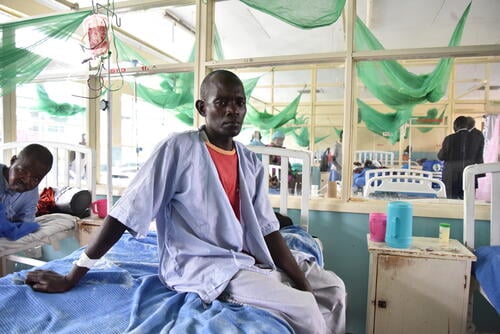
Mohamed Hussein Bule, a 27-year-old refugee who lives with Type 1 diabetes, checks his blood sugar levels. Dagahaley refugee camp, Kenya, September 2019.
© Paul Odongo/MSF

Twenty-seven-year-old Mohamed is a teacher in a primary school in Dagahaley, Dadaab refugee camp in Kenya. He came to Dadaab in 1992 with his mother, after fleeing violence in Somalia.

Mohamed was keen on football but had to stop playing when his health suddenly deteriorated.

“I used to play soccer, but I stopped in 2014 as I would get exhausted,” Mohamed says. “I started passing urine frequently and lost weight, going from 68 kg to 35 kg.”  

While visiting an uncle in Nairobi in 2016, he went to a health facility where his blood sugar was tested and found to be high. He was provided with insulin, paid for by his uncle, which he took three times a day. One month later, he returned to Dadaab and came to MSF’s Dagahaley hospital.

“I went to the hospital and my treatment was changed,” he says. “They trained me a lot to be how I am today… they taught me how to inject, how to understand hyper and hypoglycaemia. I don’t even feel like I am diabetic.”

Mohamed injects himself with insulin twice a day and has a follow-up visit at the hospital every three weeks.

“The doctor here plans the schedules for us,” he says. “I go for review every 21 days, when they also replenish our supplies. The insulin in the bottle is usually enough for 21 days.”

“People know that diabetes is not contagious, and if something can’t be transmitted, then people don’t get too concerned,” Mohamed says.


Diabetes is a chronic, progressive disease that can be controlled with effective treatment. However, in many countries, people living with diabetes are not getting the treatment they need to stay healthy and alive. It is a shameful fact that only about half of people who require insulin have access to it. Barriers to accessing insulin are largely due to high prices, challenging storage requirements and complex treatment protocols.

Storage recommendations for insulin require refrigeration until its expiry date, or until it is opened for use. Once in use, the storage recommendations on the label of most human insulins are below 25 degrees Celsius for 42 days. In many settings, this results in people being asked to travel to the health clinic for injections and monitoring, at least twice a day, for life.

MSF works in over 70 countries worldwide and in most of these settings, insulin is often not available in public health facilities or private pharmacies. MSF provides treatment and care for diabetes in multiple projects across a number of countries (including Jordan, Lebanon, Iraq, Syria, South Sudan, Democratic Republic of Congo, Tanzania, Kenya, Zimbabwe, and Bangladesh), to people living in resource-limited and humanitarian settings.