


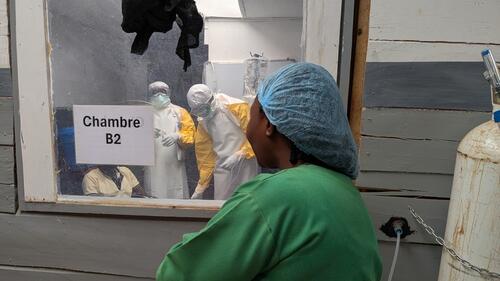
The Ebola disease outbreak in North Kivu province, Democratic Republic of Congo, has intensified dramatically since early September, with the province now accounting for nearly 40 per cent of all newly confirmed cases nationwide. This is up from 24 per cent at the end of August.
With new hotspots emerging every week, treatment capacities remain largely insufficient and inadequate. This situation places current patients and entire communities at even greater risk.
“It is like fighting a megafire,” says Stéphanie Hoffmann, coordinator of the Médecins Sans Frontières (MSF) Ebola treatment centre in Butembo. “Multiple outbreaks are developing at the same time, with varying intensity and in different locations. As long as new hotspots continue to emerge while the virus spreads across northern North Kivu, containing the epidemic will remain extremely difficult.”
As long as new hotspots continue to emerge while the virus spreads across northern North Kivu, containing the epidemic will remain extremely difficult.Stéphanie Hoffmann, coordinator of the MSF Ebola treatment centre in Butembo
“Although Butembo has reported a slight decline in confirmed cases in recent days, neighbouring Beni has seen infections rise,” she says. “This does not mean that case numbers will not rise again in Butembo, or other locations later. The outbreak remains highly unpredictable, with transmission patterns changing from week to week.”
North Kivu is bearing an increasing share of the country's Ebola burden at a time when access to specialised care remains insufficient. As of 28 September, 34 per cent of confirmed Ebola patients were still being treated in non-specialised health facilities because of limited bed capacity in dedicated treatment centres and delays in diagnosis.
Many of these facilities lack the resources and expertise required for Ebola case management, raising the risk of further transmission among patients and healthcare workers.
“For weeks, treatment capacity has stretched to its limit,” says Hoffmann. “Because there are not enough beds available, we are sometimes forced to refer confirmed Ebola patients elsewhere, despite the significant risk this poses to the wider community. In addition, standards of care in some peripheral facilities do not always meet the requirements for Ebola treatment. This is extremely concerning.”
Until recently, Butembo health zone, home to an estimated two million people, had only two Ebola treatment centres. Two additional treatment centres have recently opened, but substantial investments are still needed to ensure adequate quality of care.
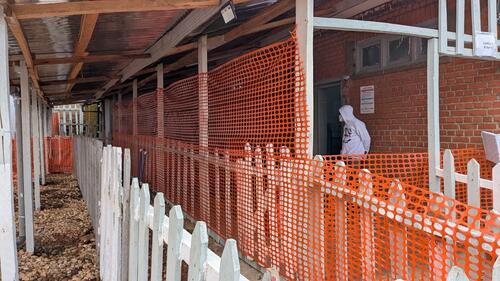
As part of our support to health authorities in the Ebola response, MSF works with three healthcare facilities in the area: the Kitatumba Ebola treatment centre, with a capacity of 29 beds for suspected and confirmed cases; the Catholic University of Graben transit centre, with 16 beds for suspected cases awaiting diagnosis; and the Musienene health zone transit centre, which has five beds, also intended for suspected cases.
Community trust remains essential
“Having transit and treatment centres is essential, but it is only part of the response and is not enough to contain the outbreak,” says Hoffmann. “More than 60 per cent of Ebola-related deaths continue to occur in the community.”
“Building trust between local communities and response teams is just as important as expanding treatment capacity,” she says. “Patients must be willing to seek care early and accept isolation measures. Without that trust, we risk seeing more deaths and further spread of the disease into neighbouring areas.”
To strengthen community engagement, MSF works with community leaders, healthcare providers, and youth organisations to encourage awareness and acceptance of Ebola response measures.
Given the scale of the needs, MSF cannot respond to the crisis alone. We are calling for an urgent mobilisation of all stakeholders to immediately increase treatment capacity and guarantee access to quality healthcare in Butembo and throughout North Kivu province.
DRC Ebola outbreaks
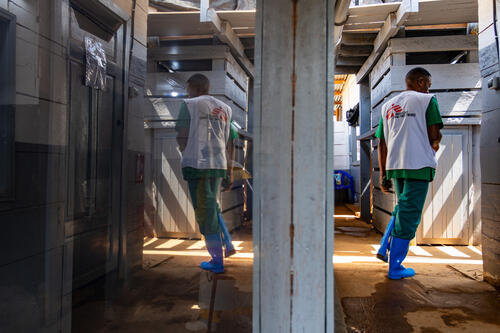
Children are being left behind in the current Ebola disease outbreak response
Press Release
15 Oct 2026
DRC Ebola outbreaks
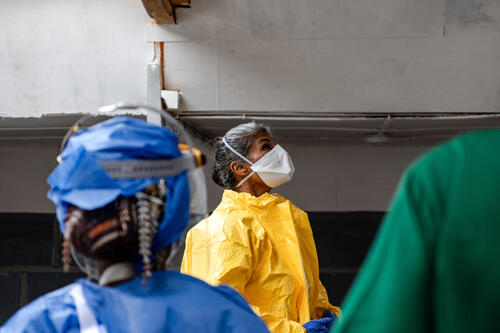
What will it take to end the Ebola disease outbreak in Democratic Republic of Congo?
Project Update
30 Sep 2026
Democratic Republic of Congo
MSF staff member tests positive for Ebola disease and is medically evacuated
Statement
1 Oct 2026