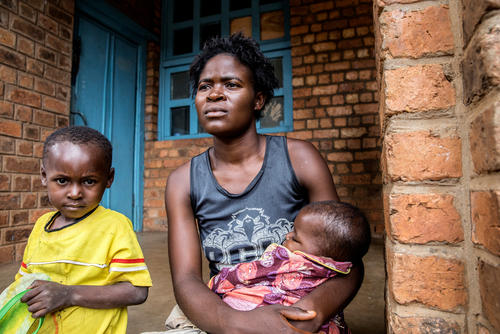
Although the violence that has affected the central Greater Kasai region of the Democratic Republic of Congo for more than a year has abated, the humanitarian needs of local communities and the hundreds of thousands of displaced people are immense. In the city of Tshikapa, the capital of Kasai (one of Greater Kasai's five provinces), MSF is supporting a hospital and three health centres. Staff and patients speak of the harrowing experiences they have endured and the difficulties they now face.
Photos: Marta Soszynska/MSF
Pascal Balananai, 32, nurse
Pascal is in charge of the inpatient department at Mukendi health centre in Tshikapa. He is from Luebo, has lived in Tshikapa for seven years, and has worked at Mukendi since early 2017.
“Some of the parents who come with their children to the outpatient therapeutic feeding centre are from Tshikapa, but the majority of them are people displaced by the violence and come from very different places, like Muyeyi or Ngombe. These people have lost next of kin and their children are malnourished. As there are no camps for displaced people, some of them live in churches and others are staying with relatives or renting homes. Before the conflict, there were malnourished children in Kasai, but then people had resources to cope with the situation. These are people who were hiding in the bush for a very long time. They suffered a lot there. There are people coming from very far away to this feeding programme. Sometimes the parents don’t tell you that the child is already sick with diarrhoea, which aggravates the situation. Our work is very important for the community.”
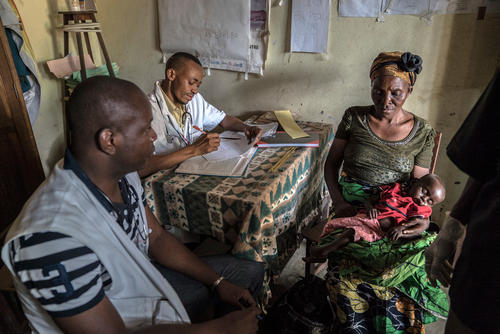
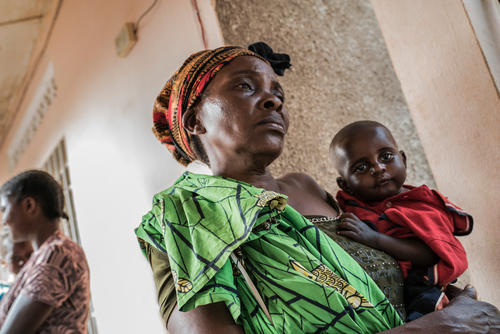
Mashanga, 58, displaced woman
Mashanga brought her 11-month-old grandson, Mulumba, to the outpatient therapeutic feeding centre supported by MSF at Mukendi health centre in Tshikapa.
“We are from Senge village, near Muyeyi town. The village was dedicated mainly to mining. An attack happened there last May. It was at night and a lot of armed men entered the town and then our house. They cut off the heads of this child’s mother and father. I can’t breastfeed him as I am the grandmother. He was just a few months old. The child was found alive afterwards. We hid in the bush for three weeks. It was very difficult. We had to cross fields to arrive here. The only time we experienced this kind of violence was before independence. Now I’m living in the church with 10 other people who are from towns like Kamako or Kamonia. It isn’t easy living there and I have nothing to do during the day. I’m alone with the child. We have other relatives scattered in other places. Before the conflict, the situation was calm. We communicated with people who spoke other languages. There were marriages between people from different communities. It isn’t possible now to go back to our hometown. All of the houses have been destroyed."
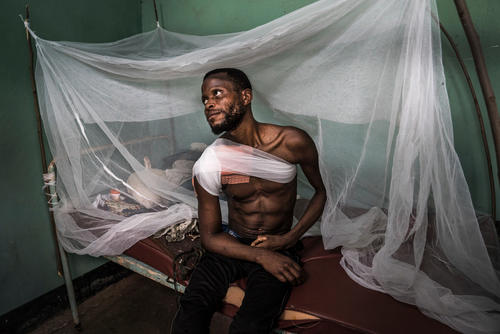
Kabeya Mamba Michel, 30, victim of violence
Kabeya is receiving inpatient treatment at Ditekemena health centre in Tshikapa. He is accompanied by his wife and daughter.
“We left the village of Senge after an attack by militiamen and the army. We were in the forest nearby. After two months living there, the police told us that we could go back to the village, but in the night some soldiers came and shot at us. I came here by walking through the forest for three or four days. We have been exposed to all kinds of problems: mosquitoes and not knowing what to eat… Some children died. I used to search for diamonds. In Senge, we also had farmers and other people doing different kinds of jobs. It isn’t possible for my family to go back there, so we looked for a room in Tshikapa. I know many people – women, men and children – who have been murdered. I can’t even count how many. They were buried in mass graves of 30 or 40 people together, just in front of the houses. My own house was burnt down. I wish we could return to peace. I have never seen anything like this in Kasai before. Before the conflict, people got along together. There are lots of needs and there are still people in hiding. If aid workers don’t come here, it will be a death sentence for us.”
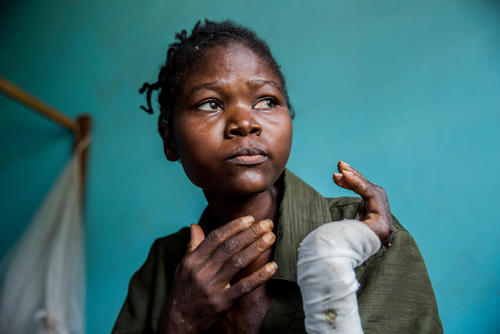
Ntumba Kasomba, 31, victim of violence
Ntumba is from Senge village, near Kamonia. She is receiving inpatient care at Ditekemena health centre in Tshikapa. Her left arm has an old injury and may need to be amputated. When her village was attacked, five of her children were killed, but her two-year-old and nine-month-old baby survived.
“A group of militiamen entered the village. We took refuge with our family in the house. When we left, they attacked us with machetes. One young child received a lot of cuts and another one died. Afterwards I hid. I can’t go back to my village because all the houses have been burnt and I don’t know what I would do there. My stepmother and my aunt are still alive. Five of my children died. My husband was shot. Almost everybody has died in the village. Only 50 to 100 people survived. They [the militiamen] wanted to expel everyone from the area who is not like them. All I wish for is for peace and to be able to take care of my children who are still alive. My husband used to search for diamonds and I used to sell flour. When I’ve recovered I will return to commercial activities.”
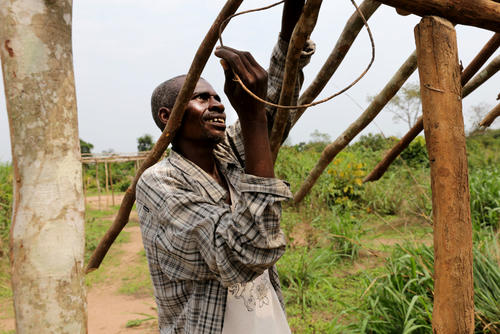
Kanku Joseph, 54, returnee
Kanku lives in Masanga Anaï, a village that was attacked by the armed militias.
“I have been back in the village for five months already. While I was in the forest, it was a problem as my children got very sick. My house was destroyed. I am living temporarily in the school while I rebuild my house. I’ve been building for the past week, and it will take up to two months to complete because we have no proper tools for this work. I lost my brother and four nephews to the violence. My grandson is also dead. I have lost many goods as well. My main concern at the moment is to have a home again. I am hopeful that everything will change for the better.”
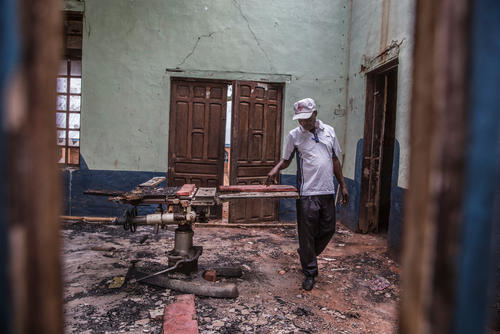
Jean-Paul Buana, 50, nurse
Jean-Paul manages the health centre in Mayi Munene, a town in the rural area of Kasai province. He is originally from Kananga city, but has lived in Mayi Munene for the past 10 years.
“In the month of March, militiamen arrived and began to kill policemen and soldiers. The policemen fled. Teachers, pastors, nurses were the next ones [to be killed]. They burned the house of the administrator, they burned the school... The most serious attacks happened in April. They looted all the medicines from the health centre and then burned the building. The operating theatre, the cold store for the vaccines, the pharmacy, the consultation rooms, the reception rooms were all destroyed. I cried when I went into the building and saw all the destruction. It is not right to do this. The militiamen occupied the town for about two months. They beheaded some people and then the army killed them.We used to have 150 patients a month here, and this was the referral health centre for around 128,000 people in the area. We used to perform caesareans, renal surgery, laparotomies, etcetera, but from March to July all medical activities stopped. We returned only in July once the army was here again. At the moment there are 12 staff, but in reality just six are working. The level of consultations is lower than before the conflict. Many people have still not come back. We are still missing drugs and other supplies. We now carry out healing activities, but vaccinations are not possible. Every Friday there is an outpatient feeding clinic, with about 50 children enrolled.The most important needs are food and schooling. Seeds and tools have been lost. Most people in this area used to make their living by searching for diamonds. It is very difficult to start over again, and we need more humanitarian aid. The world has forgotten Kasai.”
Kanku, 21, displaced woman
Kanku currently lives in Mayi Munene town with her two children: Dani and Ale, aged five and two. She has brought two-year-old Ale to the outpatient therapeutic feeding centre supported by MSF.
“We are from Kamako [close to the border with Angola]. My husband, a diamond seeker, was murdered there. After the violence started up, we decided to stay in the woods. At one point I was separated from my husband. Each of us was carrying one child, but my husband was shot down. I stayed for a month in the bush near Kamako. Then I moved to the town of Kamonia, where I stayed for another month, and then I spent three months living in a church in Tshikapa. In Tshikapa I heard that my older sister was looking for me. I came to Mayi Munene because she lives here.The worst thing I've experienced is the danger posed by the armed militiamen. During my journey, I saw a lot of people die. I saw corpses, probably more than 100 of them. Sometimes I felt very emotional, at other times I trembled with fear. It is very difficult today to survive with children and without food. We have barely received any aid. I don’t think it is possible to return to Kamako. I have lost everything I owned there.”