


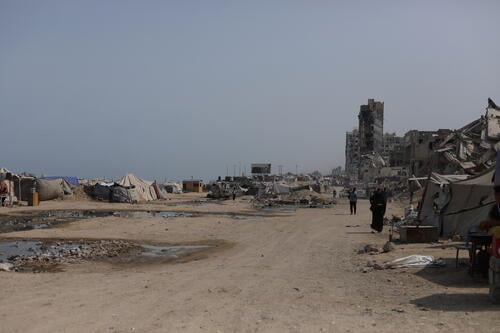
The announcement of the first phase of the ceasefire in Gaza, Palestine, brings a welcome moment of relief for exhausted, starved, and grieving Palestinians, and a great relief to the families of all Israeli hostages — but it comes after more than two years and over 67,000 lives lost across the Strip.
While we welcome the ceasefire, it does not mark the end of this horrendous suffering — people in Gaza are left to survive amid the ruins of what were once their homes, facing immense medical, psychological, and material needs.
“The feeling of our colleagues and the people around us is one of hope, a lot of hope, wishing that this nightmare will finally stop and they will be able to be at peace, be able to recover from their trauma, both physical and mental,” says Jacob Granger, MSF emergency coordinator in Gaza. “But there's also a lot of uncertainty of what is going to happen, what are the next steps.”
The ceasefire must be respected and sustained because it's the only way for care to be provided at the scale people desperately need — something that was impossible under siege and bombardment. In the long term, we hope to see this ceasefire leading to efforts to rebuild the Strip, including restoring the shattered healthcare system.
The most basic necessities are still urgently needed in Gaza: medical equipment, medicines, food, water, fuel, and adequate shelter for two million people who will face the approaching winter without a roof over their heads.
This ceasefire must be accompanied by an immediate massive and sustained scale-up of aid into and across the Strip, including the north. We urge the Israeli authorities to allow a sufficient and unimpeded flow of humanitarian assistance and to authorise medical evacuations for patients in need of urgent specialist care. At the same time, the UN-led humanitarian coordination mechanism must be reinstated to guarantee safe and impartial access to aid for people in need, wherever they are in the Gaza Strip.
Gaza-Israel war
"This is not a ceasefire": Life in Gaza continues to be suffocated six months on
Press Release
10 Apr 2026
Gaza-Israel war
Gaza: Israeli entry restrictions cause critical shortage of medical supplies
Project Update
3 Apr 2026
Gaza-Israel war
MSF reaffirms decision to challenge Israel’s ban on 37 NGOs from operating in Palestine
Statement
30 Mar 2026