


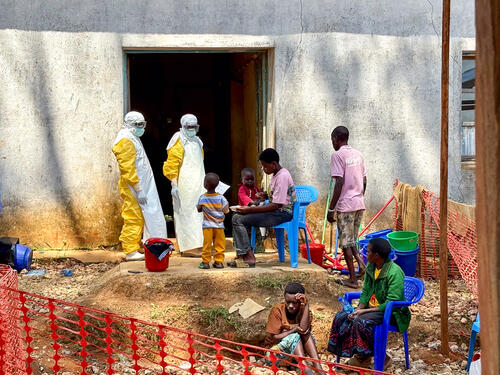
- The Ebola disease outbreak in Democratic Republic of Congo has not been contained, and the number of new cases has not fallen on a national level.
- While the spread is slowing down in Ituri province, the outbreak is moving into new, underprepared areas.
- Strengthening the Ebola response is urgently needed, particularly beyond the areas where response capacities are concentrating.
Bunia, Democratic Republic of the Congo – The race to contain the Ebola disease outbreak in Democratic Republic of Congo (DRC) is far from over, warns Médecins Sans Frontières (MSF). While some indicators, such as declining patient admissions and slower transmission, may suggest the outbreak is easing, MSF teams are observing a worrying trend: cases are emerging and spreading into new, underprepared areas while basic response measures are still not in place in the original hotspots, making containment efforts increasingly challenging.
“Assuming the outbreak is under control because some Ebola treatment centres are admitting fewer patients would be a mistake,” says Anthony Kergosien, MSF emergency coordinator in DRC. “In Ituri [province], the original epicentre, the spread is indeed slowing down for now. But nationally, the number of new cases has not fallen.”
“The outbreak is not shrinking, it is moving: South Ubangi has become the seventh affected province, while North Kivu now accounts for nearly half of all newly confirmed cases, with test positivity rising sharply in recent days,” says Kergosien. “While undetected chains of transmission are already taking hold in the main operational hubs, the spread of the outbreak into new areas with even weaker preparedness and response capacities poses a serious risk.”
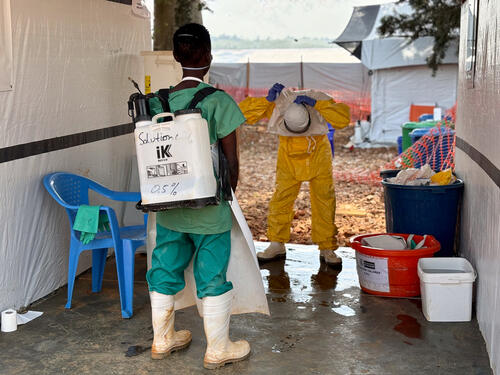
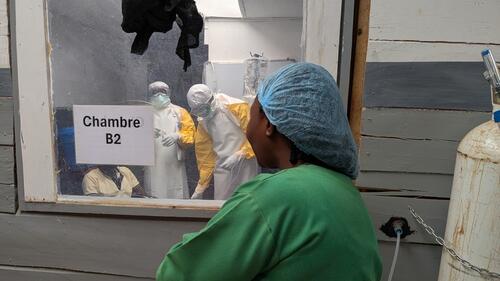
DRC is currently facing the largest Ebola disease outbreak ever recorded in the country. Since May, more than 7,200 confirmed cases and 3,500 deaths have been reported, with the true toll likely higher due to gaps in surveillance and case detection. To make sure our response is the most effective, MSF is sending staff and resources towards rapid-response teams. These teams support early case detection, patient observation and treatment, infection prevention and control measures, contact tracing, surveillance, and community engagement.
“This strategy is about detecting and trying to contain new clusters early, before they grow into large outbreaks,” explains Kergosien. “In health zones, such as Bambu, where we currently have a rapid response team deployed, health systems are already stretched thin by chronic funding gaps, staffing shortages, and weak referral capacities. Ebola pushes these fragile structures past their limits. Our teams provide a frontline response to bridge the most urgent gaps while the wider response scales up.”
However, MSF teams alone cannot address the expanding edges of this outbreak. Sustaining this approach requires a significant increase in operational support from UN agencies, including the World Health Organization (WHO). A more responsive and comprehensive engagement that strengthens all pillars of the Ebola response is urgently needed, particularly in areas beyond the main hubs where response capacities are concentrating.
Such support would enable MSF teams to focus on rapidly responding to newly emerging clusters, while ensuring affected communities receive the full range of services required to contain the outbreak.
DRC Ebola outbreaks
Ebola disease outbreak spreads like a megafire in North Kivu as new hotspots multiply
Project Update
5 Oct 2026
Democratic Republic of Congo
MSF staff member tests positive for Ebola disease and is medically evacuated
Statement
1 Oct 2026
DRC Ebola outbreaks
What will it take to end the Ebola disease outbreak in Democratic Republic of Congo?
Project Update
30 Sep 2026