Asia & Pacific

Ebola disease in DRC: find out how we're responding
Learn more
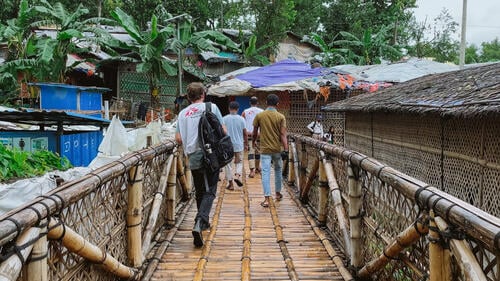
MSF staff walking through the Bangladesh refugee camps.

Bangladesh

Learn about MSF projects in Bangladesh, where a million Rohingya people are living after fleeing targeted violence in Myanmar.
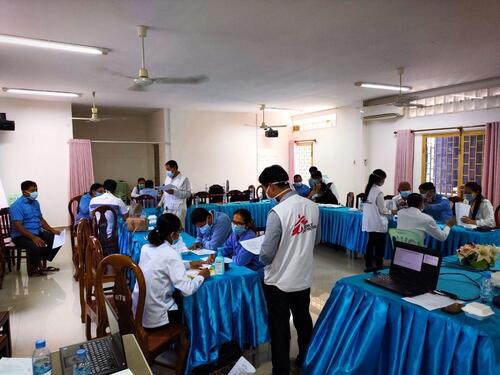
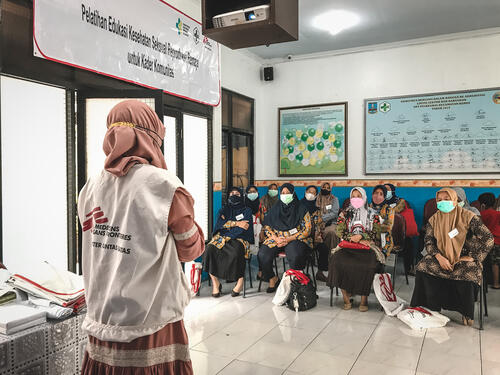
Nurses of the Ministry of Health receive training in Sangker operational district, ahead of the relaunch of the hepatitis C nursing activity pilot, where nurses will lead the care of hepatitis C patients.
In addition to skills related to hepatitis C, new measures around infection prevention control regarding COVID-19 are taught.

Until the end of June 2020, just 141 cases were confirmed in Cambodia, and a quarter of them originates from a European tourist group in March. The authorities were quick to implement thorough contact tracing and asked our teams to help with this. We’ve also contributed to the new IPC and clinical guidelines for Cambodia and developed training units. Subsequently, about 300 staff members of hospitals run by the Ministry of health received training. Given the difficulty of importing medical equipment, the team is now trying innovative approaches to develop oxygen ventilation systems by using commercially available diving masks and 3D-printing the necessary connectors in the country in anticipation of an outbreak of COVID-19 in Cambodia.

Cambodia

We handed over our projects in Cambodia in 2021.
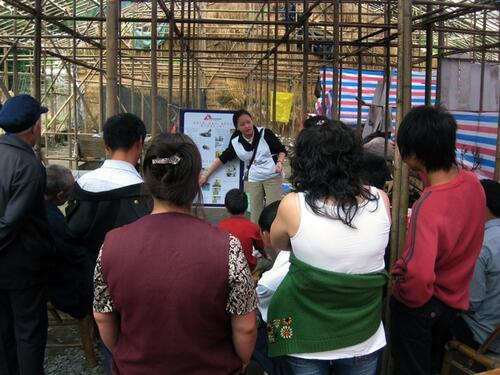
An MSF national staff is giving psychoeducation. An MSF mental health team is conducting community outreach activities: going from camp to camp in Longmenshan, Pengzhou, Sichuan province to provide psychoeducation to the villagers on topics such as (i) safety precautions before, during, and after an earthquake; (ii) psychological reactions following an earthquake and self-help techniques for managing these reactions/symptoms. Poster boards with relevant information are custom-made for distribution in camps and villages. Additionally, a psychologist is posted in a fixed clinic in front of a government and hospital and a basic medical treatment base. Another two psychologists form a mobile unit to visit IDP camps in the area to screen people for psychological difficulties and to offer on-site psychological support.

China

MSF first worked in China in 1989 and closed its projects in 2014.
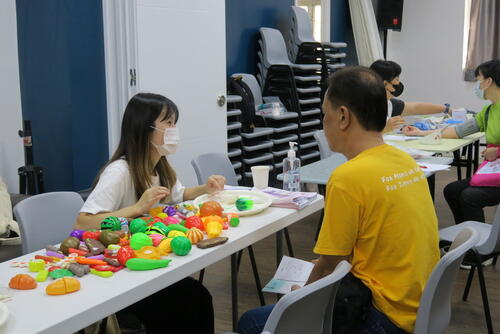
As a global financial hub, Hong Kong projects an image of prosperity and resource abundance. In its shadows however, consistently marginalised groups fall outside of the well-developed healthcare system’s reach. Doctors Without Borders/Médecins Sans Frontières (MSF) has provided free primary healthcare to the homeless communities in Hong Kong’s Yau Tsim Mong and Shum Shui Po districts, the majority of whom are aged 50 or above, since August 2023. People experiencing homelessness in Hong Kong do not receive adequate medical care most often due to their lack of health literacy and inability to prioritise their own health and well-being. 
 
Responding to these unmet needs, MSF initiated a model of social-medical partnerships with local NGOs to deliver holistic patient-centred care, which MSF teams provided by offering regular basic health screenings, health promotion sessions and psychosocial support for people experiencing homelessness, while collaboration partners offered ongoing case follow-up. These local partners also received support in capacity-building to ensure continuity of care for people in the programme as MSF’s project came to an end in December 2024.

Hong Kong

MSF most recently worked in Hong Kong to support people experiencing homelessness.
An MSF staff member converses with Anam (name changed), a 17-year-old DRTB (Drug Resistant Tuberculosis) patient and her mother outside the MSF DRTB Clinic, Chembur, Mumbai.


Anam (name changed on request), a bright 17-year-old, excels not only at English and Science in school but is an equally good Mehndi/henna artist. She tells us happily that she has completed a professional Mehndi course and learnt needlework. She aspires to become a fashion designer. 
She scrolls through her phone gallery, bringing up photos of the bridal henna designs that she has created. As her hand moves over the screen, there is a contrast between those delicate designs and the pattern on her own hand from the PICC Line (Peripherally Inserted Central Catheter).
Anam was first diagnosed with pulmonary TB at the age of nine. Before her diagnosis, she frequently had a cough and a fever. When her mother initially took her to a doctor, she was suspected of having double typhoid. 
Being diagnosed with TB at such a young age came as a blow to Anam’s family, who had no history of the disease.  Her mother later got to know that Anam studied with around eight to ten TB positive patients in school. The stigma around the disease is so strong that other children or their families never informed the school authorities. The parents feared that their children would be expelled, bullied, harassed or discriminated against. Anam’s mother decided that it was important to break this lethal chain. She informed the Principal and did not send Anam to school for the next five months. 
For 14 months, Anam received treatment at a private hospital with support from her immediate family and friends. However, the treatment did not work and her symptoms such as weight loss and vomiting worsened. The treatment at the private hospital cost her family around Rs 5,500 monthly (Rs 2,500 for medicines and Rs 3,000 for tests). In February 2021 she was finally diagnosed with drug-resistant tuberculosis (DR-TB) at a government DR-TB centre.  She was put on a DR-TB regimen, however subsequent investigations revealed additional resistance to other drugs as well. She suffered from cough, fever and weight loss. Since her condition was not improving with the treatment received so far, she ultimately came to MSF.  
At the MSF Clinic, Anam was put on a regimen of the oral drugs bedaquiline, delamanid, linezolid and amoxicillin, and an intravenous treatment with the injection imipenem. This regimen was built for her based on her resistance to certain drugs and she has been taking it for the last one and a half years.  
Anam’s mother says, “We have been through a very rough patch, but we found help every step of the way. The psychosocial support in terms of counselling, and the medical support that we received at the MSF clinic reduced our financial and medical treatment worries.”
Despite constant encouragement and support, every day Anam is also witness to another TB story unfolding outside her bedroom window. The impact of stigma and lack of awareness about TB is having serious consequences for a girl not much older than Anam in the neighbouring house. Anam recalls distraught conversations with her ‘window friend’: how she has been locked inside her room because of the disease; how her parents have abandoned her; and the irregularity of her meals. Anam’s mother says that their neighbours don’t allow other community members to help them. Bereft of medical and psychosocial support, her ‘window friend’ developed suicidal tendencies that resulted in one failed attempt to jump off the roof.  
Anam realises that her friend’s parents may have prevented the suicide attempt, yet they contributed nothing to alleviating the everyday suffering. No proper treatment is sought, she says. Anam’s mother tried to counsel the girl’s parents but they are reluctant to listen to anyone.
The story of Anam and her ‘window friend’ highlights the importance of medical treatment and psychosocial support in TB treatment, and the importance of raising awareness around the disease and fighting stigma.  And for Anam, even a small dream like hanging out with friends on a vacation post-recovery, keeps her going.

India

In India, we focus mainly on mental healthcare, screening and treatment for HIV, tuberculosis (TB) and hepatitis C, and support to victims of sexual and gender-based violence.
The MSF Indonesia adolescent health project focused on improving the quality of, and access for adolescents to, targeted health services, including health promotion and education sessions. Capacity building was one of the activities in this project, and health workers were trained on the topic of adolescent sexual reproductive health.

Indonesia

Learn about MSF projects in Indonesia, where we work on emergency preparedness.
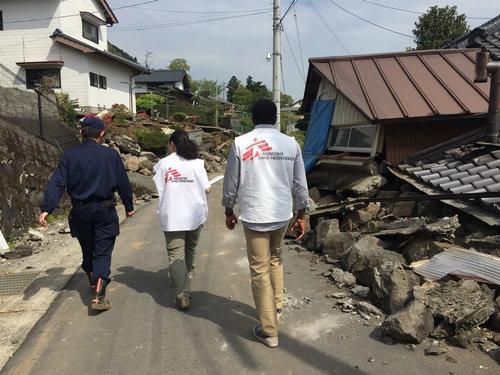
The MSF team is conducting an exploratory research in Tateno, Minami-aso village, Kumamoto prefecture.

Japan

MSF has responded to natural disasters in Japan in 2011 and 2016, and the COVID-19 pandemic in 2020.
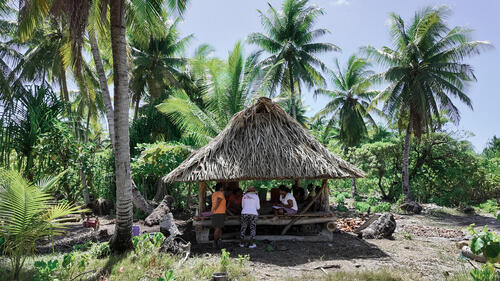
MSF midwife Esther Karume works with local community
members in Abaiang to test women of child-bearing age for high blood pressure in Abaiang. Non-communicable diseases such as diabetes and hypertension are common.

Kiribati

Learn more about MSF activities in Kiribati.
District de Champassak. Dans cette region, MSF mene des projets d’assistance technique pour relancer les services de sante et garantir un acces aux soins pour les minorites et les personnes demunies. Le programme a ete transmis aux autorites laotiennes en 1999.

Laos

MSF first worked in Laos in 1989 and closed its projects in 2007.
Patients, most of whom are from the Rohingya community, queue up for triaging at the MSF clinic in Butterworth, Penang.

Malaysia

Our teams provide healthcare support to the Rohingya and other communities through our clinic in Butterworth (Klinik Mewah 6), our mobile clinics in Penang, and our activities in detention centres.

Mongolia: National staff in car..
In 2001 MSF supported some 30,000 people after a quarter of their livestock died due to the 'dzud', exceptionally cold and dry winter weather.  More details in supplementary caption.

Mongolia

MSF closed its projects in Mongolia in 2010.