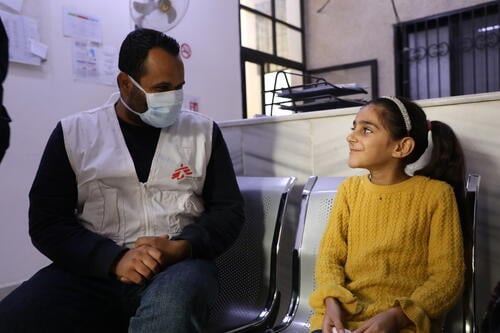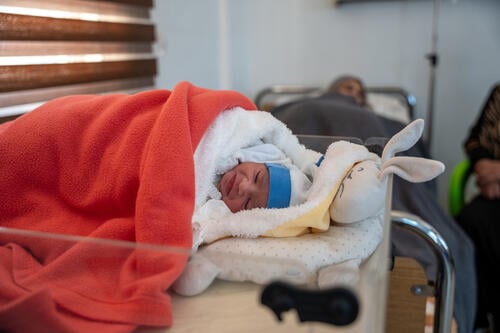
Twelve months after the fall of Bashar Al-Asad’s government, people and communities in southern Syria now have more options to access healthcare, as teams from Médecins Sans Frontières (MSF) are working in this part of the country for the first time in almost 12 years. MSF staff are witnessing significant health needs in Dara’a governorate, where years of conflict have caused extensive destruction to the infrastructure and severely affected the provision of healthcare to the communities. Today, MSF is providing free mother-and-child medical care at Nawa National Hospital to help support these pressing needs.
The conflict, and its substantial impact on the healthcare system – including shortages of essential medical supplies and an understaffed workforce – left thousands of people without access to healthcare services. Facilities were only partially functional; some activities stopped completely, including those at Nawa National Hospital.
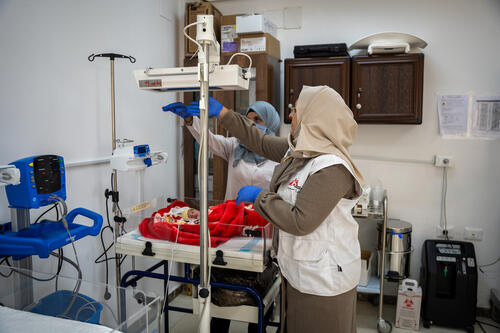
“Years of prolonged crisis have severely affected the hospital’s capacity to provide care, making it harder for people who need immediate medical attention, especially mother-and-child healthcare,” says Ulrich Crepin, MSF head of mission in Syria.
“Our activities are helping to support a population of 1.2 million people, as the hospital serves as a lifeline for multiple communities in Dara’a governorate,” says Crepin.
We are working in collaboration with the Directorate of Health (DoH) Syria to deliver essential mother-and-child healthcare, strengthen infection prevention and control measures, promote health awareness, and offer mental health support to patients. Since July, MSF has assisted the safe delivery of 1,203 newborns, to reduce maternal and neonatal illness and deaths in Dara’a governorate.
Years of prolonged crisis have severely affected the hospital’s capacity to provide care, making it harder for people who need immediate medical attention, especially mother-and-child healthcare.Ulrich Crepin, MSF head of mission in Syria
MSF teams are also training local DoH staff to improve the quality of care, including training for mass casualty events in five different health facilities in Izra, Nawa, Al-Hirak, Busra Al-Sham, and Al-Sanamayn in Dara’a governorate. Our teams have also trained DoH staff on infection prevention and control measures, blood bank and cold chain management, and other technical skills. We have also donated cold chain equipment, including refrigerators and freezers to support a fully functional blood bank at Nawa National Hospital.
Support to people displaced from Sweida
Starting in July this year, violence erupted in neighbouring Sweida governorate, displacing thousands of people who had to flee their homes, leaving clothes and basic needs behind. Their displacement has been prolonged for months now, leaving them unable to return.
During the conflict that broke out in Sweida, our teams donated mass casualty incident kits to frontline hospitals, including four kits for Nawa National Hospital. The violence forced many families to flee and seek safety in Dara’a.
“As people’s needs grew, so did our response,” says Regidor Esguerra, MSF medical coordinator in Syria.
“We prepared our mobile clinics to provide essential care to affected people and are providing medical consultations, mental health support, health promotion and donations of relief and winter kits,” he says.
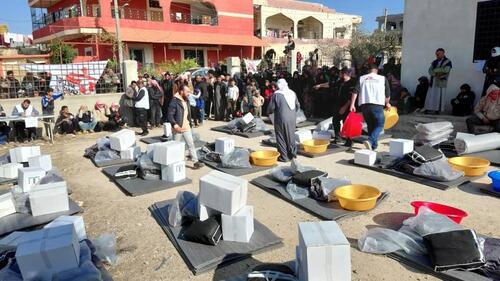
According to Ministry of Emergency and Disaster Management Syria, more than 27,000 people were displaced into Daraa governorate during the Sweida conflict. Between 24 November and 14 December, MSF teams have provided 327 medical consultations, 81 individual and group mental health sessions, and 113 health promotion sessions for displaced families. We have also donated 1,145 relief and winter kits, including hygiene products, kitchen essentials, mattresses, blankets, and winter clothes, as winter is approaching and many families lack basic necessities for survival.
The situation in Dara’a remains critical after years of conflict; the water and sanitation needs are high, requiring the urgent attention of organisations and humanitarian groups. MSF continues to provide essential services—from mother-and-child care to mental health support—ensuring that people and communities have access to the care they need.
Syria
Syria: MSF concludes three years of support to Darat Izza healthcare centre
Project Update
6 May 2026
Syria
After years of detention former Al Hol residents face uncertain future
Press Release
27 Feb 2026