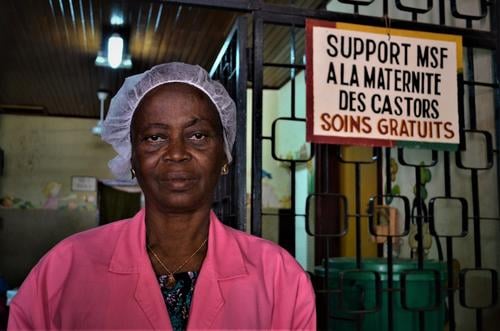
Ms Marie-Josée Yakité, MSF midwife at the Castors HRUB since 2014

"I’ve been working here with MSF at Castors since 2014. For 20 years, I worked at Castors before the arrival of MSF, and also at the Hôpital de l’Amitié – a big hospital in Bangui, the capital of the Central African Republic.
We often look after patients who can’t get treatment elsewhere because they don’t have the money. People know that here we offer quality care to everyone, free of charge. In health centres that are not managed by international organisations like MSF, you have to pay for everything. If a patient can’t pay, they send them here. I remember one lady who was referred to us from one of the main hospitals in Bangui. This woman had already been monitored for pre-eclampsia. When the medical staff realised that there was foetal distress, they referred her to us. Not because the hospital couldn’t treat this kind of complication – it was just a matter of money.
In the health centres where patients have to pay for their care, when women arrive in labour, the staff make an assessment of all the tests and the procedures that need to be performed, and an estimate of how much it will cost. And then they make them pay. And if they realise that the woman doesn’t have the money, and that she needs treatment she can’t afford, they prefer to refer her here at Castors because we don’t ask for any money for our services.
We also have women who show up here ready to give birth, but who, for lack of money, have not had any prenatal examinations or tests, for syphilis, toxoplasmosis or HIV for example. We see this very often, especially women who are HIV-positive. These women come to us in labour, without having had a prenatal HIV test. And in theory this test should be free, as it is covered by the Global Fund. Yet sometimes they force women to pay for a whole raft of prenatal tests and they refuse to do the HIV test if the women don’t do the other tests, for which they have to pay. They ask them to pay for the medical supplies, the gloves, the health card, everything.
Because of these financial questions, some people refuse to go to hospital. They prefer to stay at home and rely on traditional medicine. Not long ago, we treated a young woman of 19 who had taken traditional oxytocics. She wanted to give birth at home, she didn’t want to go to a health centre because she didn’t have the money to pay. But the dose of the medicine she took was too high – she ruptured her uterus and her baby died. When the family saw she had suffered a haemorrhagic shock, she was taken to the health centre near her home, which then referred her here to Castors. By the time she came here, three days had already passed. Luckily we managed to save her, but we had to carry out a hysterectomy. She already has a healthy child, but sadly for her, she can’t have any more.
It’s the referrals from other health centres that are the most complicated. Very often, these women come to us in a very serious condition. Sometimes they bring us a woman on the back of a motorbike, and she dies before making it to the door. I suspect that sometimes the health centres keep patients longer than they should in the hope that they might still squeeze something out of them. I tell all the women to come here to Castors as soon as they feel their first labour pains. Here we have qualified staff who can guarantee high-quality care to all patients, irrespective of who they are and where they come from."
Ms Marie-Josée Yakité, MSF midwife at the Castors Hospital, posing next to the sign that reads: "MSF Supported Maternity in Castors. Care is Free". Central African Republic, November 2017
© Sandra Smiley/MSF

8 ways user fees for health are harmful to people

Ms Marie-Josée Yakité, MSF midwife at the Castors Hospital, posing next to the sign that reads: "MSF Supported Maternity in Castors. Care is Free". Central African Republic, November 2017
© Sandra Smiley/MSF
Ebola disease in DRC: find out how we're responding
Learn more

1.People die or get sicker 

Ms Marie-Josée Yakité, MSF midwife at the Castors HRUB since 2014
When people simply don’t have the means to pay either formal or informal healthcare fees, they are de facto excluded or delayed from receiving care and aren’t treated in time. This can lead to death or complication from treatable diseases such as malaria and can happen even when seemingly small amounts are requested.

Reality check

In the Democratic Republic of Congo, a 2017 MSF population survey in the health zone of Bili, northern Ubangi showed that in a quarter of cases of illness preceding death, no care was sought. Of these, 27 per cent were attributed to a lack of money.

2.People receive sub-standard or incomplete treatments

When drugs and treatment are unaffordable, people may get less effective treatments or not the full package of care they need. 

Reality check

At a health centre in Malawi, some mothers receive only half of the pills needed to treat their children for malaria as they are unable to pay the full amount (equivalent to 9 USD), thereby putting the children’s lives at risk.

3.Prevention of diseases is reduced

When people are asked to pay for prevention services such as vaccination or screening tests, they are more likely to opt out, putting themselves or others in danger, especially if they carry communicable diseases.

Reality check

In Central African Republic, a pregnant woman is asked to pay the equivalent of 2.7 US dollar for an HIV test but she can’t afford it.

4.Treatment for disease requiring care over an extended period of time becomes more complex and, ultimately, more expensive

Patients who need (life) long, uninterrupted, or repeated treatment and key priority health services, such as treatment for HIV, tuberculosis (TB), malaria, and maternal and child care dropping out of care because of the recurrent costs.

Reality check

Close to one in four HIV patients hospitalised in the MSF-supported hospital wards in Kinshasa die because the illness is too advanced by the time patients seek care. Over half of these patients were previously on treatment but interrupted it, with a lack of money as one of the main reasons.

5.People become poorer

There are countless examples of people having to borrow money or sell belongings in order to pay for healthcare, impoverishing their entire family.

Reality check

In a study undertaken by MSF in five districts in Afghanistan, 44 per cent of people who sought care had to borrow money or sell some belongings to get treated.

6.Patients are kept imprisoned in health facilities until they pay

As absurd as this may sound, there are countless examples of people who are kept captive in health facilities until they have paid the fees they owe.

In a rural area of DRC, a mother and her baby are not allowed to leave the hospital until they pay 38 USD for an emergency caesarean that saved their lives.

7.Epidemics go unnoticed or underreported, delaying response

When people decide not to seek care or to delay their visit to health centres, it increases the risk of expansion and continued disease transmission in communities.

Reality check

During the recent Ebola outbreak in Likati, DRC (August 2017), the introduction of free healthcare by health authorities led to an increase in outpatient consultations and hospital admissions, which in turn enabled better detection of suspected cases.

8.It’s more difficult for vulnerable groups to access health services

Vulnerable groups such as the elderly, the poor, refugees and women and children will usually be most affected by user fees as they have less access to services, less means or less rights.

Reality check

A refugee in Jordan stopped treatment for her non-communicable disease because she can’t afford the fees (23 US dollar per consultation).