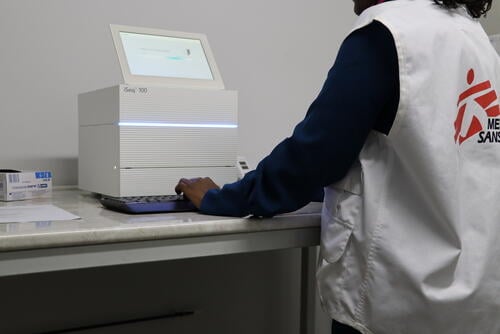
Next-generation sequencing (NGS) machine in the MSF managed laboratory in Nukus. NGS is a new technique which allows to analyse every gene in TB bacteria DNA. This technique provides information on mutations of resistance to TB drugs.  

MSF renovated and equipped a mycobacteriological laboratory biosafety level 3 in Nukus and introduced advanced rapid TB diagnostics technologies. The laboratory has the capacity for conducting culture tests, drug sensitivity tests and sputum smear quality control. The laboratory carries out the second-line drug sensitivity tests (DST). Introduction of NGS is also planned for Nukus laboratory.
MSF renovated and equipped a mycobacteriological laboratory biosafety level 3 in Nukus and introduced advanced rapid tuberculosis diagnostics technologies. The laboratory has the capacity for conducting culture tests, drug sensitivity tests and sputum smear quality control. Uzbekistan, April 2023.
© Victoria Gendina/MSF
Ebola disease in DRC: find out how we're responding
Learn more
In Karakalpakstan, western Uzbekistan, we focus on the implementation of a comprehensive care programme for drug-resistant and drug-sensitive tuberculosis (TB).

With the comprehensive care programme, we support the Ministry of Health (MoH) in its rollout of protocols reflecting global best practices, as well as introduce healthcare innovations, and promote shorter course TB treatment regimens using new and repurposed drugs. 

We have also implemented the TB PRACTECAL clinical trial. This is the first-ever multi-country, randomised, controlled clinical trial, aiming to demonstrate the safety and efficacy of a six-month, all oral treatment regimen for drug-resistant TB. We are now working with the World Health Organization to promote the new regimen as the international standard of care for drug-resistant TB patients.

In the capital, Tashkent, we provide support for the diagnosis and treatment of people living with HIV and co-infections. In 2021, we also launched a mobile laboratory to support the diagnosis of HIV and co-infections among vulnerable people. 

Our teams also support the MoH in its efforts to develop the public healthcare system.

Our activities in 2024 in Uzbekistan

Data and information from the International Activity Report 2024.

MSF in Uzbekistan in 2024 In Uzbekistan, Médecins Sans Frontières (MSF) supports the Ministry of Health to improve diagnosis and treatment for people with HIV and tuberculosis (TB).
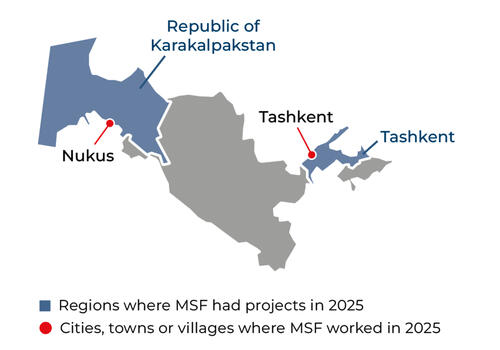
Country map for the IAR 2024.
© MSF

In the capital, Tashkent, and the surrounding region, we continued our collaboration with the Republican AIDS centre, providing testing for HIV, hepatitis C, and sexually transmitted diseases, as well as information on treatment opportunities and specialist referrals. Through targeted outreach activities, our teams engage with people from high-risk groups who would otherwise have difficulty accessing diagnosis, and medical and preventive care. We also support the diagnosis and treatment of people living with HIV and co-infections at Tashkent AIDS centre.

In Karakalpakstan, in the west of the country, MSF runs a comprehensive care programme for patients with drug-resistant forms of TB.  We ensure that all eligible patients with multidrug-resistant TB (MDR-TB) in Karakalpakstan receive treatment using the latest, all-oral, six-month regimen. In the second half of the year, we expanded our MDR-TB support to the neighbouring Khorezm region.  

In 2024, we also provided direct technical assistance on the treatment of patients with severe forms of extensively drug-resistant TB in Nukus TB hospital.


in 2024

Uzbekistan

Language
English