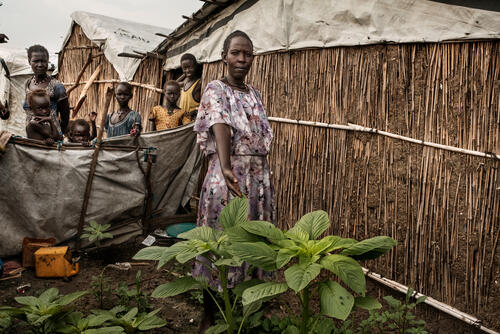
Name changed for their safety: Akech (wife) and Kuany (husband)

Akech (33) tries to cultivate a small garden with some veggies like eggplants and greens on the polluted soil of the PoC Camp in Bentiu. 

Akech and her husband  Kuany, parents of 9 children, came with the first waves of refugees on 27-12-2013 to the PoC Camp in Bentiu. They had a bright and wonderful life in the city of Bentiu. 

But with the beginning of the clashes between the official SPLA soldiers and the troops in opposition (SPLA/IO) the killing started. 

„Bodies over bodies were to be seen on the streets and we started to run with all our kids to the Camp Site“, says Kuany thoughtfully. „I lost during all this fightings and burnings all my documents, incl my University tittle prooving that I am received, teacher. We lost our identities, nothing is left. We had a great life, 35 cows, a garden with veggies and flowers. I can still remember their smell. Now we are here, under most awful and miserable conditions, and limited food access.“

Besides the terrifying wood collecting for some extra money of his wife due to the many sexual outbreaks of violence outside the camps, the food was not enough. One day in 2014, Kuany decided to go with friends to Nyabol, a place rich in fishes.  

"We didn't even have the chances to install us when official troops (SPLA) started to shoot. We jumped into the water and hid in the swampy bushes. I remember the voice calling us. Are you shot? I recognized the voice, the voice of one of my former students. I went out of the water and he questioned me what I was doing here. My explanation of the hunger and the need to feed my wife and kids were good enough. He and his others SPLA mates were visibly surprised and all of my friends were allowed to come out and to leave alive the area. Over hours I was shaking, the shock was deep inside my body and soul."

Kuany went for Christmas 2015 to the city of Bentiu to check on his property. Nothing was left, no roof, no
© Peter Bauza

Enduring Bentiu

© Peter Bauza
Ebola disease in DRC: find out how we're responding
Learn more

When it first began, the conflict in South Sudan quickly spread along ethnic lines. By early 2018 with no end to war in sight, as many as 2.4 million people had decided to leave the country entirely, making South Sudan the largest refugee crisis in all of Africa, and the third largest worldwide behind only Syria and Afghanistan.

In addition to those who fled to neighbouring counties, another two million have been internally displaced within the country. Over 200,000 live in one of six Protection of Civilians (PoC) sites established by the United Nations Mission in South Sudan. 

Surrounded by trenches and large mounds of earth topped with barbed wire fences and UN watchtowers, the Bentiu PoC appears from above as an incongruent square box framed by a sea of nature that toggles between hues of vibrant green in the rainy season and dusty brown in the dry season.

Video

Enduring Bentiu - video
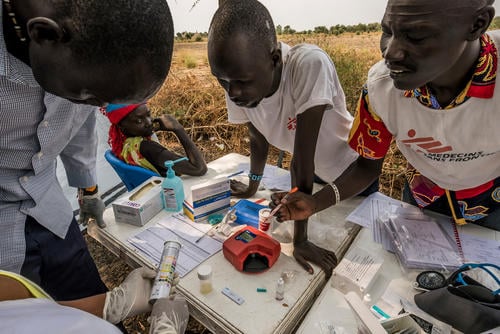
With the South Sudan civil war now in its fourth year, thousands of people who fled from ethnic violence continue to seek shelter at one of six Protection of Civilians (PoC) sites established by the United Nations Mission in South Sudan. The largest of these is Bentiu, which serves as a place of refuge for nearly 115,000 people, in poor living conditions. It is within this context that MSF provides the only secondary healthcare and surgical services available both within the PoC and surrounding areas. Watch this video to see how people must endure the situation in Bentiu PoC.
Jason Rizzo/MSF