




8040 Results
 
msf-placeholder
Global

Seven years on

"The 'August 30 Decision' was supposed to help countries without drug manufacturing capacity access affordable medicines - but the system is so complicated that seven years on, we see that virtually nobody has been able to benefit from it," said Michelle Childs, Director of Policy Advocacy at MSF's Campaign for Access to Essential Medicines. Project Update - 27 Oct 2010
 
msf-placeholder
Haiti

More preparation and prevention and treatment with Haiti cholera outbreak

MSF is continuing to prepare for the possibility that the disease could spread. At present, MSF can treat cholera at eight of its facilities in the Artibonite region and in and around Port-au-Prince. Project Update - 25 Oct 2010
 
msf-placeholder
Pakistan

People returning home after Pakistan floods has impact on feeding programmes

With the emergency phase of the Pakistan floods over, people are returning to their homes, leaving the camps and settlement areas where they were receiving emergency aid. Project Update - 25 Oct 2010
 
msf-placeholder
Haiti

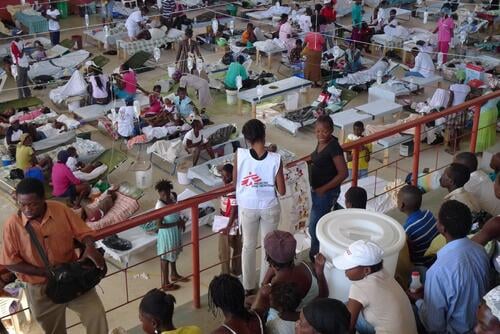
MSF teams treating cholera patients in Saint-Marc, Artibonite region, Haiti

Assessment teams sent to Mirebalais and Petit Riviere. Project Update - 24 Oct 2010
 
msf-placeholder
Haiti

MSF begins treatment in cholera-affected region of Haiti

Following the outbreak of acute diarrhea in the Artibonite region of Haiti, Médecins Sans Frontières (MSF) medical teams - including doctors, nurses and logisticians - immediately traveled to the affected areas along the Artibonite River, between the cities of Saint-Marc and Mirebalais. Project Update - 21 Oct 2010
 
msf-placeholder
Pakistan

As emergency phase ends, Pakistan flood victims show symptoms of excessive stress

Flood waters have largely receded and people have begun to return to what remains of their homes. Project Update - 21 Oct 2010
 
msf-placeholder
Pakistan

Letter from the field: One day in my life - A midwife in Balochistan, Pakistan

Olivia Lowe is a midwife working in Kuchlak, near Quetta in Pakistan's volatile Balochistan province. She manages the antenatal and postnatal care as well as the birthing unit at MSF's mother and child healthcare centre in Kuchlak. This is her first MSF mission. Voices from the Field - 20 Oct 2010
 
msf-placeholder
Global

Open letter to the U.S. government about the quality of food aid

"On the eve of World Food Day 2010, I write on behalf of Médecins Sans Frontières (MSF) to urge the U.S. to stop supplying nutritionally substandard food to malnourished children in developing countries". - Sophie Delaunay, Executive Director?U.S Section of MSF Press Release - 15 Oct 2010
 
msf-placeholder
Global

Reforming quality of global food aid critical to fight childhood malnutrition

Top donor countries must end double standard of supplying nutritionally substandard foods to young children in malnutrition 'hotspots' Press Release - 13 Oct 2010
 
Houses in the Boubazar slum near Kamrangirchar.<br />In the Kamrangirchar slum of Dhaka - on the banks of one of the most polluted rivers in the world - MSF runs a primary healthcare centre that provides care to children under five and pregnant and lactating women. Nearby, MSF also runs a therapeutic feeding centre. Through a largely home-based programme, these children are being fed with Plumpy Nut, a thick nutrient-rich peanut paste which helps children regain normal body weight. 
Kamrangirchar is one of Dhaka's many slum areas, a product of the urban mass migration that makes this capital the world's most rapidly expanding city. Development of public services and infrastructure has struggled to keep pace, and access to affordable health care is very limited. Formerly used as a dumping ground for the city's rubbish, the Kamrangirchar peninsula only started to become heavily populated over the last few decades. Covering just three square kilometres, the area is now home to 400,000 people. Through its presence, MSF hopes to bring its expertise and experience in treating malnutrition so that more children and their mothers can continue to live and grow up healthily.
Bangladesh

Slum conditions in Bangladesh pose health hazards, and malnutrition is a sign of other illnesses

"The level of health awareness in this community is very low, and people have a great deal of superstitious beliefs, such as believing that children may be touched by bad spirits through consuming breast milk or eating fish," Sophie de Montpelier, MSF's field coordinator. "Some mothers believe that a baby with diarrhoea should not be given extra water because the body already contains too much liquid. That's why MSF is investing a lot in health promotion activities here." Project Update - 13 Oct 2010
Four mothers posing in a corridor of the Hospital in Bili. All four of them are staying in the hospital with their child, that's suffering from a severe case of malaria. Since the beginning of the project in 2016, the pediatric ward already treated more than 4.000 cases of complicated/severe form of malaria.
Médecins Sans Frontières (MSF)

Independent medical humanitarian assistance

We provide medical assistance to people affected by conflict, epidemics, disasters, or exclusion from healthcare. Our teams are made up of tens of thousands of health professionals, logistic and administrative staff - most of them hired locally. Our actions are guided by medical ethics and the principles of independence and impartiality. We are a non-profit, self-governed, member-based organisation.

Learn more