



Ebola disease in DRC: find out how we're responding
Learn more
7999 Results
 
Phumeza Tisile, 23 years, takes her last tablets for XDR-TB at Lizo Nobanda TB Care Centre, Khayelitsha, South Africa on August 16, 2013. During her two year treatment for XDR-TB, Phumeza took over 20,000 pills and had over 200 injections.
Tuberculosis

Clinical Access to Bedaquiline Programme for the treatment of drug-resistant tuberculosis

This article documents the process whereby MSF obtained access to bedaquiline for TB patients in South Africa. Journal article - 6 Feb 2014
 
And yet another wave of displacement in the town of Bouca, (Ouham region) northeastern Central African Republic (CAR), after clashes between reported anti-balaka elements and ex-Séléka forces took place last week. For the second time in over two months, people had to flee to the bush running away from the fighting. Bouca was the center of attacks in September in which the civilian population, both Christians and Muslims, were targeted by the armed groups. Around 80 people were killed. The video shows, through interviews with direct an indirect victims of violence, the consequences of the fighting, forcing thousands of people to hide in the bush or to look for protection in churches, schools or airstrips.
Central African Republic

Rain does not wash the blood away (Part II)

José Mas Campos, MSF Emergency Coordinator in Bangui, describes what he saw in CAR. Voices from the Field - 6 Feb 2014
 
And yet another wave of displacement in the town of Bouca, (Ouham region) northeastern Central African Republic (CAR), after clashes between reported anti-balaka elements and ex-Séléka forces took place last week. For the second time in over two months, people had to flee to the bush running away from the fighting. Bouca was the center of attacks in September in which the civilian population, both Christians and Muslims, were targeted by the armed groups. Around 80 people were killed. The video shows, through interviews with direct an indirect victims of violence, the consequences of the fighting, forcing thousands of people to hide in the bush or to look for protection in churches, schools or airstrips.
Central African Republic

Rain does not wash the blood away (Part I)

José Mas Campos, MSF Emergency Coordinator in Bangui, describes what he saw in CAR. Voices from the Field - 6 Feb 2014
 
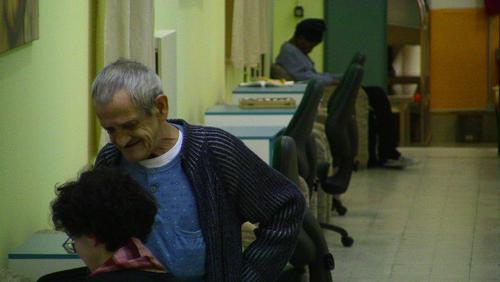
MSF nurse Rebecca Cuthbert takes care of a 63 year-old Romanian homeless.
The nurse is at the dorm in via Aldini, Quarto Oggiaro area.
Italy

Reaching out to the forgotten: providing access to medical care for the homeless in Italy

A programme for outpatient and intermediate inpatient care for the homeless was pioneered by Médecins Sans Frontières (MSF) in Milan, Italy, during the winter of 2012-2013. This paper documents the characteristics and clinical management of inpatients and outpatients seen during this programme. Journal article - 5 Feb 2014
 
Recovery room of the Community Hospital.
Central African Republic

"This was my most difficult mission”

Jessie Gaffric, MSF project coordinator at Bangui Community Hospital describes the situation there. Voices from the Field - 5 Feb 2014
 
View of a Médecins sans frontières (MSF) clinic set up at the Tomping camp for  displaced people in the grounds of the United Nations Mission to South Sudan (UNMISS) base in Juba, South Sudan. MSF is currently carrying out around 230 consultations per day in the camp since three weeks.  Between 13,000 and 17,000 people are residing at the camp. The main diseases include respiratory diseases, acute diarrhea and malaria.
South Sudan

"Living in impossible conditions"

MSF’s emergency coordinator, Forbes Sharp, gives an update on the dire conditions for people in Tomping camp. Voices from the Field - 5 Feb 2014
 
Mothers are feeding their children ready-to-use fortified peanut paste.
Democratic Republic of Congo

Providing mental healthcare in North Kivu

MSF teams integrated psychosocial care into activities in Bibwe to respond to mental health needs in the area. Project Update - 4 Feb 2014
 
Muslim community leaving Bossangoa
Central African Republic

Fleeing Bossangoa

After numerous incidents of violence, people are now leaving the town of Bossangoa in fear. Project Update - 3 Feb 2014
 
msf-placeholder
Sexual violence

Collecting data on sexual violence: what do we need to know? The case of MSF in the Democratic Republic of Congo

Claire Magone has published a paper, in Humanitarian Exchange Magazine (issue 60, February 2014 ) focusing on gender-based violence (GBV) in humanitarian crises. In an article called "Collecting data on sexual violence: what do we need to know? The case of MSF in the Democratic Republic of Congo", she cautions against an over-emphasis on collecting prevalence data over addressing victims' needs. Humanitarian Exchange Magazine - 2 Feb 2014
 
Vaccination needles kept cool during the Medecins Sans Frontieres expanded program of immunisation mobile clinic in Abien Dau transit returnee camp where children under the age of 5 are being vaccinated against measels, polio, tetnus, whooping cough and diphtheria.  Abien Dau, Warrup State, Southern Sudan. 8 January, 2011. Photo: Kate Geraghty.
Access to medicines

The polio eradication campaign: time to shift the goal

The polio campaign is at risk of becoming irremediably unpopular if the eradication goal is pursued at all costs. Journal article - 31 Jan 2014
Four mothers posing in a corridor of the Hospital in Bili. All four of them are staying in the hospital with their child, that's suffering from a severe case of malaria. Since the beginning of the project in 2016, the pediatric ward already treated more than 4.000 cases of complicated/severe form of malaria.
Médecins Sans Frontières (MSF)

Independent medical humanitarian assistance

We provide medical assistance to people affected by conflict, epidemics, disasters, or exclusion from healthcare. Our teams are made up of tens of thousands of health professionals, logistic and administrative staff - most of them hired locally. Our actions are guided by medical ethics and the principles of independence and impartiality. We are a non-profit, self-governed, member-based organisation.

Learn more