



Ebola disease in DRC: find out how we're responding
Learn more
123 Results
 
Amina Story 7/7

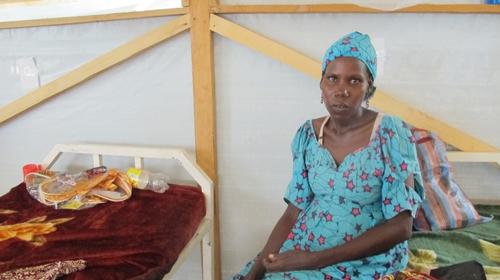
Amina is 15 years old, she looks like she has the weight of the world on her shoulders. Her small frame shrinks further in size as she talks about what she has experienced.

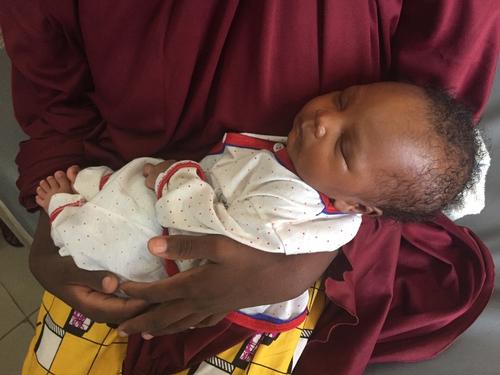
Sleeping on the hospital bed besides her is her son Yaqub, who she gave birth to a few days ago in MSF‘s health facility in Maimusari, 15 kilometres from the centre of Maiduguri, the capital of Borno State, north east Nigeria.

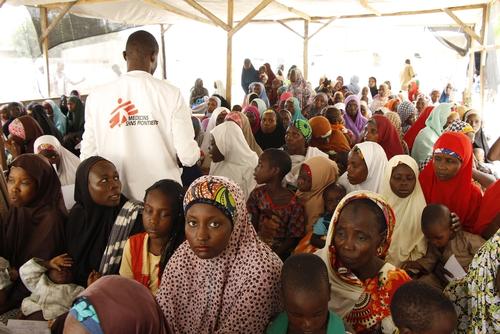
The MSF health centre in Maimusari is heaving with women and children, everwhere you look women are huddled holding their babies or seated on benches waiting to be seen by health workers.

I say women, but many of the faces in the crowd are teenager girls similar in age to Amina. Some of these girls have given birth to their second or third child. 

More than five hundred women and babies are being treated in this MSF health facility daily and more than seventy babies are delivered every week. 

MSF runs an In Patient and Out Patient Department,  maternity and ante natal services and an Ambulatory Theraputic Feeding Centre – ATFC. This is where malnourished  children and babies are provided with threaputic treatment. 

Amina says she is her husbands second wife, he has five children from his first wife, Amina says she has no idea where he is and he has yet to meet their newborn son. 

Amina is from Bama, a town in north east Nigeria. 
Bama is one of the frontlines in the ongoing conflict between the Nigerian army and Boko Haram that has left more than one million displaced and facing a growing nutrition crisis. 

Amina was evacuated from Bama and refered to MSF‘s health facility in Maimusari. The journey by road takes two and a half hours, the road is in poor condition and dangerous because it is part dotted with military checkpoints and is close to the Sambisa Forest in Gwozah, where Boko Haram are said to have a base. 

“I don‘t remember the journey from Bama to Maiduguri because I was in so much pain I had passed out. My youngest sister, Noor, aged five acompanied me on the journey. Was I scared ? I have spent my whole life being scared and so this was no different“ says Amina.

“It is very hard to be a girl here. Many bad things happen to girls, unspeakable things happen and they start happening to little girls as young as ten“ Amina twists the fabric of her dress as she talks and looks away frequentky trying to avoid eye contact with the nurse in the room. 

“What can I tell you ? It is impossible for me to talk about these things. “

I ask her how she feels about being a mother?

She shrugs her shoulders and then leans back and looks in to the distance.

In the same room as Amina there are two women on each bed with their newborns. 

The older looking mothers handle their children with more experience and attachment, holding their babies close as they breastfeed them. 

In one bed there are twins nestling into the blankets they’re laid out on. Many of the new mothers have expresionless faces. They look utterly exhusted.

Fatima,  35, has given birth to her sixth child, she says her baby was deliverd safely by MSF and she is thankful that she had somewhere to turn to in her time of need. 

“I felt safe here and knew that I would get good care and my baby would be healthy. I do not know what tomorrow will bring and all I can do is hope for the best for my child and all the children.“

MSF midwife Etsuko Nakamura is doing the rounds in the health centre. 

In the delivery room a woman has just given birth and has a retained placenta which can be life threatening as it can cause infection. Nurses masage her uterus to try and encourage the placenta to discharge. 

Another woman is in labour and the staff are preparing for her delivery.

“Our women patients are mostly in poor general health and for most it is very difficult for them to get to see a doctor because they don’t have the money or their family members do not see it as a priority,“ says  MSF midwife Etsuko.

“We deliever up to fifteen babies daily, many of the women have had repeat pregnancies and deliveries in a short space of time – their bodies are weak and exhausted. 

As always with our work  we see the dailly impact of conflict and poverty. We see how women and children’s lives are made harder by violence and instability. 

It is the women and children who are the most vulnerable and suffer the most,“ says Etsuko.
Nigeria

Amina, a 15-year-old mother in Maiduguri

“Our women patients are mostly in poor general health, and for most it is very difficult for them to get to see a doctor because they don’t have the money or their family members do not see it as a priority,” explains Etsuko Nakamura. Voices from the Field - 18 Aug 2016
 
Dayo, 31, was referred to Mora Hospital in Cameroon in late July by MSF teams in Banki, Nigeria.

 She accompanied her sick four year-old son, Barine. The child urgently needed to be admitted to hospital as he was suffering from severe acute malnutrition.
Nigeria

We are scared to return

Patient testimonies from Banki Voices from the Field - 11 Aug 2016
 
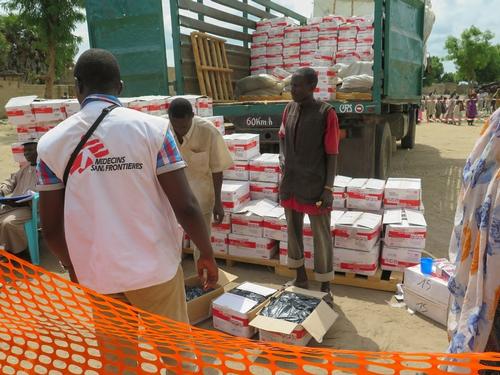
During the second week of July 2016, MSF organised an exploratory mission and an emergency distribution for more than 15,000 displaced people leaving in dire conditions in the city of Banki, in Borno State – Nigeria.
Nigeria

MSF warns of large-scale humanitarian disaster in Borno State

More than 500,000 people are living in catastrophic and unsanitary conditions in a number of villages and towns across Borno State, northeastern Nigeria. “In Banki, as in a number of other areas, people have almost no access to humanitarian aid,” says MSF’s emergency programme manager Hugues Robert. Press Release - 27 Jul 2016
 
For the first time, a Médecins Sans Frontières team went to Dikwa, a town 90km from Maiduguri in Borno State, northeast Nigeria, to carry out a nutrition assessment on children under the age of 5 years. There are around 70,000 displaced people living in Dikwa, some of whom have have been living in Boko Haram controlled areas until very recently. The team recorded a 13% rate of severe malnutrition amongst those screened.
On the morning of 20th July alone, they identified 34 children who required hospitalisation and a further 663 severely malnourished cases. Due to the limited medical and transport capacity, the team was only able to evacuate the most urgent cases, who were immediatey admitted to the Gwange Inpatient Therapeutic Feeding Centre (ITFC), on the outskirts of Maiduguri.

Triage in Maimusari health center. Every day, medical team is doing about 500 consultations as well as 300 prenatal consultations and 10 deliveries.
Nigeria

Crisis Info on Borno Emergency - July 2016

Crisis Update - 22 Jul 2016
 
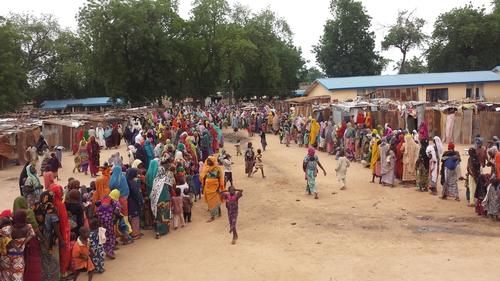
People are queuing for screening. The displaced population in Bama camp is estimated between 10 000 to 12 000 persons.
Nigeria

Health disaster in Borno State

The health situation in Borno State in northeast Nigeria is critical. At least 500,000 people who are either displaced or cut off in enclaves outside state capital Maiduguri are in urgent need of food, medical care, drinking water and shelter. “Aid agencies must deploy a massive relief operation to respond to this health disaster”, says Dr Isabelle Defourny, director of operations at Médecins Sans Frontières (MSF). Press Release - 20 Jul 2016
 
"This is the first time MSF has been able to access Bama, but we already know the needs of the people there are beyond critical,” said Ghada Hatim, MSF head of mission in Nigeria. “We are treating malnourished children in medical facilities in Maiduguri and see the trauma on the faces of our patients who have witnessed and survived many horrors.” 

During its assessment, the MSF team counted 1233 cemetery graves located near the camp which had been dug in the past year. Many of those graves—480—were of children
“Bama is largely closed off,” said Hatim. “We have been told that people including children there half starved to death. According to the accounts given to MSF by displaced people in Bama new graves are appearing on a daily basis. We were told more than 30 people are dying a day due to hunger and illness.”
Nigeria

At least 24,000 displaced people in dire health situation in Bama

Critical humanitarian needs identified for displaced in Bama, Borno State, Nigeria Press Release - 22 Jun 2016
 
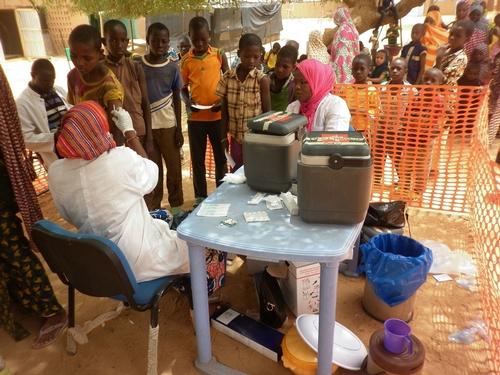
In Mangaize, Tillabery region, western Niger, around 15000 people have been vaccinated against measles. The priority to prevent outbreaks from multiplying is to vaccinate in areas where mobile populations are living alongside indigenous people.
In addition to vaccination activities, MSF is supporting the health authorities to prepare the response to new measles and meningitis outbreaks by strengthening epidemiological surveillance and providing free treatments to health facilities.
Niger

MSF teams respond to two epidemics and ward off a third

With simultaneous epidemics of meningitis and measles in Niger, teams from MSF have been supporting the Ministry of Health in its efforts to bring them under control, while taking steps to prevent cholera spreading from neighbouring Nigeria. “In the struggle to prevent the epidemics from spreading, our current priority is to administer vaccinations in areas where displaced people are coming into contact with the local population,” says MSF emergency coordinator Augustin Ngoyi. Project Update - 26 May 2016
 
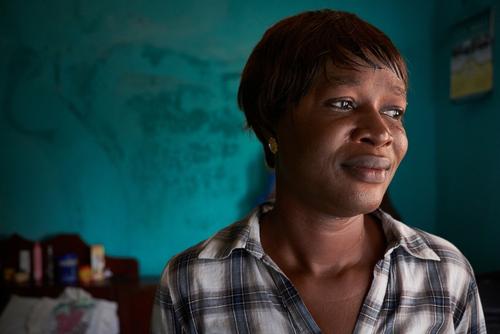
Portrait of Odia at her home in Conakry, Guinea on March 18, 2016. 

"I learnt in 2005 that I was HIV positive when I for a medical checkup. But the first time, it was my father who received the results from my tests and he did not tell me what they were. I returned to the hospital again with a friend of my mother and was tested again. That’s when I learnt I was HIV positive. I was stigmatised by my Aunty at first, today though I don't face problems. I am a counsellor in an MSF treatment centres for those who come for HIV tests."

MSF launched a HIV testing campaign in Conakry with the support of health authorities moving throughout several neighbourhoods throughout 2016.

In Guinea, only one in four people living with HIV are on life-saving antiretroviral treatment. Lack of voluntary HIV testing, estimated at only 5% from the latest study dating from 2012, hampers the necessary increase of people on ART.
HIV/AIDS

7 things you may believe about HIV/AIDS that turn out to be wrong

MSF calls for donors and UN agencies, in particular UNAIDS, the Global Fund, Pepfar and EU donors, as well as affected governments, to develop and implement a fast-track plan to scale-up life-saving antiretroviral treatment for countries where ART coverage reaches less than one-third of the population, particularly in West and Central Africa. Project Update - 19 Apr 2016
 
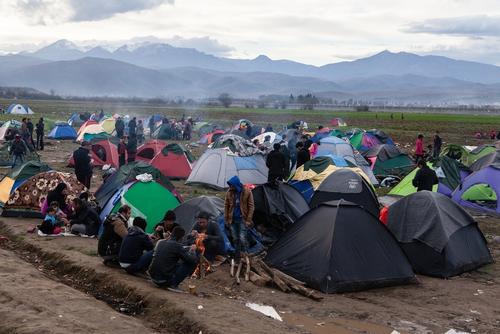
At the transit camp at Idomeni, on the Greek - Macedonian (FYROM) border.
Mediterranean migration

EU Migration Crisis Update - March 2016

The EU/Turkey deal is not a solution to the refugee crisis. As other deterrence measures, this cynical agreement will not stop people from crossing the sea or from looking for more dangerous roads in the hands of smugglers Crisis Update - 21 Mar 2016
 
MSF also supports the CAR’s National Program, which is supposed to vaccinate all children following a predefined timetable. Unfortunately difficulties of access, the failures of the health system and the recent upsurge in violence have long interrupted the program.
Vaccination

High vaccine prices hamper immunisation efforts in Africa, but are missing from agenda of key vaccination conference

"If vaccine prices continue to spiral out of control, we will continue to see countries in Africa and around the world faced with difficult decisions about which deadly diseases they can and can’t afford to protect their children against," says Dr Myriam Henkens, International Medical Coordinator at MSF. "Ministers at this conference literally can’t afford to waste this opportunity to again speak out against high prices and push for change." Press Release - 24 Feb 2016
Four mothers posing in a corridor of the Hospital in Bili. All four of them are staying in the hospital with their child, that's suffering from a severe case of malaria. Since the beginning of the project in 2016, the pediatric ward already treated more than 4.000 cases of complicated/severe form of malaria.
Médecins Sans Frontières (MSF)

Independent medical humanitarian assistance

We provide medical assistance to people affected by conflict, epidemics, disasters, or exclusion from healthcare. Our teams are made up of tens of thousands of health professionals, logistic and administrative staff - most of them hired locally. Our actions are guided by medical ethics and the principles of independence and impartiality. We are a non-profit, self-governed, member-based organisation.

Learn more