



Ebola disease in DRC: find out how we're responding
Learn more
123 Results
 
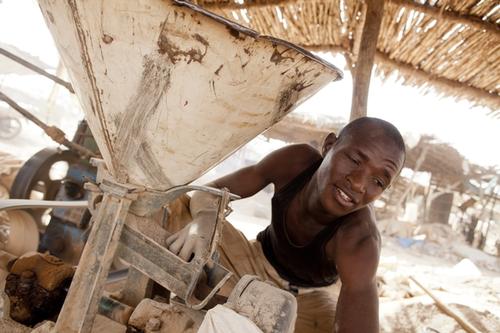
Bagega gold processing site. Hanafi Sami, 25 years old from Bagega village. Hanafi is newly married to his first wife. He has heard about lead poisoning and is always very careful to leave his tools in the compound where it is safer, he does not want any negative effects for any future children.  The stones containing the gold are being put through a grinder after they are crushed, what is left is sand. This man is sifting out any small stones that might still be there.
Nigeria

MSF starts treating lead poisoned children in Bagega

MSF has finally been able to start medical treatment for children suffering from lead poisoning in the village of Bagega. Press Release - 23 Apr 2013
 
After severe floods hit eastern Nigeria in september 2012, Doctors Without Borders/Médecins Sans Frontières (MSF) provided medical assistance and distributed aid kits to populations in need.
Hundreds of villages were destroyed and thousands of people were affected by the floods, which occurred after heavy rainfall caused the Benue River to rise above its banks. The situation was worsened because additional water was released from a dam in neighbouring Cameroon. In some places, houses were totally submerged, their residents forced to flee.
MSF’s intervention began early September 2012, when medical and logistics teams were deployed in Adamawa and Taraba states. MSF used motorboats to reach isolated and displaced populations in remote flooded areas that were left without access to medical attention.
MSF teams exercised vector control, carried out mobile clinics, provided primary and emergency health care and distributed NFI kits and mosquito nets. In Taraba state, MSF mobile clinics carried out 1,430 consultations in Mayorenewo and 10 nearby villages. In Adamawa state, MSF mobile clinics treated 5,500 patients in 33 flooded villages and two internally displaced people’s camps in Numan and Borong. Soaps and mosquito nets were also distributed to 2,200 beneficiaries.
Nigeria

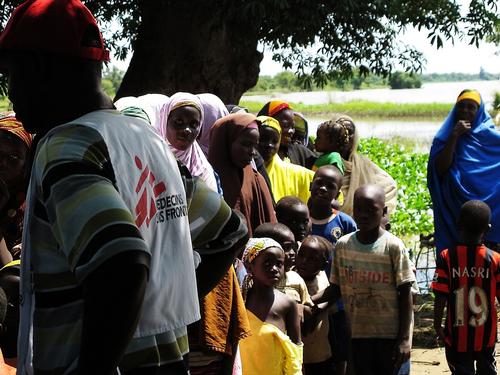
MSF provides medical assistance in flood-affected areas

After severe floods hit eastern Nigeria in September, MSF provided medical assistance and distributed aid kits to populations in need. Hundreds of villages were destroyed and thousands of people were affected by the floods. MSF staff also found high rates of malaria, particularly in the Mayorenewo area, where more than 80 per cent of the patients tested positive. Project Update - 2 Nov 2012
 
msf-placeholder
Malnutrition

MSF's dual response to an expected nutritional crisis

The annual "hunger season" seems likely to be particularly serious in the Sahel this year, and a few regions may face acute nutritional crises in the coming months. MSF is expanding its nutritional activities to address the seasonal “peak” in malnutrition rates, while also developing longer-term approaches to be integrated into regular programs. Project Update - 30 Mar 2012
 
hopital de Jahun
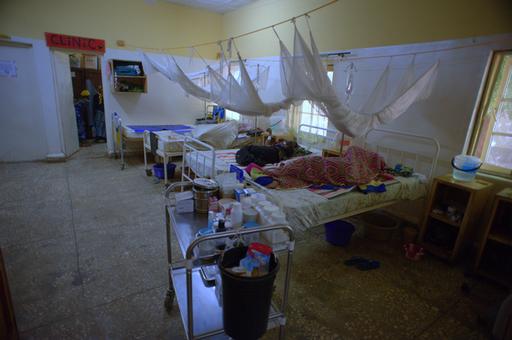
 Programme de prévention et de réparation des fistules  (obstetrical fistula ) vésico-vaginales, scènes et portraits de patientes
Nigeria

Preventing and treating obstetric fistulas in Nigeria

Obstetric fistulas, most often the result of prolonged obstructed labor, is an opening that occurs between the bladder and the vagina, or between the rectum and the vagina and causes a woman to become incontinent, among other devastating medical and social consequences. According to the UN, an estimated two million women live with fistulas today—about half of them in Nigeria. Voices from the Field - 8 Mar 2011
 
msf-placeholder
Women's health

The other Butterfly Effect: MSF treats women injured in childbirth

An estimated two million women live with fistula worldwide, most in Africa. This problem is largely hidden because it often affects young women who live in poor and remote areas, with very limited to no access maternal health care. Project Update - 7 Mar 2011
 
msf-placeholder
Nigeria

Lead poisoning continues to affect hundreds of children in northwestern Nigeria

Earlier this year, cases of lead poisoning in children and adults were confirmed in five villages in Zamfara state, northwestern Nigeria. Since early June, MSF, in collaboration with Ministry of Health, has been providing emergency treatment for children under five years of age and breast feeding mothers, as they are the most vulnerable group to be affected by the poisoning. Project Update - 10 May 2010
 
msf-placeholder
Project Update

Seven million vaccinated for meningitis in West Africa

Photo Essay: Seven million vaccinated for meningitis in West Africa Photo Story - 12 May 2009
 
msf-placeholder
Project Update

MSF to vaccinate over four million people in West Africa for meningitis

While ensuring a quick access to treatment for the sick people, MSF is undertaking mass vaccination campaigns in Nigeria and Niger and is closely following the situation in other countries in the region. Project Update - 2 Apr 2009
 
msf-placeholder
Nigeria

After measles vaccination campaign epidemic decreases in Nigeria

A measles vaccination campaign has been completed in the state of Yobe, northeastern Nigeria - the epidemic is starting to lessen. Project Update - 4 Jul 2008
Four mothers posing in a corridor of the Hospital in Bili. All four of them are staying in the hospital with their child, that's suffering from a severe case of malaria. Since the beginning of the project in 2016, the pediatric ward already treated more than 4.000 cases of complicated/severe form of malaria.
Médecins Sans Frontières (MSF)

Independent medical humanitarian assistance

We provide medical assistance to people affected by conflict, epidemics, disasters, or exclusion from healthcare. Our teams are made up of tens of thousands of health professionals, logistic and administrative staff - most of them hired locally. Our actions are guided by medical ethics and the principles of independence and impartiality. We are a non-profit, self-governed, member-based organisation.

Learn more