


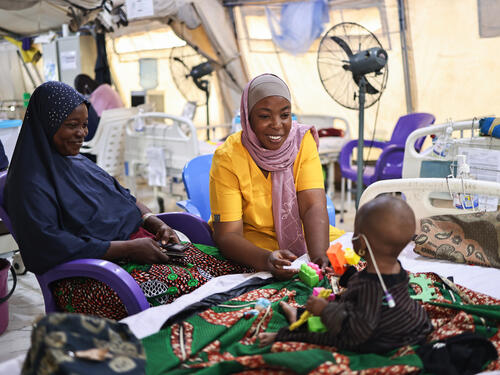
The cries of children fill the intensive care unit of Médecins Sans Frontières’ (MSF’s) Nilefa Kiji nutrition facility in Maiduguri, Borno state, Nigeria. Nurses move from bed to bed checking vital signs, dispensing therapeutic milk, and reassuring anxious parents. Every child here is fighting severe acute malnutrition, a condition that continues to claim young lives across northern Nigeria.
Many have suffered severe wasting and weight loss. Since malnutrition weakens their immunity, some also arrive with other diseases too, such as measles, diphtheria, and malaria. For many children with severe acute malnutrition, treatment can last from one week to a month. Throughout that time, caregivers remain at the hospital, often separated from their families and burdened with worries of what waits for them at home.
The stories of caregivers – often mothers of the children – rarely get told. Yet their emotional wellbeing is tested by weeks of anxiety from their child’s condition, uncertainty, separation from their families, and the fear of losing a child.
Fatima Ibrahim’s 23-month-old daughter, Aisha, was admitted to the Nilefa Kiji nutrition facility in Maiduguri after battling meningitis and repeated convulsions. The three weeks spent in hospital were filled with conflicting emotions. While grateful to see her daughter improve, Fatima could not stop thinking about the eight children she had left at home.
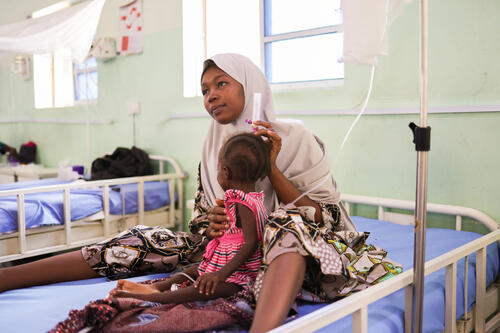
“I am worried about my children," she said. “There is no one to take care of my children. Their father is away and they do not have anything to eat or drink.”
One day, she learned that one of them had developed a fever but there was no money for treatment. “I cried and could not eat,” she said. “Even this morning, I could not eat until the afternoon.”
Halima Mohammed, another mother, experienced a different kind of strain after spending 45 days moving between hospitals with two sick children.
“I was having good sleep before my children fell ill,” she says. “Now I barely sleep. For the past two days, I have not been feeling well myself. I pleaded for my daughter’s discharge, and I assured them that I was not running away; that my daughter is now better, but they advised against self-discharge as my daughter was not yet in a stable condition.”
Latifat Abdulkareem faced another painful dilemma when her eldest son visited the hospital during her daughter's admission. “He asked me when I was coming home,” she said. “He said they were hungry since I wasn't around.”
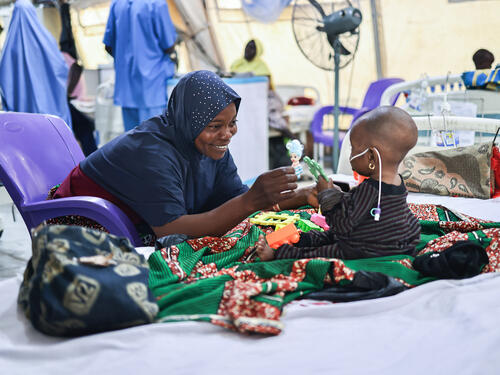
Helping several caregivers whose children have been admitted for malnutrition, Kethurah John, an MSF counsellor educator, says that the condition of their children at home leaves caregivers with two difficult choices, and that sometimes their husbands do not help the situation.
“A woman once told us that her husband called her and told her that he is tired of taking care of the children, so he left the children with the neighbours,” says Kethurah. “She could not cope staying in the hospital. She had six children. She had to leave, not because she wanted to, but because she feels this is just one child. And every day when she is given food, she cries because she is thinking of her children, maybe they can’t get that.”
For Mariya Mukhtar, nine days after arriving at an MSF facility in Kano with her severely-ill daughter, the hospital had become a place of reassurance. Her daughter had arrived with a severe fever, vomiting, and loose stool after several unsuccessful visits to other health facilities. Mariya feared she might not survive.
After some time, she began seeing a dramatic change. Her daughter could now sit up, play, recognise her, and talk — things she could not do when they arrived.
“I am in no rush to leave,” says Mariya, because she can see real improvement every day. She now feels at ease, knowing her daughter is receiving care.
... Caring for the caregiver is also part of caring for the child.Kethurah John, an MSF counsellor educator
These stories reveal an often-overlooked consequence of malnutrition. While medical statistics capture admissions and recovery rates, they cannot measure the emotional burden people carry while trying to support their sick children.
To address these challenges, MSF integrates mental health and psychosocial support into our malnutrition programmes in Nilefa Kiji nutrition facility. Caregivers receive psychological first aid on arrival, followed by individual counselling and group sessions where they can share experiences, express their fears, and learn coping strategies. Children also participate in structured play activities that help restore a sense of normalcy during recovery.
The support extends beyond counselling. When caregivers become distressed after losing contact with relatives, counsellors help them reach family members by phone. In some cases, supervised home visits are arranged so caregivers can briefly check on their families before returning to complete their child's treatment.
Kethurah says many caregivers gradually regain hope as they witness their children's recovery. Some even return after discharge simply to show how healthy their children have become.
"For us, those moments remind us that caring for the caregiver is also part of caring for the child,” she says.
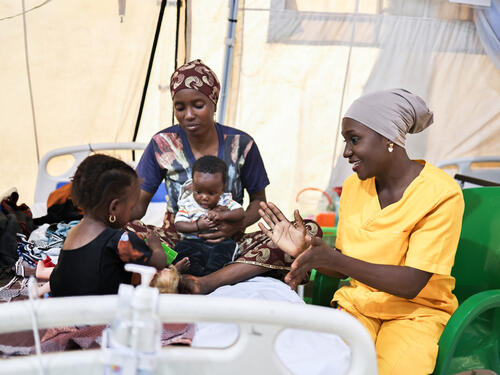
Supporting caregivers is more than an act of compassion. Their emotional wellbeing influences their ability to remain engaged in treatment, follow medical advice, and provide the care their children need to recover.
As the fight against malnutrition continues, the needs of children and those who care for them cannot be separated. Healing is not only about restoring a child's weight. It is also about restoring hope and resilience to the person who sits at their bedside every day.
MSF supports the state Ministries of Health in Zamfara, Katsina, Kebbi, Borno, Bauchi, Sokoto and Kano in providing lifesaving care for children suffering from malnutrition. In 2025, MSF teams treated 425,634 children for acute malnutrition across northern Nigeria, a 41.8 per cent increase compared to 2024.


Ukraine
Another senseless Russian attack kills and wounds several people in Dnipropetrovsk
Crisis Update
25 Oct 2026