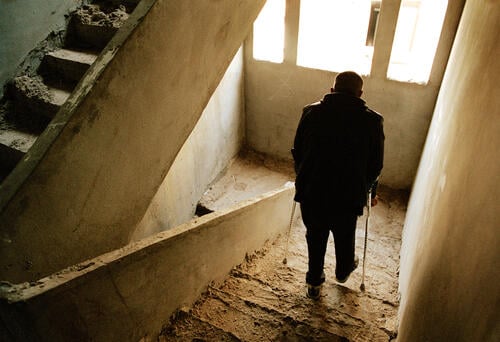
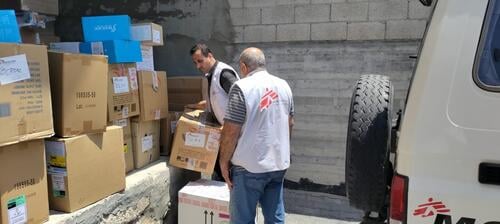
Each year thousands of Palestinians suffer from conflict-related violence. In 2021 alone, Israeli forces and settlers injured more than 18,300 people across Palestine. To improve the capacity of Palestinians to respond to people’s medical needs, teams from Médecins Sans Frontières (MSF) have trained community volunteers in first aid, trained hospital staff in dealing with mass casualty events, and donated drugs to major hospitals across Palestine.
Training community volunteers in the West Bank
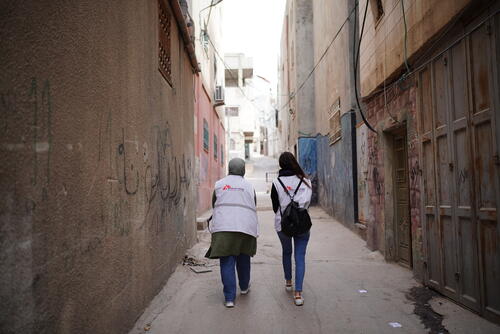
Qualified as a schoolteacher, 22-year-old Omar Basam Abu Hamad has been volunteering as a paramedic since 2014. He lives in Al-Fawwar refugee camp, south of Hebron city, where a single health centre serves some 9,500 Palestinians. With the health centre struggling to cover residents’ needs, community volunteers like Omar often help in bringing health services to local people.
The training focused mainly on general emergency techniques – how to organise patient flow, how to triage patients, how to treat trauma patients.Enrico Vallaperta, MSF nurse and trainer
When the security situation in the camp is calm, Omar assists a nurse during patients’ home visits. After being trained by MSF in mental health support, Omar is now able to provide psychological first aid as well as medical services to the patients he cares for.
But “the security situation is unpredictable,” he says, and sometimes his community needs emergency medical support.
Al-Fawwar camp has long been a hotspot for violence in the West Bank. Camp residents are harassed on an almost daily basis. When violence breaks out in the camp, it can leave large numbers of people injured and requiring urgent medical care.
Responding to such incidents can be challenging for Omar and other community volunteers, who have limited training and experience of triaging the wounded.
Omar Basam Abu Hamad, volunteer paramedic
“Now we know what to do and we are ready to act. We have learned how to triage patients. We also identified a place where injured people can be taken to receive medical aid safely in such circumstances.”
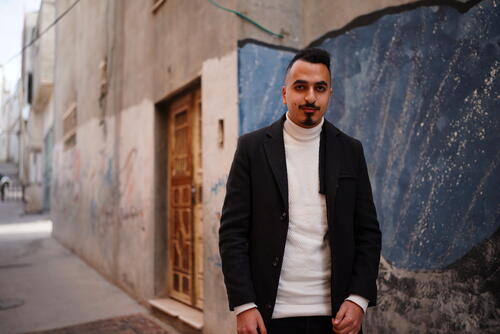
Omar was among 80 volunteers trained by MSF in 2021 in Al-Fawwar camp to ensure that patients receive the best care possible after violent incidents occur.
“Now we know what to do and we are ready to act,” says Omar. “We have learned how to triage patients. We also identified a place where injured people can be taken to receive medical aid safely in such circumstances.”
Omar says that he is proud to serve his community, despite the risks to his own safety.
Similar training sessions have taken place in three other communities across Hebron governorate since last year – in Al-Arroub camp, Beit Ummar and Mohtasseb – as well as in four hospitals providing specialist level care in the area.
MSF has also trained volunteers from six communities who live close to the separation fence in Jerusalem, where violence between Palestinians and Israeli forces is frequent.
At the same time, in coordination with the Palestinian Ministry of Health, 42 doctors and nurses in Ramallah have been trained by MSF to train others in administering basic life support and advanced trauma support.
Supporting hospitals in the Gaza Strip
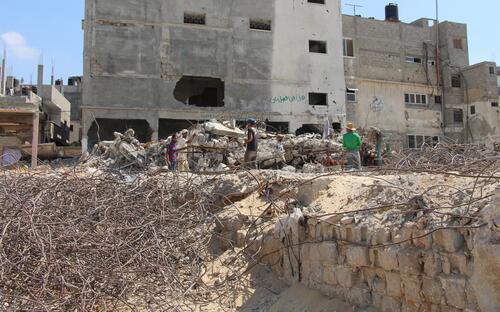
In the Gaza Strip, MSF has been supporting Gaza’s health authorities since October 2021, through capacity building and by helping to reorganise the emergency rooms of some of the main hospitals.
We also have been helping to reinforce the capacity of health workers to deal with mass casualty influxes, which is when 10 or more wounded people arrive simultaneously at a medical facility.
During the most recent Israeli military campaign in Gaza in May 2021, more than 250 people were killed, and close to 2,000 others were injured. Many casualties arrived at hospitals within a short period of time and staff in emergency rooms in Gaza’s main medical facilities struggled to cope.
Beit Hanoun hospital, in the north of Gaza, received large numbers of wounded, before transferring them to Ministry of Health hospitals elsewhere. From October to December 2021, we provided a three-month on-the-job teaching course to 70 emergency room staff at Beit Hanoun. The staff were mainly nurses and doctors, and the training helped them gain practical skills and improve quality of care.
“The emergency room doctors had good knowledge, but they didn’t have the experience of applying what they had learned at university,” said Enrico Vallaperta, an MSF nurse and trainer. “The training focused mainly on general emergency techniques – how to organise patient flow, how to triage patients, how to treat trauma patients.”
“The next round of training will be more specialised, focusing on wound care, toxicology, etc,” said Vallaperta.
In 2022, MSF plans to extend this training to other hospitals in Gaza.
MSF continues to provide surgical and post-surgical assistance to burns and trauma patients in the Gaza Strip and to provide mental health services in Hebron, Nablus and Qalqilya.
Palestine
Caring for the severely injured after deadly escalation in Gaza
Project Update
19 Aug 2022
Palestine
Palestinians in Hebron suffer from lack of healthcare and psychological distress
Project Update
25 Jul 2022