Mariam* is on Lesbos with her family, her husband and her 2-year-old girl, while she is also expecting another child.

We are a family of three. Me, my husband and my two-year-old daughter. I am also 8 months and 3 weeks pregnant. I arrived on Lesbos two years ago. I have lived in Moria camp and now I live in the new camp of Kara Tepe.

When the Moria camp was on fire, everywhere we looked, there was fire. We were in the middle of it, so we went to the mountains to protect ourselves. After the fires, we were in the streets for around ten days. We didn’t have any food and water. Food was not enough for everyone.

Now in Kara Tepe camp, the living conditions continue to be difficult. There is cold, there is heat, we cannot go to the toilet easily, we don’t have a good life here. I don’t feel well. It’s two years that I haven’t gone to a private toilet. We are in a bad mental health situation.

Right now, I don’t know if we can get recognized as asylum seekers or if we are going to get a rejection. We also have problems with getting permission to get outside of the camp. Until now, my daughter has never been to a park. I wish we could move freely, so that I could take my daughter to a park.

She is very aggressive because of what she has experienced here. She “likes” to fight all the time. She doesn’t like to play. She’s not a child who likes to play with friends, to laugh, to speak and play with dolls. All there is in her mind is the the violence she has witnessed here. The fights in the camp, the time that we had to run away, the fires, the teargas. During this age, it is important to care about the little girl, to give her a lot of love and take her to nice places, but this is not possible here.

For example, when she was learning to walk, there were no walls for her to grab to be able to stand. All we had was a blanket hanging so when she was trying to stand, she would grab it and it would fall.

My wish is to get better psychologically. And to be able to go to work, me and my husband and live like a normal person. I don’t like to be told where to go, where not to go and what time to go in and out. I wish, like all the people do, to have a good life without any stress and to have a house and for my daughter to at least play in the house.
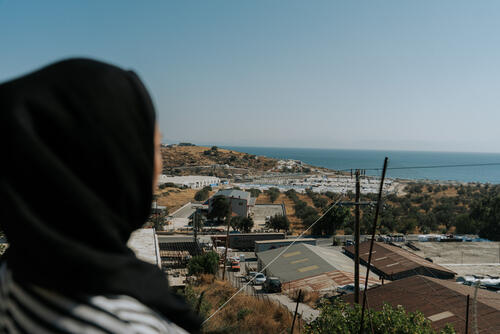
Mariam*, from Afghanistan, looks over the Kara Tepe camp on Lesbos, where she's lived for two years. Greece, September 2021. *Name changed to protect identity. 
© MSF

One year on from Moria fire, EU denies dignity to migrants trapped on Greek islands

Mariam*, from Afghanistan, looks over the Kara Tepe camp on Lesbos, where she's lived for two years. Greece, September 2021. *Name changed to protect identity. 
© MSF
Ebola disease in DRC: find out how we're responding
Learn more

On 8 and 9 September 2020, the notorious Moria migrant camp, on Lesbos, Greece, burned to the ground. The fire later became a moment symbolic of the European Union’s total failure of their approach to the refugee and migrant ‘hotspots’ on the Greek islands.

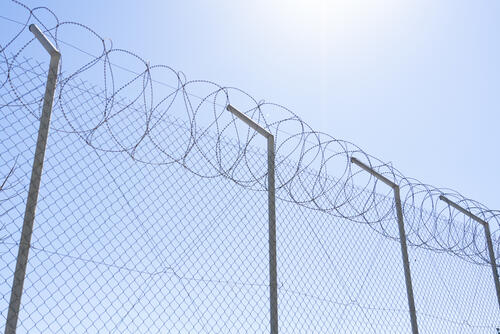
One year after EU promises of a “fresh new start” on migration, European and Greek leaders continue to deny basic dignity to asylum seekers and migrants searching for safety in Europe. Meanwhile, their hideous plan to construct prison-like camps in the five North Aegean islands is moving forward.

“In Greece, the future looks more dystopian than ever, as those who make it to cross the sea continue to live in miserable camps on the Greek islands”, said Konstantinos Psykakos, Head of Mission of MSF in Greece. “It is a tragic irony that as the world observes the latest developments in Afghanistan, the EU and Greece are inaugurating a new prison like-centre to trap refugees on Samos island.”

“This is the best demonstration of the cruelty of the EU's migration policies”, said Psykakos.

MSF to EU leaders As humanitarian crises unfold in several parts of the world, we continue to call on the European Commission, Greece, and European States to implement policies that are focused on protecting and assisting refugees and asylum seekers.
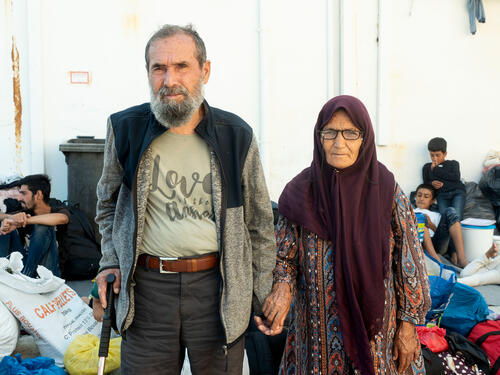
GREECE. Lesbos.September 16, 2020. Mohammed Karim and his wife are both at high-risk to COVID-19. Mohammed is 76 and cannot walk a few steps without being breathless. After the fire that destroyed Moria, Mohammed and his family were on the streets for over a week without access to the most basic services, such as toilets, showers, regular food, and healthcare. They told MSF Health Promoters that they didn’t want to go inside the new camp, because the they are afraid that they will continue to live in horrible conditions without access to healthcare. Mohammed has been trying to reunite with his daughter who lives in the UK however he still remains trapped on the island.  
MSF has witnessed the constant deterioration of people’s health and mental health for over five years as the EU-Turkey deal continues to keep already traumatized people stuck inside cycles of suffering. Since the fire the situation has only deteriorated further. The only solution is clear; the evacuation of all people from Lesvos to safe accommodation in EU states, were these people can have the chance to begin a life again.
Mohammed Karim and his wife have been trying to reunite with his daughter who lives in the UK, however they remain trapped on Lesbos. Greece, September 2020.
© Enri CANAJ/Magnum

People continue to report to teams from Médecins Sans Frontières (MSF) how the limbo situation on the islands, the arbitrary and fast track asylum processes, the fear of deportation, and the precarious living conditions contribute to the deterioration of their health and mental health. Children seeking mental health support at the MSF clinic on Lesbos, often exhibit regressive behaviours such as aggression, withdrawal and secondary enuresis (bedwetting) or present delays in cognitive, emotional and social development.

People who have experienced significant trauma have difficulties in processing their very distressing memories and remain afraid for much of the time. Post-traumatic stress disorder and depressive disorder symptoms are among the most predominant ones seen by our doctors, being present in close to or more than half our child and adult patients.

“There is no difference between the old Moria and Kara Tepe camp,” said Ali*, a survivor of torture in Syria who has been on Lesbos for one year and six months. “The procedures are the same. It is the same system.”

“As a sick person, I feel I am going from bad to worse day by day,” Ali continued. “The European parliament, the European Union, they know what’s going on in this shameful camp, but nobody can feel us.”
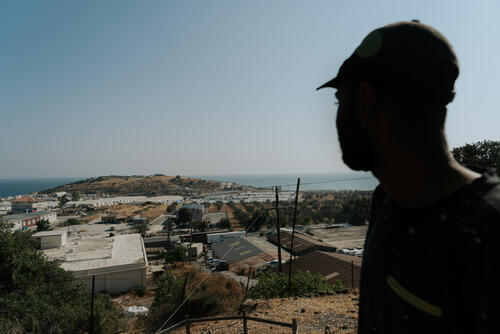
Ali*, torture survivor on Lesbos “There is no difference between the old Moria and Kara Tepe camp... It is the same system. The European parliament, the European Union, they know what’s going on in this shameful camp, but nobody can feel us.”
“I have been in Lesvos for 1 year and a half. If there was no war in Syria, I would have never left my country. I left because of the war. I have been held in prison there and I have been beaten so hard, that now I have a blood clot in my head. I have also been exposed to bombardments with chemicals and gun powder.

When I came here in Lesvos, in this new camp I had a heart stroke. As a sick person, I feel that I am going from bad to worse day by day here. There is no difference between the old Moria camp and this camp. The procedures are the same. The system is the same.

Whatever I say, cannot cover everything of what I want to tell you. The European parliament, the European Union, everyone knows what is going on in this shameful camp, but they cannot feel our pain. Whatever we say, will not make any difference.

The night of the fire in Moria camp we were so scared. We did not know where to go. For almost two weeks, we were homeless in the streets. It felt like you were under siege in Syria.There was no water, not even toilet. It was so shameful, but it was not sad. It was shameful for Europe.

The night of the fire I realized that Europe does not have humanity.
Ali*, a Syrian survivor of torture, looks out over the camp on Lesvos, where he's remained trapped for 18 months. Greece, September 2021. *Name changed to protect identity.
© MSF

“We are in a bad mental health state,” said Mariam,* a mother from Afghanistan who has already spent two years on Lesbos. “Right now, I don’t know if we can get recognised as asylum seekers or if we are going to get another rejection.”

“Until now, my two-year-old daughter has never been to a park. We have problems with getting permission to get outside of the camp,” Mariam continues. “My little girl tends to have aggressive behaviours because of what she has witnessed here. She doesn’t like to play, to laugh, to speak or play with dolls.”

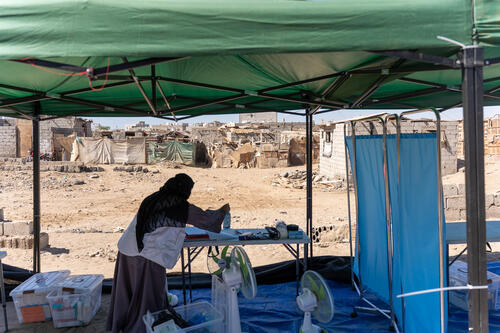
Recently, MSF teams on Lesbos moved to a location near the Kara Tepe camp, where we provide vaccinations to children against common childhood diseases, and sexual and reproductive healthcare services to refugee women. We continue to offer mental health care to children and adults in our clinic in Mytilene.

It is a tragic irony that as the world observes the latest developments in Afghanistan, the EU and Greece are inaugurating a new prison like-centre to trap refugees on Samos island. Konstantinos Psykakos, MSF Head of Mission

As humanitarian crises unfold in several parts of the world, we continue to call on the European Commission, Greece, and European States to implement policies that are focused on protecting and assisting refugees and asylum seekers, instead of ways to deter, stop and deport those who seek safety in Europe.

This starts with refraining from building centres that will trap people in prison-like settings on the Greek islands, and rather focus on humane and dignified reception policies. All facilities on the Greek islands must have, as their sole purpose, the provision of urgent assistance and facilitation of relocating newly arrived asylum seekers to safe reception structures across Europe.

*Names changed to protect privacy.