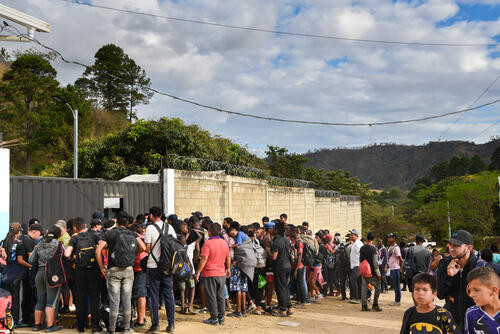
The situation for migrants at the border between Nicaragua and Honduras has worsened in recent months. Since the beginning of March, a new wave of people who are migrating has been crossing the eastern borders of Honduras. From January to March, more than 30,000 people have entered the country irregularly between the municipalities of Trojes and Danli, both border points with Nicaragua. Médecins Sans Frontières (MSF) mobile clinics continue to travel to different points in the area to provide medical and humanitarian assistance to people on the move.
 
In the midst of these consultations, MSF teams listen to the stories of people who arrive affected by physical exhaustion and have experienced situations of violence that impact their mental and emotional health. This was the case for Natasha and René, who had to leave Venezuela with their puppy Juan Pablo to cross the Darien jungle between Colombia and Panama to Danli.
 
Their testimony was captured in a coloring book to try to bring people closer to this type of situation in a different way; as well, to give health promotion teams something they can provide children waiting at border points with to awaken their interest in drawing, as well as use as a child-friendly support tool to help them see others are also facing this difficult journey.
 
Like Natasha and René, between 80 and 160 people are treated every day at the MSF clinic for different health conditions. In 2022, the teams provided more than 17,000 medical consultations at two border points in the country: Danli and Trojes. Of these people, a large percentage are minors, pregnant women and people with chronic diseases.

Nicaragua

MSF mobile clinics travel to different points in Nicaragua and Honduras to provide medical and humanitarian assistance to people on the move. Nicaragua, March 2023.
Ebola disease in DRC: find out how we're responding
Learn more

MSF closed our last projects in Nicaragua in 2019.

MSF’s first ever mission was in Managua, the capital and largest city of Nicaragua, where an earthquake destroyed most of the city and killed between 10,000 and 30,000 people in 1972.

We spent 22 years treating victims of Chagas, a parasitic disease that attacks the heart and the nervous and digestive systems. The project closed in 2005, after the national health ministry had included the disease in a new 10-year plan and the rate of infections had dropped.

In 2018, we returned to Nicaragua to offer psychosocial support to people suffering from conditions such as anxiety, adjustment disorder and post-traumatic stress as a result of having witnessed or experienced violent events associated with civil and political unrest.

We also provided training in basic mental healthcare, psychological first aid and self-help to community leaders, groups and educators to enable them to give psychological support to others in crisis situations. We handed over all our activities to other organisations and closed our projects at the end of 2019.

Nicaragua

Language
English