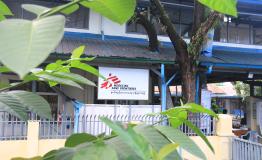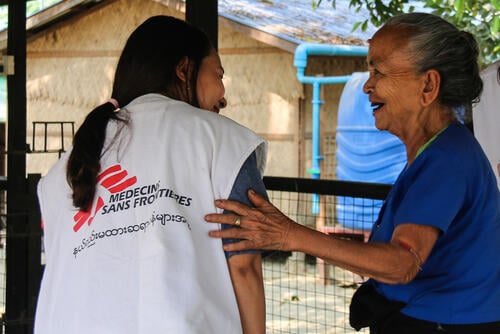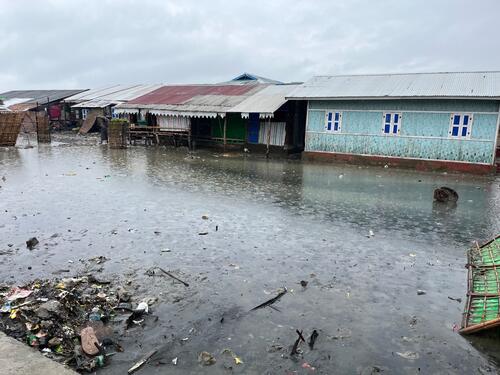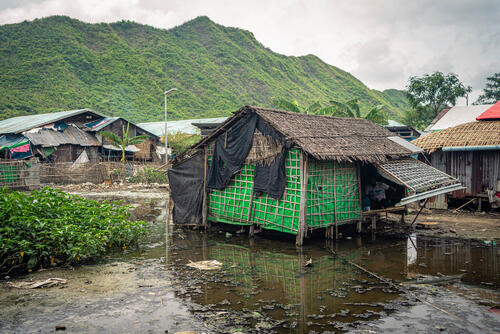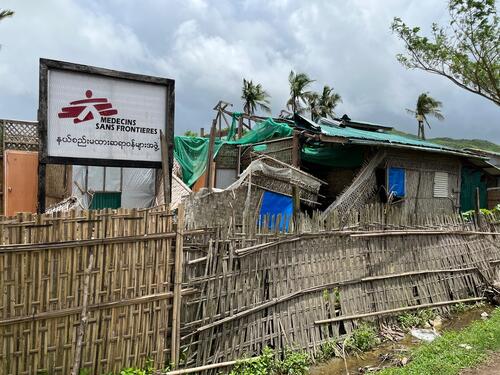
One month after Cyclone Mocha hit parts of Myanmar, MSF staff are still witnessing damage caused by the storm in many areas of Rakhine state.
A view of the MSF clinic at Kein Nyin Pyin camp Pauktaw, Rakhine State, after it was damaged by Cyclone Mocha. Myanmar, 22 June, 2023.
© MSF
The military’s seizure of power in Myanmar in February 2021 left the public healthcare system in disarray, threatening millions of people’s ability to access healthcare.

MSF teams continue to care for HIV, tuberculosis and hepatitis C patients, provide basic healthcare and reproductive and sexual healthcare services, and to respond to medical emergencies.

We pioneered HIV treatment in Myanmar – at one point becoming the largest provider of antiretrovirals in the country – and steadily grew a large patient cohort. In 2015, we began working with the Ministry of Health to transfer patients to the decentralised National AIDS Programme, so people can receive care closer to home. This has been suspended since the military seized power, and we are now seeing those patients return to us in greater numbers at our clinics in Shan, Kachin and Tanintharyi.

Despite restrictions on humanitarian access to conflict-affected areas, we have mobile teams based in Sittwe and Maungdaw in Rakhine state, who offer basic healthcare. They also arrange emergency referrals for patients from all communities, including those forcibly detained in camps.

Our activities in 2025 in Myanmar

Data and information from the International Activity Report 2025.

MSF in Myanmar in 2025 Médecins Sans Frontières (MSF) teams in Myanmar continued to face barriers in providing humanitarian assistance to communities in need. Despite this, we delivered emergency assistance to people affected by conflict, exclusion, and an earthquake.
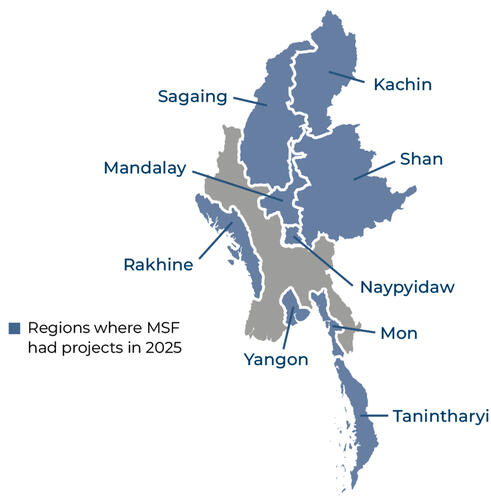
Country map for the IAR 2025.
© MSF

In 2025, we saw the gap between people’s needs and our ability to respond grow, as increasing access restrictions – including bureaucratic and administrative measures that limited our ability to travel and move supplies – impeded our medical humanitarian action. Wherever possible, MSF teams provided lifesaving care to communities through regular and emergency programmes.

As well as maintaining our support to the national AIDS and tuberculosis (TB) programmes in Kachin state, northern Shan state, and Yangon region, we provided treatment for sexual and gender-based violence, general healthcare, sexual and reproductive health services, and emergency referrals to specialist facilities across our projects.

In 2025, enhanced infection prevention and control (IPC) measures were introduced in national TB programme clinics across Yangon region. MSF’s IPC support began in February at Insein Union TB institute, later expanding to two more facilities, and included carrying out renovations to infrastructure, donating materials, and providing training and monitoring.

We also assisted communities affected by conflict between the Myanmar Armed Forces and different ethnic and resistance groups. In Kachin, we distributed hygiene kits to displaced families in areas that were safely accessible to us. In Rakhine state, Rohingya people continued to attempt journeys by sea, in hope of escaping the systemic persecution the minority group faces in Myanma,r by reaching neighbouring countries, such as Bangladesh and Malaysia. When boats are intercepted by the Myanmar Navy, people aboard, including children, may be detained. We provided 30 days’ worth of food to children after they were released.

When a 7.7 magnitude earthquake struck Myanmar in March, MSF delivered emergency assistance in the most heavily affected areas, including Mandalay, Sagaing city and Nyaung Shwe in southern Shan state. We focused on distributing relief items and shelter kits, and improving water and sanitation conditions by drilling boreholes, constructing a pipeline, and installing water treatment systems.  

In Dawei, Tanintharyi region, we were forced to suspend and eventually close a project due to high levels of insecurity, ending 20 years of essential healthcare services. 


In 2025

Myanmar

Language
English