


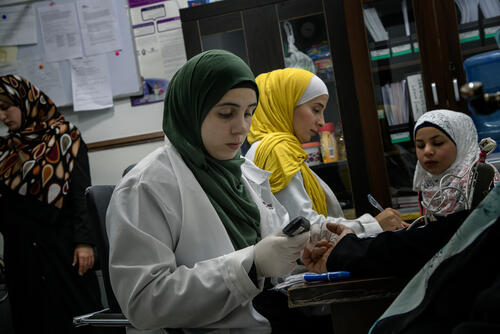
On International Nurses Day, MSF celebrates the work, dedication and passion of its 8,843 nurses saving lives around the world.
Video
Nursing in northeast Nigeria
Being a nurse brings out the humanity in you.Philomena Obiefuna, nurse in Nigeria's Borno state
“Being a nurse brings out the humanity in you”. These are the words of Philomena Obiefuna, a Nigerian nurse caring for malnourished children in the country’s conflict-ridden Borno state. A sense of our shared humanity is something Médecins Sans Frontières (MSF) tries to bring to every community it helps. Each day, our nurses make that possible.
From cholera outbreaks to extreme violence, from providing basic care in deprived and remote communities to helping those forced to flee their homes, it would be hard to find a medical activity where MSF’s nurses are not involved. It would be almost impossible to find any project where nurses are not on the frontline, delivering life-saving care to patients; every hour of every day.
Whether they scrub-in as nurse anaesthetists in an operating theatre, vaccinate thousands of children in one day, manage a hospital ward, travel hundreds of kilometres to help install a mobile clinic in an isolated community or triage people rescued from a sinking boat, MSF’s nurses are usually the first face a patient sees when in MSF’s care. Their expertise, talent and skills play a critical role in the treatment of our patients.
Despite MSF’s name, everyone who works for us knows that none of our activities – spread out over more than 70 countries – could carry on without the daily commitment, passion and skills of MSF’s 8,843 active nurses. One in five MSF employees is a nurse and an overwhelming majority (close to 90 per cent) are local staff hired in the country where they work, providing care to their own communities.
Anyone who has spent time as a patient in a hospital will say that most of their daily interactions were with nurses. This is as true in the most deprived areas of South Sudan as it is in a private clinic in New York. MSF operations are no exception: whatever the needs of patients are, our nurses are there to care for them.
In MSF, nursing care means a patient-centred approach, where the way we treat and support a patient is adapted to suit their situation.
There is also the technical side of caring. Nurses do many clinical acts, including resuscitating patients, monitoring vital signs, cleaning and dressing wounds, administering pills and injections, inserting intravenous lines, providing vaccinations, and much more.
Despite working is some very difficult environments, MSF insists that care delivered should be evidence-based and of the highest possible quality. All the medical acts nurses perform can only be life-saving if they are performed well, at the right time and with the right equipment. In MSF, the expectation of high quality nursing care is supported by a number of guidelines, protocols and standard procedures to help them. But beyond these procedures, the expertise, talent and skills of nurses play a critical role in the treatment of patients.
“The skills of nurses often make the difference between life and death” explains Dr Sebastian Spencer, MSF’s Medical Director. “I will never forget that nurse in Central African Republic who taught me how to perform an intraosseous blood transfusion, basically how to inject blood directly into the marrow of the bone. We saved a child that day in Paoua, but what I learnt from that nurse allowed me to save more lives and even to teach that technique to others. There’s a lot doctors can learn from nurses.”
Our nurses make a huge difference by helping patients to perform actions that they cannot easily do on their own. These include seemingly basic tasks like breathing normally, eating and drinking, eliminating body waste, sleeping or resting, and maintaining body temperature within normal range. These all contribute to the patient’s recovery, and to them regaining their autonomy as soon as possible.
Nurses are the ears that listen to patients’ stories, their fears and hopes. They are the shoulders to cry on when family members lose a loved one to injury or disease. They are counsellors when patients lose faith in their recovery. They are the desperately-needed smile in a stressful situation. They simply care for people.
Ahmad Nabil, an Iraqi nurse working with internally displaced people fleeing conflict in northern Iraq says, “As a nurse, my specialty is to provide medical services, but sometimes being listened to is what really helps these people.”
MSF would not be able to continue without nurses. If our doctors have no borders, our nurses definitely have no limits. The extraordinary work done by these professionals sometimes does not get the recognition it deserves, but anyone who has witnessed their daily commitment and passion can testify to the difference they make. Yet for MSF nurses, like so many nurses around the world, the best reward is probably the sometimes subtle one they get from their patients.
In the words of Michael Shek, a British nurse who has worked in both South Sudan and Syria, “In a lot of the places where MSF works, people literally have nothing, and being there and being able to alleviate their suffering, and seeing the smiles on their faces when they leave your facility is one of the most joyful things you could ever see.”

Yemen
As conflict engulfs Mocha, health workers keep hospital open
Voices from the Field
11 Sep 2026
Sudan
Aid cuts force mass clinic closures across Sudan, leaving millions without healthcare
Press Release
8 Sep 2026
Mediterranean migration
Europe is failing its legal and moral obligation to save lives at sea
Statement
8 Sep 2026