




261,200
261,2
116,100
116,1
19,600
19,6
4,240
4,24
Médecins Sans Frontières is working around Mali to improve access to healthcare in both rural communities and urban areas.
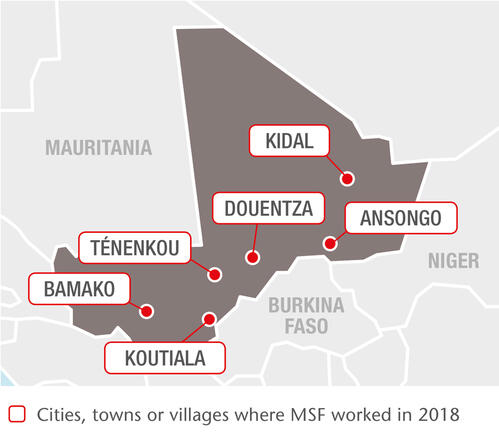
Mopti
Central Mali’s Mopti region has become increasingly unstable, with frequent outbreaks of violence, both intercommunal and between the military and non-state armed groups. Many aid organisations have stopped working in the region, meaning access to medical assistance is further curtailed.
We have teams working in Douentza and Ténenkou hospitals, and organising referrals from surrounding areas often affected by fighting.
In August, we expanded our activities to three health centres in remote areas of Douentza district, and sent ‘malaria agents’Community health workers trained to test and treat simple malaria, and to refer more severe cases. to hard-to-reach communities in Ténenkou district to support our mobile clinics during the malaria peak, between July and December.
Ansongo
In Ansongo town, Gao region, we support the local hospital with emergency care, surgery, maternal and child healthcare and neonatology. We provide medical and psychological care for victims of violence, including sexual violence, and organise emergency referrals to Gao hospital as required. We also provide care for pregnant women and children under five at a health centre in town.
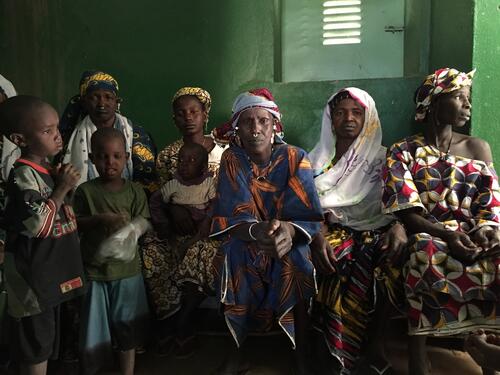
We run a community-based healthcare programme in several nomadic sites in the surrounding district, to ensure that nomadic communities also have access to healthcare.
The focus is on preventing, diagnosing and treating the most common diseases affecting pregnant women and children. We also support the referral of cases from the community to primary health centres.
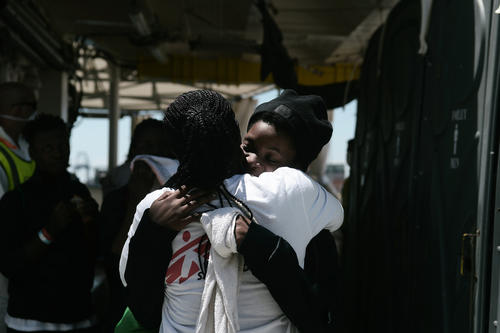
In April, when more than 700 sub-Saharan migrants expelled from Algeria passed through Gao city, we distributed around 500 hygiene kits and provided psychological assistance to 260 people.
Kidal
North of Gao, we have been supporting the delivery of medical and mental healthcare in Kidal district since 2015, through two health centres in the town and four in the periphery.
We also assist with epidemiological surveillance and referrals to Kidal hospital, and run a programme similar to the one in Ansongo to address common diseases affecting pregnant women and under-fives in 30 nomadic camps.
In 2018, we carried out a multi-antigen campaign in partnership with the Ministry of Health and local authorities to vaccinate more than 10,000 children under five throughout the region.
Koutiala
In the south, we support nutrition and paediatric services at Koutiala hospital, where we completed the construction of a new 185-bed paediatric care unit in 2018. In addition, we have teams conducting a range of preventive and curative activities in health centres and communities, especially during the seasonal malaria and malnutrition peaks.
By June, we were supporting 37 out of the 42 district health centres, with extra community workers engaged during the malaria peak. Our teams in Koutiala conducted over 160,000 outpatient consultations during the year.
Bamako
In October, we started working with the Ministry of Health on the diagnosis and treatment of cervical and breast cancer. We are supporting the haemato-oncology unit at University Hospital of Point G, including the provision of hospital and home-based palliative care.
794
794
€14.8 M
14.8M
1992
1992
Find us online