


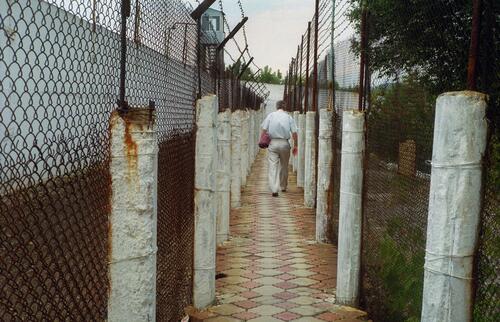
Medical Director of the Colony 3, Dr. Nikolai Gopilo, walking to one of the compounds where prisoners with drug-resistant TB are held. Colony 3 looks like a small village where inmates are allowed to walk freely inside the compound without constrains from the administration. Territory is secured by double fences, armed guard towers, armed guard patrols, and a "pass-system" of entry. Medical and non medical staff work in close proximity with the detainees.

The internal hierarchy of the prisoners, which was inherited from the Soviet regime and exists today in all the republics of the former USSR, is a kind of "caste" system that is defined by a rigid unwritten code, functioning quite independently of the penitentiary administration. The authorities know that the castes exist and are aware of their rules and realities.
Medical Director of the Colony 3, Dr. Gopilo, walking to one of the compounds where prisoners with drug-resistant TB are held. 
© Aleksandr Glyadyelov/MSF

Humanitarian work in prisons: the experience of Médecins Sans Frontières

Medical Director of the Colony 3, Dr. Gopilo, walking to one of the compounds where prisoners with drug-resistant TB are held. 
© Aleksandr Glyadyelov/MSF
Ebola disease in DRC: find out how we're responding
Learn more

The full article is available in Humanitarian Aid on the Move

Humanitarian action by NGOs in detention centres is quite rare and poorly documented. Despite the fact that prisoners are among those who have the least access to quality health care services, MSF has never chosen to make detention centres one of its strategic priorities. The inherent difficulties linked to this operational context explain the limited number of projects the organisation has developed and managed in prisons.

Author

Jean-Marc Biquet