


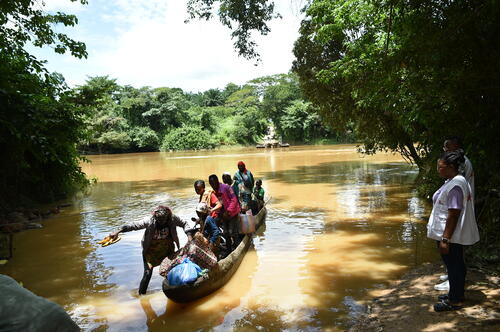
“When I went into labour, I started making my way to the nearest health centre, but then I felt one of my two babies coming, so I spread my cloth under a mango tree and gave birth on my own,” says Musa Yahyah, an Médecins Sans Frontières (MSF) patient in Sierra Leone.
“A traditional birth attendant helped me deliver the second baby under the mango tree. Afterwards, she called a motorbike-taxi to take me and my twins to the mother and child hospital in Hangha run by MSF, because I was bleeding a lot. They gave me a transfusion of two pints of blood, then me and my babies were finally fine,” says Musa.
Despite major progress made, in 2020 Sierra Leone still ranked as one of the countries with the highest number of women deaths in childbirth, with an estimated 443 maternal deaths per 100,000 live births, according to the World Health Organizationhttps://www.who.int/publications/i/item/9789240068759.
Video
Ambulance services in Sierra Leone
Many women in Sierra Leone live in remote, rural areas, far from health facilities, and cannot afford the high cost of transport to reach a hospital. This is compounded by poor roads, a countrywide shortage of ambulances and a lack of proper patient referral mechanisms. By the time a woman experiencing complications in childbirth does manage to reach a hospital, it may be too late.
“Late referrals can be fatal, and some medical complications could be avoided if women with obstetric emergencies were able to reach health facilities on time,” says Amadu Musa, a nurse at MSF’s mother and child hospital in Hangha, Kenema district.
“We had a patient from Daama village, about two hours from our hospital, who was pregnant and was referred very late. When the doctors did a scan, they found out that the baby did not have a heartbeat. The mother was also very anaemic and in a critical condition,” says Musa.
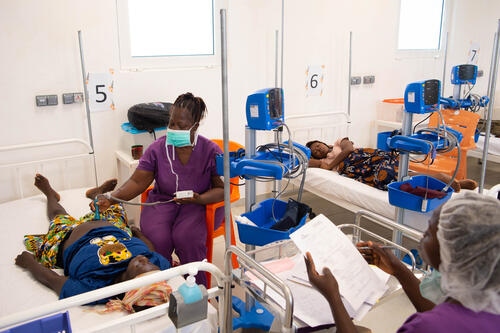
Our teams in Kenema carry out emergency caesareans and other lifesaving surgery for pregnant women and new mothers. We also work in two other locations in Sierra Leone – in Mile 91, and in Magburaka, Tonkolili district – to help local health staff respond to maternal and paediatric medical emergencies.
In the first seven months of 2023, our teams in Kenema, Mile 91 and Magburaka helped 3,326 women deliver their babies, 505 of them by emergency caesarean.
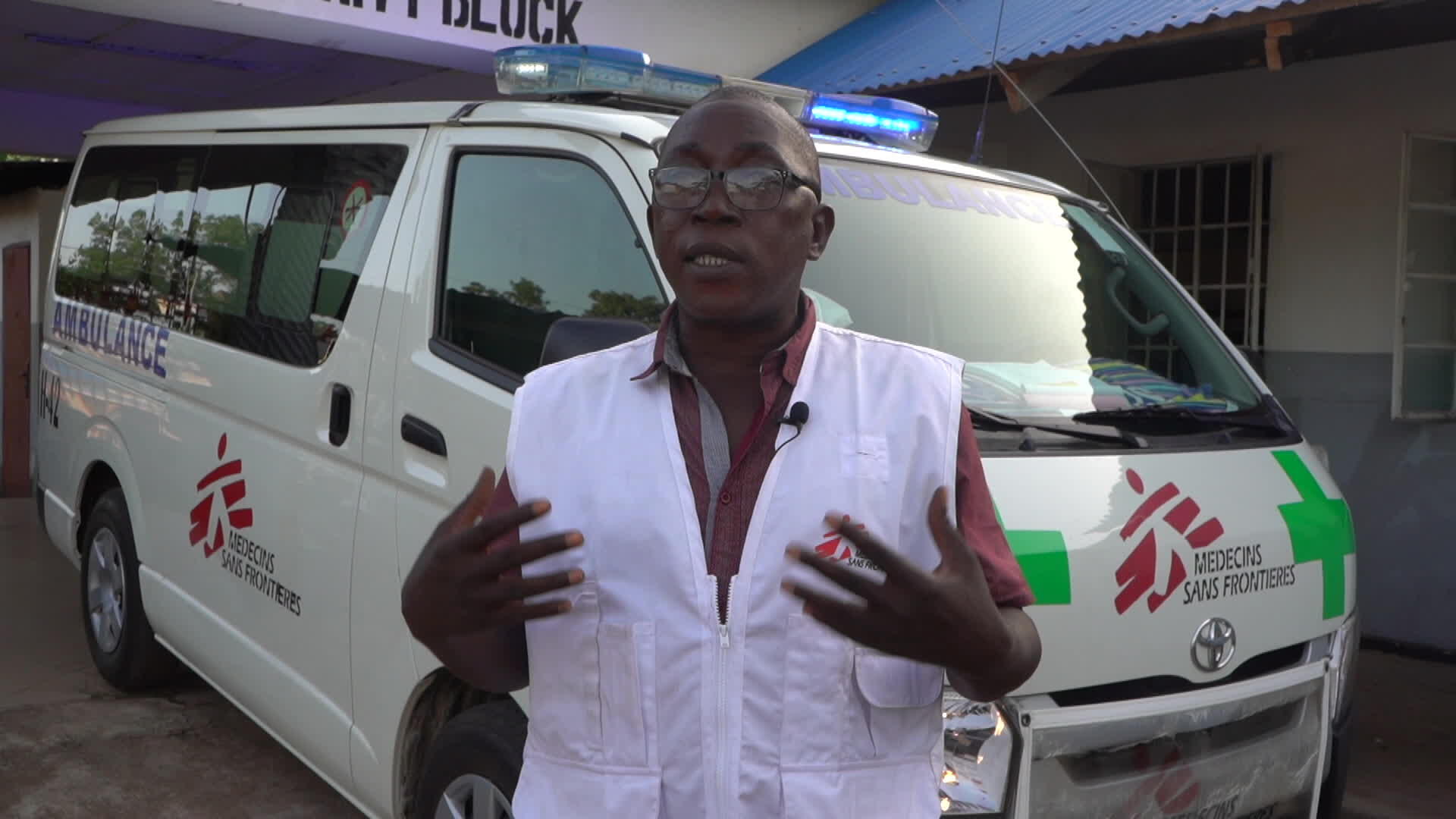
MSF’s work in Sierra Leone also includes running an ambulance service to get women and children in need of emergency care to hospitals as fast as possible.
“There is a significant need for ambulances to transfer pregnant women experiencing complications from local clinics to hospitals,” says Kennedy Uadiale, MSF medical coordinator in Sierra Leone.
“A good referral system is key and needs to be prioritised to ensure a decrease in maternal and neonatal mortality and save more lives,” he says.
A good referral system is key and needs to be prioritised to ensure a decrease in maternal and neonatal mortality and save more lives.Kennedy Uadiale, MSF medical coordinator in Sierra Leone
Between January and July 2023, MSF’s eight ambulances transferred 372 pregnant women and new mothers with their babies to a hospital for emergency care. The women faced a range of life-threatening conditions including pregnancy-induced hypertension, post-partum haemorrhage, anaemia in pregnancy and antepartum haemorrhage.
We also reimburse women for the cost of taking a motorbike-taxi, the only alternative transportation available in most places, to health facilities, paying for 900 trips in the first seven months of 2023.
Umo Ngamanga, aged 18, comes from Moyamba district in southern Sierra Leone. She gave birth to her first baby at home because she was unable to reach the nearest health centre in time.
“I started experiencing labour pains at night, but to get to the health centre in Foindu, 10 kilometres away, you have to walk for two hours as well as cross a river,” says Umo.
“My baby could not feed, and he had a fever, so the next day I took him to Foindu. He was immediately taken by motorbike-taxi to Hinistas community health centre, and then by an MSF ambulance to Magburaka hospital. After receiving care, he got better, and I was able to bring him home.”
Umo Ngamanga, 18, comes from Moyamba district in southern Sierra Leone
“My baby could not feed, and he had a fever, so the next day I took him to Foindu. He was immediately taken by motorbike-taxi to Hinistas community health centre, and then by an MSF ambulance to Magburaka hospital.”
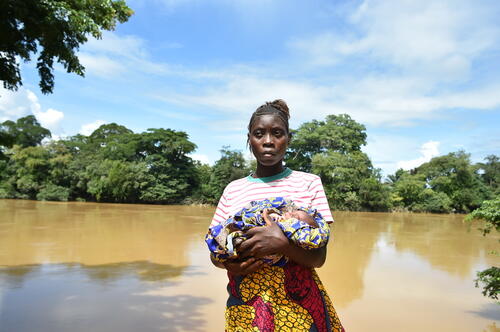
MSF has also trained traditional birth attendants in Kenema district to monitor pregnant women and watch out for danger signs, referring them to the closest health centre for medical attention, or calling an MSF ambulance to take them to hospital if they need advanced care.
Our activities to provide care for mothers and children in Sierra Leone are crucial, but much more is needed if the country is to continue the progress made in the past 23 years.
“Health programming in the country needs to include staffing, maintenance and fuel costs for existing ambulances at the National Emergency Medical Services,” says Mohamed Morchid, MSF head of mission in Sierra Leone.
“It is also important to consider creative and sustainable models for supporting emergency transport needs from patients’ houses to their nearest health facilities, as this remains one of the main barriers in terms of access to quality medical care,” says Morchid.
“We encourage the Ministry of Health and Sanitation, as well as health and development partners and stakeholders, to make additional investments in emergency transport. This would help save many more lives,” he says.
In Mile 91 and Magburaka town, in Tonkolili district, our teams work with the Ministry of Health and Sanitation to provide healthcare for mothers and children in local health centres and Magburaka hospital.
In 2019, in Kenema district, MSF teams finished the construction of a mother and child hospital in Hangha, where we provide comprehensive emergency obstetric and newborn care. In Makeni regional hospital, in Bombali district, our teams provide treatment for patients with drug-resistant tuberculosis.
Ebola and haemorrhagic fevers
Five things to remember a decade after the Ebola outbreak in West Africa
Project Update
20 Mar 2024
DRC Ebola outbreaks
Children are being left behind in the current Ebola disease outbreak response
Press Release
15 Oct 2026
DRC Ebola outbreaks
What will it take to end the Ebola disease outbreak in Democratic Republic of Congo?
Project Update
30 Sep 2026