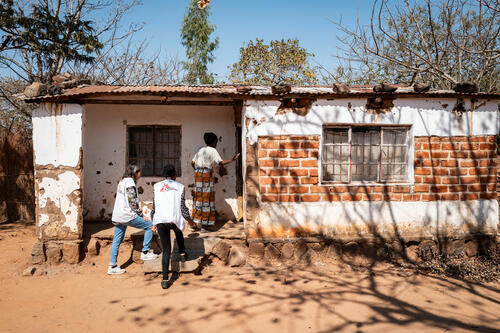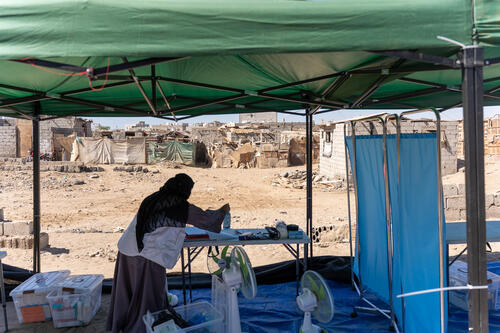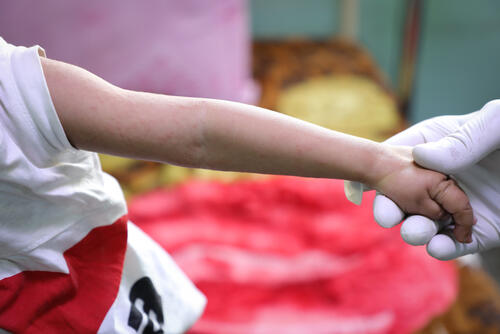
Over the past three years, there has been a substantial increase in the number of children admitted to Médecins Sans Frontières (MSF) hospitals in Yemen for measles. In the first half of 2023, the number of measles patients received in MSF-supported facilities has nearly tripled, at almost 4,000, compared to the whole of 2022.
Considering the impact of almost nine years of conflict, and the economic hardship wracking the country, what we're seeing is likely the tip of the iceberg.
In 2022, we raised the alarm on surging child malnutrition in Yemen – a condition that exacerbates other diseases. Malnutrition weakens the immune system, making children, especially those who are not vaccinated, even more susceptible to the deadly impact of measles.
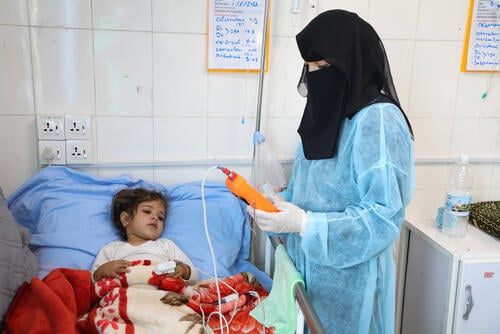
Both of these conditions are preventable, and highlight the lack of essential healthcare and the poor economic conditions for people in Yemen. These factors have had a substantial impact on the lives of people like Aisha, and her three-year-old son Abdullah.
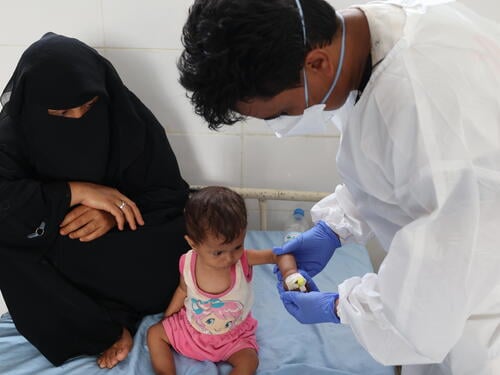
“Abdullah was suffering from throat pain, high fever, and red eyes; then a red spotty rash appeared on his body,” says Aisha about her son, Abdullah, who has been admitted to Abs hospital in Hajjah governorate.
“When I took him to the clinic, the doctor said he had measles with complications, and he would need to be hospitalised. Abdullah had already received some vaccines, but some were missing; it was difficult to keep going to the clinic. Transport was either unavailable or very expensive. So, we didn't cover all his vaccines,” says Aisha.
The increase we’ve seen this year cannot be ignored – the caseload has nearly tripled... These are not just numbers we’re talking about – they’re children’s lives.Isaac Alcalde, MSF head of mission in Yemen.
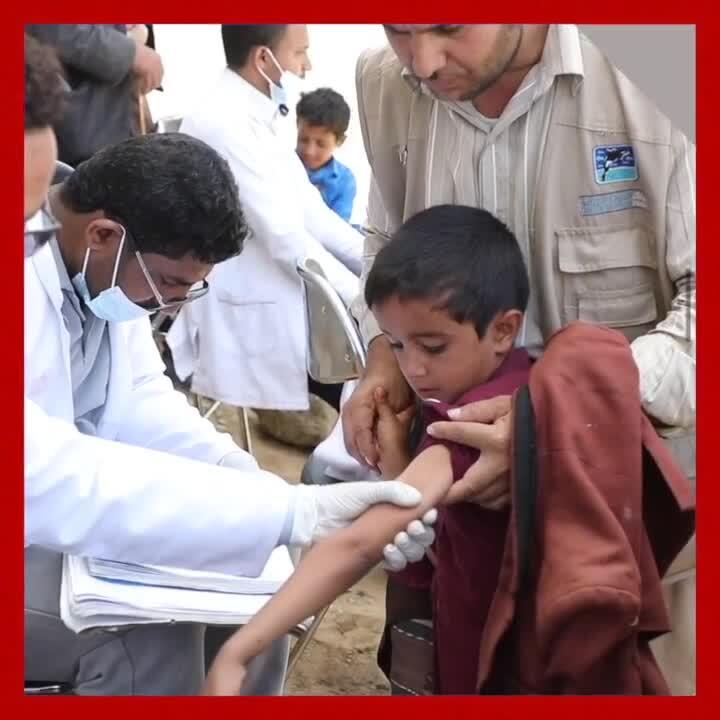
Measles is a highly contagious viral infection that can easily spread in densely populated communities. It predominantly affects children under five and is particularly dangerous for those with underlying conditions or complications. Although a potentially deadly disease, it is preventable through vaccinations.
Economic hardship, fuelled by violent conflict, makes it extremely difficult for people in remote areas to pay for fuel or transport to bring their children to the hospital. Aggravating this is the absence of vaccination campaigns, and affordable and functional general healthcare facilities in the country, forcing people to travel further afield to obtain the necessary treatment.
As a result, patients often arrive in MSF-supported hospitals with complications, including advanced-stage measles, which could be avoided with preventive care such as vaccination or with timely medical treatment.
While it’s difficult to quantify all the factors in Yemen’s growing challenges with measles and other preventable diseases, it’s clear that major gaps in routine vaccination and limited access to basic healthcare facilities play a major role. To make matters worse, we have seen a huge increase in the prevalence of the disease in our clinics this year.
Video
Rise of Measles in Yemen
“In 2020, we saw the number of measles patients in our clinics drop from 731 in 2019, to just 77. We might attribute this to the massive vaccination campaign carried out in 2019,” says Isaac Alcalde, MSF head of mission in Yemen.
“But the dramatic increase we’ve seen this year cannot be ignored – the caseload has nearly tripled, going up to almost 4,000, increasing the strain on medical facilities, which are already overloaded. These are not just numbers we’re talking about – they’re children’s lives,” says Alcalde.
Unfortunately, this increase in the number of measles cases is not an isolated issue. Our teams have witnessed the rise and devastating impact of the disease in Amran, Sa’ada, Hajjah, Ibb, Hodeida, Taiz, Marib and Shabwah governorates.
United Nations agencies have also highlighted the severe increase in vaccine-preventable diseases in Yemen, pointing out that the country recorded more than 22,000 measles cases in 2022, including 161 deaths. In April of this year, there had already been 16,114 cases. With diphtheria and pertussis – whooping cough – cases are also on the rise, as are deaths from each disease.
Scaled up response needed to save lives
In some of the health centres we support, we have adapted our activities to cater to the increased needs. For instance, since we started our response to measles in Al Bayda governorate, we saw a total of 1,784 cases between mid-February and June 2023.
Nearly 52 per cent of cases were complicated, while only 12 per cent of these patients had been vaccinated prior to admission, offering a bleak illustration of the low level of immunisation.
This lack of immunisation appears to be driven by logistical barriers, including the restrictions on humanitarian imports, the number of health facilities able to provide vaccinations, as well as an absence of health education to highlight the essential role vaccines play in protecting people from diseases like measles.
Our teams have also extended the measles isolation unit in Abs Hospital to cater to the increased number of patients. In Al Qanawis Mother and Child Hospital, in Al Hudayda governorate, more than half of the patients admitted to the paediatric ward were children suffering from measles, just days after it opened in May 2023.
Similarly, a substantial increase of cases in Mocha, Taiz governorate, saw the need for a new isolation ward to be opened specifically for measles in April 2023. In Khamer and Haydan, 35 per cent and 41 per cent (respectively) of patients admitted to the paediatric unit were suffering from measles. The common thread in these different locations is a high prevalence of cases, along with an alarmingly low level of immunisation.
Addressing this grave health crisis demands a comprehensive and coordinated response. To protect Yemeni children from the risk of measles, it is imperative to bolster preventive measures, community involvement, and enhance case management.
The authorities, along with humanitarian and health actors in Yemen, must ensure the availability of vaccines in health structures, increase the accessibility and capacity of general healthcare facilities, strengthen referral pathways and reinforce community health awareness.
MSF first started working in Yemen in 1986 and we have been present in the country continuously since 2007. Our teams work in 11 hospitals and provide support to another 16 health facilities across 13 governorates. In 2022, we admitted more than 108,000 people for inpatient care, provided over 71,000 outpatient consultations, more than 36,000 surgical interventions, and assisted more than 35,000 births.