


Since early 2023, Djugu territory in Ituri province, Democratic Republic of Congo (DRC), has seen intense intercommunal violence and armed clashes, forcing an estimated 156,000 people to flee their homes. This is the latest surge of violence in a decades-long conflict, which has seen 700,000 people displaced within Djugu territory and 1.7 million across Ituri province.
Gunfire crackles, down the hill from the hospital of Drodro, about two kilometres away. A few hours earlier, there had been clashes on the northern route, a few kilometres away.
Now the noise is getting closer. Traumatised by years of chronic violence, patients and hospital staff have only one reflex: to flee. Even if that means interrupting their treatment.
Quickly, everyone packs up their belongings. Mothers wrap their sick children in cloths and secure them on their backs, then grab whatever else they can carry and hurry away.
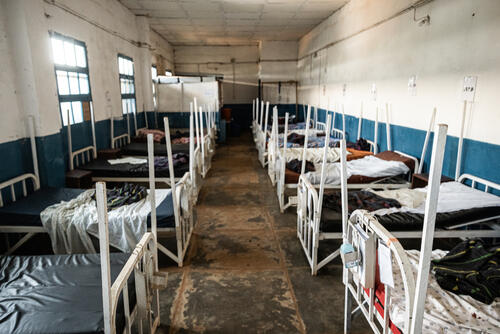
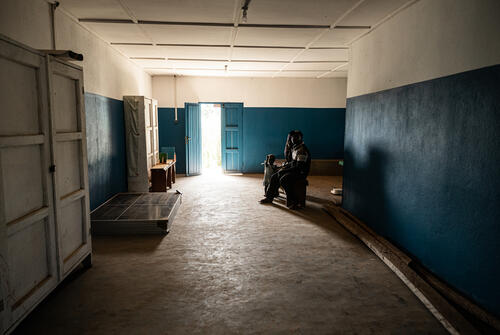
In less than 30 minutes, Drodro hospital, with its 100 beds, is empty. Some patients and their caretakers were able to escape the area quickly, before the roads became too dangerous to travel, but others were too late. They had to turn back in the direction of the hospital.
Back in Drodro hospital, they all squeeze into one room to take refuge. The generator has been switched off, to allow the people inside to hear clearly if gunfire is approaching. The only noise is of children crying.
Cycles of violence
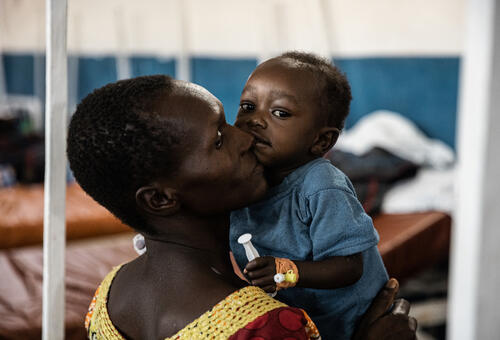
“I was on the hospital bed with my baby when the other mothers came up to us and said, ‘we have to leave, there's gunfire’,” says Joécie, mother of 17-month-old Salomon, who is being treated for severe malnutrition and anaemia.
“People were running around in panic. Without thinking any further, I wrapped my baby in a blanket and left. But in the panic, I forgot some of my things: his medical records and my kitchen utensils.”
After fleeing, Joécie decided to return to the hospital with her son later that night. “My son was too ill,” she says. “He had a fever and we had nothing to eat. I had no choice but to come back. It was a difficult night - I was panicking and I barely slept.”
Joécie, mother of 17-month-old Salomon, who is being treated for severe malnutrition and anaemia.
“He had a fever and we had nothing to eat. I had no choice but to come back. It was a difficult night - I was panicking and I barely slept.”
Chronic violence, and the fear of further violence, has left people in this area with deep psychological scars, for generations. Many people are fearful of accessing medical facilities, seeing them as potential targets and inherently unsafe. Some would only seek care in an extreme emergency.
“Imagine that people have been living through this conflict for years, over several generations, with repeated displacements and few prospects for the future,” says Grâce Longa Mugisa, Médecins Sans Frontières (MSF) mental health advisor. “They are constantly reminded of the massacres of their neighbours and family members. It's difficult to think logically.”
This is the third time since the beginning of the year that some medical facilities in Drodro health zone have been deserted following clashes nearby.
“I've been working with MSF since 2015, in several countries, but I've never experienced this type of event - a hospital emptying out like this,” says Dr Kelly Tsambou, MSF’s head of medical activities in Drodro health zone.
“When patients flee, what can we do? You can't stop them. Every patient should be able to feel safe in medical facilities. Elsewhere, hospitals are often used by the civilian population as a place of refuge during conflicts, but that's not the case here,” says Tsambou.
They are constantly reminded of the massacres of their neighbours and family members. It's difficult to think logically.Grâce Longa Mugisa, MSF mental health advisor
Insecurity directly hinders access to healthcare
Today, only eight of 16 health facilities in Drodro health zone are functioning. To continue to provide impartial aid, we aim to respond equitably to needs and provide care to each of the communities.
However, chronic violence and repeated displacements are disrupting medical activities. Our response has been to offer additional resources to various health facilities, with the aim of facilitating access to medical care for as many people as possible, and in support to the Ministry of Health.
“Since MSF arrived in the region in 2019, our teams have always had to deal with cycles of violence,” says Soumana Ayouba Maiga, MSF project coordinator. “But faced with the recent upsurge in violence, we have had to adapt by increasing resources to certain medical facilities to enhance healthcare services and bring them closer to the communities.”
We are also rehabilitating the health centre at Blukwa'Mbi – where large numbers of displaced people are living with host families – to transform it into a referral centre that can provide specialist medical care.
“The construction of an operating theatre, with a solar-powered electrical system, will enable medical teams to carry out procedures such as caesarean sections,” says Maiga. “We want to provide access to more specialist care for people who can't access the hospital in Drodro.”
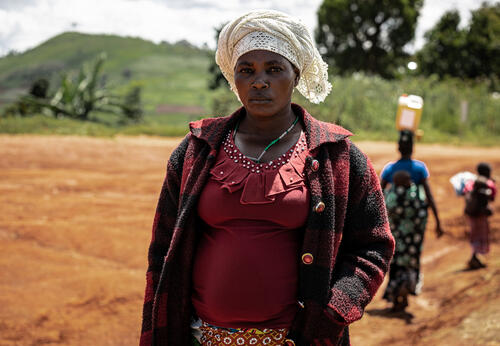
Micheline, a 43-year-old mother, hosts numerous people who have been displaced
“What worries me most today is access to food. Most of us don't eat every day, even the children. It's not harvest time now, so there's nothing.”
Urgent scale up of assistance required
Often ignored by the media and without political or international attention, the 1.7 million displaced people in Ituri province are in desperate need of humanitarian assistance: food, clean drinking water, proper sanitation, shelter, education, and healthcare.
The chronic insecurity makes it impossible for people to reach their fields and tend the crops – the main economic activity in the area.
In some parts of Drodro health zone, our teams are almost alone in responding to people’s medical needs. The humanitarian needs are catastrophic. It is essential that humanitarian assistance is provided for the people here in a neutral and impartial manner.
MSF teams provide healthcare in Drodro general hospital, as well as two health centres, two advanced health posts and six community health sites in Drodro health zone, in collaboration with the Ministry of Health.
Since the beginning of 2023, our teams in Drodro health zone have provided 25,630 medical consultations, treated 850 children for malnutrition, provided 435 mental health sessions and cared for 165 survivors of sexual violence.
Democratic Republic of Congo
Massive needs everywhere as displacement reaches unprecedented levels in DRC
Project Update
20 Dec 2023
Democratic Republic of Congo
Violence exacerbates malnutrition in North Kivu, DRC
Project Update
26 Oct 2023
Democratic Republic of Congo
The struggle to survive amidst violence and displacement in North Kivu
Documentary
4 Sep 2023