


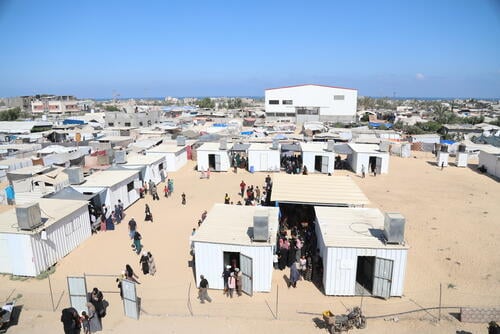
For over 10 months, the war in Gaza, Palestine has led to the displacement of over 1.9 million people.1 Often forced to move within minutes of Israeli forces announcing an evacuation order, many people have now been displaced multiple times. In Al-Mawasi, Khan Younis, the Palestinian Agricultural Development Association (PARC), with Médecins Sans Frontières (MSF) support, is providing emergency latrines, solar water pump systems, water treatment plants, and goods such as tents, to some of the displaced people arriving in Khan Younis.
As evacuation orders by Israeli forces continue to compress people into smaller and smaller areas along the now increasingly cramped coastal area of Deir Al-Balah and Khan Younis in the Gaza Strip, the living conditions in Al-Mawasi are getting worse. OCHA - the United Nations Office for the Coordination of Humanitarian Affairs - estimates that from 22 to 26 July alone, more than 190,000 Palestinians were displaced in Khan Younis and Deir Al-Balah.
The living conditions are extremely difficult... Children are the most impacted, especially by skin conditions that are highly contagious.Dr Youssef Salaf Al-Farra, PARC paediatrician
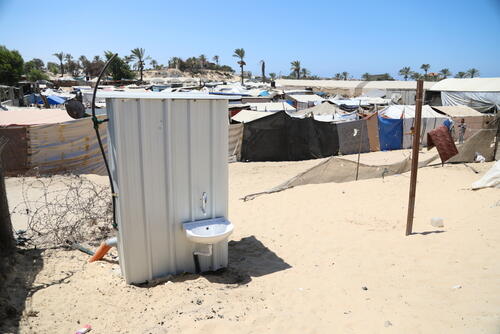
Those displaced in Al-Mawasi, Khan Younis, in southern Gaza, are living in dusty tents, overcrowded with several family members. They are without proper access to food, water, and essential services, such as sanitation and healthcare. People may have to queue for hours for water, even for latrines, and are unable to regularly shower.
“The living conditions are extremely difficult. Every day, we see between 300 to 400 people at the medical clinic, of which 200 cases are related to skin conditions,” explains Dr Youssef Salaf Al-Farra, a PARC paediatrician. “Children are the most impacted, especially by skin conditions that are highly contagious.”
Between 1 July and 21 August, at least 16 evacuation orders have been issued by Israeli forces in Gaza. An estimated 213,000 Palestinians have been affected between the beginning of August to 16 August, and 86 per cent of Gaza has come under evacuation orders since the war began, according to OCHA.
After months of endless evacuation orders by Israeli forces, people are left without belongings. Many arrive in Khan Younis without even a plastic bag of belongings, or a single bar of soap.
People are forced to move in a rush with very little forewarning, which can be particularly challenging for people with disabilities, women with children and elderly people.
As skin conditions are increasing, PARC, supported by MSF, has built over 300 latrines, including accessible latrines for people with physical disabilities in the Deir Al-Balah camp. They’ve also installed three solar water pump systems and provided basic healthcare to displaced people.
Rasha Misbeh, displaced in Khan Younis
“Children’s faces and bodies are becoming itchy. All the children are impacted by the spread of [skin] conditions; there is not a single child who isn’t impacted. Everyone is packed closely together, which is making it worse.”
![“There is no clean drinking water, resulting in diseases spreading,’ explains displaced mother Rasha Misbeh, 24 years old. “Children’s faces and bodies are becoming itchy. All the children are impacted by the spread of [skin] conditions; there is not a single child who isn’t impacted. Everyone is packed closely together, which is making it worse”.
After ten months of war in Gaza, over 1.9 million people have been displaced according to UN OCHA. People have been forcibly displaced, often in a rush and without proper warning, from one place to another, without anything left to carry with them, except their children and a few plastic bags of belongings. People with disabilities, women, children and the elderly, are especially vulnerable.
The IDPs in Mawasi Khan Younis, southern Gaza, are living in dilapidated tents, overcrowded with many members of the family, without proper access to food, water, and essential services such as sanitation and health care. People are queuing for latrines for hours on end and are unable to regularly shower.
As skin conditions are increasing, PARC supported by MSF has built over 300 latrines, including accessible latrines for people with disabilities, operation of water wells through the provision of solar systems and primary health care to displaced people.](https://img.msf.org/AssetLink/3wo0vodpm48g112dy2k3mi7311oo6pp1.jpg "Rasha Misbeh, 24 years old, displaced from to Al Mawasi, Khan Younis, Gaza.")
“There is no clean drinking water, resulting in diseases spreading,” explains Rasha Misbeh, a mother who is displaced. “Children’s faces and bodies are becoming itchy. All the children are impacted by the spread of [skin] conditions; there is not a single child who isn’t impacted. Everyone is packed closely together, which is making it worse.”
For three months, MSF has been trying to import 4,000 hygiene kits to improve the living conditions of people in Khan Younis. The kits contain basic everyday items such as soap, toothbrushes, shampoo, and laundry powder. The scarcity of such items in Gaza means they are prohibitively expensive for people to purchase. For three months, importation of these kits has been blocked by the Israeli authorities.
MSF calls for an immediate ceasefire, as well as unimpeded safe access for staff and supplies to be able to enter Gaza and to areas most in need of support.
Gaza-Israel war
“Inflicting harm and denying care” in the West Bank: MSF report on escalation of attacks and obstructions of healthcare
Press Release
6 Feb 2025