


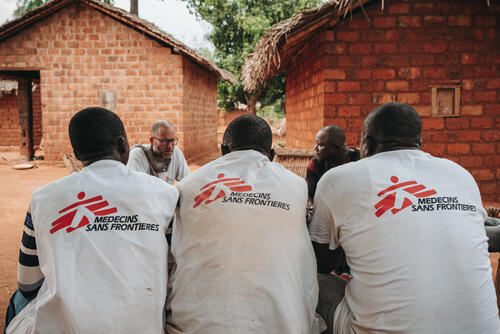
Thousands of people have been killed or wounded and millions displaced during years of bloody – but largely neglected – conflict in the Central African Republic.
Since the civil war of 2013, CAR has been marked by cycles of intensive violence. Fighting between the government and non-state armed groups, spurred by an election process, escalated in early 2021.
MSF sees the direct consequences of violence on the health of individuals and entire communities. There is a severe lack of access to healthcare; trained health workers are scarce, health services are poorly resourced and often targeted by the conflict; and patients need to travel hundreds of kilometres on dangerous roads to reach medical structures.
In CAR, we focus on treating victims and survivors of sexual violence; provide sexual and reproductive healthcare, including maternal healthcare; and provide treatment to people living with HIV.
Our activities in 2025 in Central African Republic
Data and information from the International Activity Report 2025.
2,332
2,332
€67.9 M
67.9M
1997
1997
MSF in Central African Republic in 2025
MSF works to address the critical shortage of health services in Central African Republic (CAR), in particular for women and children in hard-to-reach areas of the country.
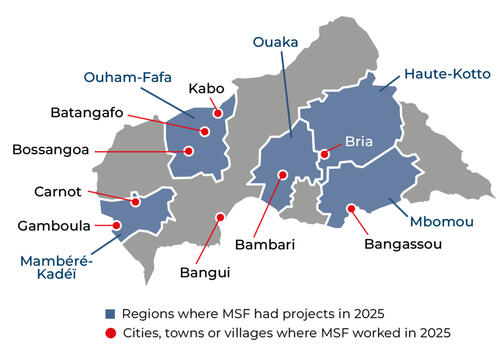
The health system in CAR is structurally fragile and underfunded, with one of the lowest doctor-to-person ratios in the world, and only half of its facilities functional. Epidemics also pose a major challenge, compounded by low vaccination coverage. Access to healthcare in rural, remote areas is further hampered by chronic insecurity, impassable roads, and the high cost of transport to the nearest facility, which is often many kilometres away.
MSF plays a crucial role in delivering essential care in the country, in the capital, Bangui, and in remote regions of Bambari, Bangassou, Batangafo, Bossangoa, Bria, and Carnot.
Improving access to healthcare
We continue to run a broad range of medical services, supporting health facilities with emergency surgery, intensive care, paediatrics, neonatology, intensive nutrition, treatment for HIV, tuberculosis and chronic diseases, and sexual and reproductive healthcare. In 2025, our teams completed the construction of a 74-bed paediatric ward at Carnot hospital, which we run in collaboration with the Ministry of Public Health.
Maternal, infant, and neonatal death rates in CAR remain among the highest globally, due to inadequate care during pregnancy and childbirth. We are responding by delivering free, high-quality services for mothers and children, such as antenatal consultations, caesarean sections, and incubation for newborns, in all our projects in the capital and in Bangassou, Batangafo, Bossangoa, Carnot, and Bria.
Malaria is a leading cause of sickness and death in CAR, particularly among children under five years old, and accounts for a large proportion of consultations in health facilities. MSF is working to improve access to diagnosis and treatment by operating ‘malaria points’ in communities, where trained community health workers are able to diagnose and treat the disease early.
Strengthening vaccination coverage
Low vaccination coverage in CAR triggers frequent disease outbreaks that directly threaten the lives of young children. In 2025, MSF scaled up support for routine vaccination programmes in all the health facilities where we worked, not only increasing the number of vaccinations administered, but also providing a constant supply of medical equipment and training Ministry of Health staff on vaccination. EURECA,* our mobile emergency response team, which conducts epidemiological surveillance across the country, assisted local health authorities with two measles vaccination campaigns in 2025.
*EURECA stands for ‘Équipe d'Urgence en République centrafricaine’

577,600
577,6
301,400
301,4
78,300
78,3
22,900
22,9

Central African Republic
Outside humanitarian spotlight, Central African Republic is dogged by conflict
Project Update
15 Jun 2011
Fistula
Fistula reconstructive surgery returns lives, dignity and well-being
Voices from the Field
8 Mar 2011
Democratic Republic of Congo
Thousands from the DRC who escaped massacre remain unprotected in neighbouring states
Press Release
13 Jan 2010
Central African Republic
Nutritional emergency in south-western Central African Republic
Project Update
21 Sep 2009
Central African Republic
Economic collapse brings a ghost town and severe malnutrition to Carnot, CAR
Project Update
7 Sep 2009
Central African Republic
In just two weeks 390 children treated for malnutrition at new MSF nutritional project in the Central African Republic
Project Update
18 Aug 2009
Central African Republic
Violence in the north of Central African Republic forces thousands to flee
Press Release
30 Apr 2009
MSF job opportunities in Central African Republic
-
OCA ISM and IT
AI Solutions Team Lead
Fixed-term (CDD) Closing date: 13/09/2026 Starting date: ASAP NetherlandsAs AI Solutions Team Leader, you will be at the forefront of shaping how AI is used within MSF. You will guide the technical development of a portfolio of AI solutions that support medical teams, operational decision‑making, and organisational…
2026-09-13 <time>2026-07-28T14:09:12+0000</time> English NL -
WACA Operations
PROGRAM RESPONSIBLE E-CELL
Fixed-term (CDD) Closing date: 10/09/2026 Starting date: ASAP Côte d'IvoireObjectives The EPM is involved in the strategic orientations of the WaCA Emergency Response. Coordinator of the HQ support team & Field mobile team he/she is accountable of the global context monitoring and analysis and holds a pivotal role…
2026-09-10 <time>2026-08-21T16:23:40+0000</time> English CI -
WACA Operations
OPERATIONAL ASSISTANT CELL
Fixed-term (CDD) Closing date: 10/09/2026 Starting date: ASAP Côte d'IvoireObjectives Reporting to the Unit Program Manager and working closely with unit members and missions, the Operational Unit Assistant facilitates the administrative organisation and day-to-day running of the Regular, Emergency and Unit for Pilot…
2026-09-10 <time>2026-08-21T09:15:46+0000</time> English CI -
East Africa Branch Office Other
Accountability & Compliance Investigations Specialist
Open-ended (CDI) Closing date: 22/08/2026 Starting date: ASAP KenyaTo support the ATU’s mandate by conducting accountability audits, compliance reviews, and proactive monitoring activities across MSF EA departments. This role also serves as an investigator for complex cases, ensuring that financial systems,…
2026-08-22 <time>2026-08-07T07:51:58+0000</time> English KE -
MSF International Finance
Project Manager: transition to new EPM solution
Fixed-term (CDD) Closing date: 16/08/2026 Starting date: ASAP SwitzerlandThe International Finance Team (IFT) is part of the International Office. One of its functions is to provide financial information to movement-wide governance bodies and other internal and external stakeholders. MSF International has been using SAP…
2026-08-16 <time>2026-01-23T12:57:42+0000</time> English CHFR -
East Africa Branch Office Other
Head of Accountability & Transparency Unit (ATU)
Open-ended (CDI) Closing date: 27/08/2026 Starting date: ASAP KenyaThe Head of the Accountability & Transparency Unit provides strategic leadership, independent oversight, and operational management of the ATU. The role is responsible for institutionalization and embedding a culture of accountability and…
2026-08-27 <time>2026-08-07T07:46:43+0000</time> English KE -
East Africa Branch Office Medical
E-health Medical Content Advisor
Fixed-term (CDD) Closing date: 25/08/2026 Starting date: ASAP KenyaThe E-Health Medical Content Advisor provides strategic, technical, and operational leadership for the design, governance, implementation, and continuous improvement of medical content across MSF Ubuntu's digital health ecosystem. The role is…
2026-08-25 <time>2026-08-10T20:37:41+0000</time> English KE -
MSF International Other
International Drug Quality Assurance Leader
Open-ended (CDI) Closing date: 08/09/2026 Starting date: ASAP Argentina, Australia, Belgium, Brazil, Canada, Chile, China, Colombia, Côte d'Ivoire, Czech Republic, Denmark, Kenya, Finland, France, Germany, Greece, Hong Kong, India, Ireland, Italy, Japan, Lebanon, Luxembourg, Mexico, Netherlands, New Zealand, Norway, Poland, Portugal, Russian Federation, South Africa, Singapore, Korea, The Republic of, Spain, Sweden, Switzerland, Taiwan, United Arab Emirates, United Kingdom, United States of America, UruguayLead the MSF Drug Quality Assurance activities in order to identify new quality sources of drug supply, consolidate the MSF drug QA system to ensure quality, safe and efficacious medicines are used by MSF patients and achieve a coordinated approach…
2026-09-08 <time>2026-08-18T08:16:02+0000</time> English AR,AU,BEFR,BR,CAEN,CL,CN,CO,CI,CZ,DK,KE,FI,FR,DE,GR,HKZH,IN,IE,IT,JP,LB,LUFR,MX,NL,NZ,NO,PL,PT,RU,ZA,SG,KR,ES,SE,CHFR,TW,AEAR,GB,US,UY -
MSF International Other
Climate, Environment & Health Engagement and Advocacy Lead
Fixed-term (CDD) Closing date: 10/09/2026 Starting date: ASAP Argentina, Australia, Belgium, Brazil, Canada, Chile, China, Colombia, Côte d'Ivoire, Czech Republic, Denmark, Kenya, Finland, France, Germany, Greece, Hong Kong, India, Ireland, Italy, Japan, Lebanon, Luxembourg, Mexico, Netherlands, New Zealand, Norway, Poland, Portugal, Russian Federation, South Africa, Singapore, Korea, The Republic of, Spain, Sweden, Switzerland, Taiwan, United Arab Emirates, United Kingdom, United States of America, UruguayThe CEH Engagement, Advocacy & Positioning Lead supports the implementation of MSF’s Climate & Environment Programme of Engagement by coordinating internal engagement, positioning, advocacy preparation, and communication on climate,…
2026-09-10 <time>2026-08-19T12:23:40+0000</time> English AR,AU,BEFR,BR,CAEN,CL,CN,CO,CI,CZ,DK,KE,FI,FR,DE,GR,HKZH,IN,IE,IT,JP,LB,LUFR,MX,NL,NZ,NO,PL,PT,RU,ZA,SG,KR,ES,SE,CHFR,TW,AEAR,GB,US,UY -
OCBA Other
RESPONSABLE DES ACHATS INTERSECTION (BASÉE AU NIGER)
Temporary Closing date: 07/09/2026 Starting date: ASAP NigerMSF est présent au Niger au travers de cinq sections (OCG, OCBA, OCP, WaCA et Epicentre). Depuis des années, MSF mène des activités médicales en support au ministère de la Santé Publique/Hygiène Publique dans plusieurs régions du pays au niveau des…
2026-09-07 <time>2026-08-18T13:28:58+0000</time> French NE -
MSF Access General Management
MSF Access Sexual and Reproductive Health (SRH) Advisor
Fixed-term (CDD) Closing date: 03/08/2026 Starting date: ASAP Argentina, Australia, Belgium, Brazil, Canada, Chile, China, Colombia, Côte d'Ivoire, Czech Republic, Denmark, Kenya, Finland, France, Germany, Greece, Hong Kong, India, Ireland, Italy, Japan, Lebanon, Luxembourg, Mexico, Netherlands, New Zealand, Norway, Poland, Portugal, Russian Federation, South Africa, Singapore, Korea, The Republic of, Spain, Sweden, Switzerland, Taiwan, United Arab Emirates, United Kingdom, United States of America, UruguayThe SRH Advisor is part of the Analysis Department of MSF’s Access team, reporting to the Head of Analysis. S/he works in a multidisciplinary team consisting of experts on medical, pharmaceutical, legal and policy issues related to access to health…
2026-08-03 <time>2026-07-24T10:29:01+0000</time> English AR,AU,BEFR,BR,CAEN,CL,CN,CO,CI,CZ,DK,KE,FI,FR,DE,GR,HKZH,IN,IE,IT,JP,LB,LUFR,MX,NL,NZ,NO,PL,PT,RU,ZA,SG,KR,ES,SE,CHFR,TW,AEAR,GB,US,UY -
OCP Human Resources
HR Cell manager - Based in Nairobi
Fixed-term (CDD) Closing date: 20/09/2026 Starting date: ASAP KenyaMain Activities of the Job: 1. Mission HR Responsibility – South Sudan, Kenya & Chad 2. Strategic Partnership with the Cell HR Coordinator 3. Field Coverage & Continuity 4. Learning & Development Leadership 5. Operational HR…
2026-09-20 <time>2026-09-03T15:05:10+0000</time> English KE -
WACA Human Resources
HEAD OF UNIT RECRUITMENT & POOL MANAGEMENT
Fixed-term (CDD) Closing date: 11/08/2026 Starting date: ASAP Côte d'IvoireObjectives The Head of Unit, Recruitment & Pool Management (R&PM), leads a team of Recruiters and Pool Managers to ensure effective sourcing and matching for both International Mobile Staff (IMS) in the field and HQ staff. This role…
2026-08-11 <time>2026-07-21T10:49:23+0000</time> English CI -
OCBA Operations
SAFEGUARDING COORDINATOR (BASED IN SYRIA OR YEMEN)
Fixed-term (CDD) Closing date: 29/07/2026 Starting date: ASAP YemenThe Safeguarding Coordinator, in collaboration with the country-level team defines and leads the implementation of a Safeguarding Strategy to strengthen detection, prevention, and reporting, based on a context-specific needs analysis. He/She/They…
2026-07-29 <time>2026-07-08T12:01:08+0000</time> English YE -
OCA Operations
Member Amsterdam Emergency Team - Water & Sanitation Team Lead/Coordinator
Open-ended (CDI) Closing date: 21/08/2026 Starting date: ASAP NetherlandsMEMBER AMSTERDAM EMERGENCY TEAM Water & Sanitation Team Lead/Coordinator (Applicants of various levels of experience are encouraged and considered. The successful candidate will be recruited at their experience level) …
2026-08-21 <time>2026-07-30T12:39:04+0000</time> English NL -
MSF International Other
Medical Device UniQuality & Unidata Product Information Specialist
Open-ended (CDI) Closing date: 07/08/2026 Starting date: ASAP Argentina, Australia, Belgium, Brazil, Canada, Chile, China, Colombia, Côte d'Ivoire, Czech Republic, Denmark, Kenya, Finland, France, Germany, Greece, Hong Kong, India, Ireland, Italy, Japan, Lebanon, Luxembourg, Mexico, Netherlands, New Zealand, Norway, Poland, Portugal, Russian Federation, South Africa, Singapore, Korea, The Republic of, Spain, Sweden, Switzerland, Taiwan, United Arab Emirates, United Kingdom, United States of America, UruguayThis position is focused on Medical Devices (MD). The objective of the position is to ensure that information related to Entities and Quality Review in UniQuality and the MD Repository is complete, accurate and available for the relevant MSF…
2026-08-07 <time>2026-07-06T13:56:26+0000</time> English AR,AU,BEFR,BR,CAEN,CL,CN,CO,CI,CZ,DK,KE,FI,FR,DE,GR,HKZH,IN,IE,IT,JP,LB,LUFR,MX,NL,NZ,NO,PL,PT,RU,ZA,SG,KR,ES,SE,CHFR,TW,AEAR,GB,US,UY -
MSF International Human Resources
MSF ICO HR Administrator
Open-ended (CDI) Closing date: 10/09/2026 Starting date: ASAP Argentina, Australia, Belgium, Brazil, Canada, Chile, China, Colombia, Côte d'Ivoire, Czech Republic, Denmark, Kenya, Finland, France, Germany, Greece, Hong Kong, India, Ireland, Italy, Japan, Lebanon, Luxembourg, Mexico, Netherlands, New Zealand, Norway, Poland, Portugal, Russian Federation, South Africa, Singapore, Korea, The Republic of, Spain, Sweden, Switzerland, Taiwan, United Arab Emirates, United Kingdom, United States of America, UruguayThe HR Admin strives for excellent HR administration for NCR International Mobile Staff (Hereafter: employees) within the mandate of MSF ICO. The HR Admin performs end-to-end HR administration related to employment contract management and processing…
2026-09-10 <time>2026-08-26T13:05:53+0000</time> English AR,AU,BEFR,BR,CAEN,CL,CN,CO,CI,CZ,DK,KE,FI,FR,DE,GR,HKZH,IN,IE,IT,JP,LB,LUFR,MX,NL,NZ,NO,PL,PT,RU,ZA,SG,KR,ES,SE,CHFR,TW,AEAR,GB,US,UY -
OCA Human Resources
LEARNING SOLUTIONS COORDINATOR
Fixed-term (CDD) Closing date: 06/09/2026 Starting date: ASAP NetherlandsAs Learning Solutions Coordinator, you will lead the development and implementation of learning strategies that strengthen both individual and organizational capabilities. You will work closely with key stakeholders across the organization to…
2026-09-06 <time>2026-08-25T11:25:33+0000</time> English NL -
OCG Human Resources
Référent fonctionnel HRIS
Open-ended (CDI) Closing date: 06/09/2026 Starting date: ASAP SwitzerlandLe poste contribue à la continuité de service, à l’évolution du système et des processus RH en lien avec les objectifs stratégiques d’OCG et du programme de transformation RH. En tant qu’acteur clé du RUN, le/la titulaire participe à l’adoption de…
2026-09-06 <time>2026-08-24T09:27:59+0000</time> French CHFR -
OCBA Logistics and supply
RESPONSABLE DES ACHATS INTERSECTION (BASÉE AU NIGER)
Fixed-term (CDD) Closing date: 07/09/2026 Starting date: ASAP NigerLe Responsable Achat Intersection a pour objectif de définir et de mettre en oeuvre la stratégie Intersectionnelle d’achat adapté aux besoins commun de chaque section présente au Niger.
2026-09-07 <time>2026-08-21T12:36:12+0000</time> French NE -
OCG Operations
Case Manager Lead
Open-ended (CDI) Closing date: 13/09/2026 Starting date: ASAP SwitzerlandThe Case Management Lead is responsible for ensuring the timely, effective, and high-quality management of complaints and reports received by the unit concerning allegations of abuse against persons, as well as fraud and corruption. The Case…
2026-09-13 <time>2026-08-21T13:36:39+0000</time> English CHFR -
OCB Operations
Coordinateur.trice Approvisionnement (f/x/h) – Haiti – MSF Belgique
Fixed-term (CDD) Closing date: 03/09/2026 Starting date: ASAP HaitiEn tant que Coordinateur.trice Approvisionnement, vous dirigerez la fonction Supply du programme, définirez et mettrez en œuvre la stratégie de la chaîne d'approvisionnement, et garantirez la disponibilité de produits, d'équipements et de services…
2026-09-03 <time>2026-08-20T09:07:17+0000</time> French HT -
OCA Logistics and supply
Indirect Procurement Advisor
Other Closing date: 13/09/2026 Starting date: ASAP NetherlandsIndirect procurement at OCA covers the goods and services required to support the organization and enable its humanitarian work, but which are not procured directly for use in medical programmes (or humanitarian operations). The Indirect procurement…
2026-09-13 <time>2026-08-20T14:32:43+0000</time> English NL -
OCBA Logistics and supply
HQ STRATEGIC BUYER (BASED IN SPAIN)
Temporary Closing date: 08/09/2026 Starting date: ASAP SpainOptimise procurement activities to enhance cost-effectiveness, quality, accountability, efficiency, and risk management in the HQ organisation’s procurement process, while supporting requesting departments with their supply needs to contribute to…
2026-09-08 <time>2026-08-20T11:10:16+0000</time> English ES -
MSF International Other
Diagnostic Imaging Advisor - Medical Physicist
Open-ended (CDI) Closing date: 10/09/2026 Starting date: ASAP Argentina, Australia, Belgium, Brazil, Canada, Chile, China, Colombia, Côte d'Ivoire, Czech Republic, Denmark, Kenya, Finland, France, Germany, Greece, Hong Kong, India, Ireland, Italy, Japan, Lebanon, Luxembourg, Mexico, Netherlands, New Zealand, Norway, Poland, Portugal, Russian Federation, South Africa, Singapore, Korea, The Republic of, Spain, Sweden, Switzerland, Taiwan, United Arab Emirates, United Kingdom, United States of America, UruguayThe Medical Physicist advisor supports the translation of the DIWG mandate and annual plan objectives into actionable steps to improve access, safety, and quality of medical imaging in MSF settings. The main objective is to enhance the safety and…
2026-09-10 <time>2026-08-20T08:58:41+0000</time> English AR,AU,BEFR,BR,CAEN,CL,CN,CO,CI,CZ,DK,KE,FI,FR,DE,GR,HKZH,IN,IE,IT,JP,LB,LUFR,MX,NL,NZ,NO,PL,PT,RU,ZA,SG,KR,ES,SE,CHFR,TW,AEAR,GB,US,UY -
OCG Operations
Operational Safeguarding Manager
Open-ended (CDI) Closing date: 20/09/2026 Starting date: ASAP SwitzerlandIn this role, you manage a function or multi-team area by overseeing people, resources, and operational priorities. You translate strategies and policies into operational plans, structure team activities, and resolve complex issues that span…
2026-09-20 <time>2026-08-19T13:49:09+0000</time> English CHFR -
OCG Other
Digital Archiving Specialist
Open-ended (CDI) Closing date: 19/08/2026 Starting date: ASAP SwitzerlandIn this role, you design, implement and maintain advanced digital archiving systems, including machine learning and automated document processing tools, in order to identify, classify, describe and preserve historical and legal documents from…
2026-08-19 <time>2026-08-19T13:01:47+0000</time> English CHFR -
OCP ISM and IT
Product Owner Ligo SIRH F/H
Open-ended (CDI) Closing date: 09/09/2026 Starting date: ASAP FranceLe/la Product Owner est en charge de l’animation fonctionnelle du système LIGO RH (Workday) pour le périmètre de MSF France et ses entités (sections partenaires, etc). Il/elle Product Owner assure le management de l’équipe en charge : - De la…
2026-09-09 <time>2026-08-19T16:39:08+0000</time> French FR -
OCG Other
Geopolitical Information and Documentation Officer
Fixed-term (CDD) Closing date: 06/09/2026 Starting date: ASAP SwitzerlandIn this role, you ensure the collection, analysis, organisation and dissemination of reliable and relevant information on geopolitical, security and humanitarian contexts, in order to support decision-making, risk anticipation, understanding of…
2026-09-06 <time>2026-08-19T13:26:00+0000</time> English CHFR -
OCP Finance
Référent Audit Nationaux Terrain F/H
Fixed-term (CDD) Closing date: 08/09/2026 Starting date: ASAP FranceLe/la chargé(e) de projet aura pour mission de : Structurer et formaliser une méthodologie d’audit standardisée Assurer l’alignement entre exigences internes et obligations réglementaires locales Accompagner le déploiement opérationnel d’un cadre…
2026-09-08 <time>2026-08-18T15:20:04+0000</time> French FR -
OCG Communication
Praktikant:in im Digital Team ZH
Other Closing date: 06/09/2026 Starting date: ASAP SwitzerlandAls Praktikant:in bist du Teil des achtköpfigen «Digital Team». Das Team ist für sämtliche digitalen Aktivitäten von Ärzte ohne Grenzen Schweiz zuständig und gehört zur Abteilung Kommunikation und Fundraising. Gemeinsam mit deinem…
2026-09-06 <time>2026-08-18T14:32:36+0000</time> Dutch CHFR -
OCG ISM and IT
AI Learning Solutions intern
Other Closing date: 06/09/2026 Starting date: ASAP SwitzerlandThe AI Learning Solutions Intern will actively contribute to the design, development, configuration, and testing of AI-enabled learning solutions, including Retrieval Augmented Generation (RAG) chatbots, AI-assisted knowledge retrieval systems, and…
2026-09-06 <time>2026-08-18T09:18:15+0000</time> English CHFR -
OCG Communication
Stagiaire pour l’Unité Digitale à Genève
Other Closing date: 06/09/2026 Starting date: ASAP SwitzerlandAcquérir et développer les compétences nécessaires à la conception, à la publication et à l’animation de contenus sur les réseaux sociaux, notamment Instagram et Facebook
2026-09-06 <time>2026-08-14T14:43:55+0000</time> French CHFR -
OCG Other
Migration Project Manager - UniField
Fixed-term (CDD) Closing date: 06/09/2026 Starting date: ASAP SwitzerlandThe Intersectional Migration Project Manager is responsible for coordinating planning activities across multiple ODs and consolidating OD resources, plans, project, and risk information into a single integrated project plan.
2026-09-06 <time>2026-08-14T13:46:17+0000</time> English CHFR -
OCBA Logistics and supply
MOBILE SUPPORT TECHNICIAN PROCUREMENT
Temporary Closing date: 26/08/2026 Starting date: ASAP Argentina, Chile, Colombia, Greece, Kenya, Portugal, Spain, UruguaySupport the implementation of effective and compliant Procurement operations across MSF OCBA missions, in alignment with operational priorities, MSF policies and OCBA strategy, to ensure the timely and agile availability of quality goods and…
2026-08-26 <time>2026-08-12T08:19:24+0000</time> English AR,CL,CO,GR,KE,PT,ES,UY -
OCP Operations
Adjoint.e Responsable Support Sécurité F/H
Open-ended (CDI) Closing date: 06/09/2026 Starting date: ASAP FranceL’Adjoint·e Responsable Support Sécurité seconde le.la Responsable Support Sécurité dans la mise en œuvre des orientations en matière de sécurité au siège et sur les missions de l'OCP. Iel contribue à l’analyse des situations et à la production d…
2026-09-06 <time>2026-08-11T14:34:13+0000</time> French FR -
OCG Other
Business Analyst
Fixed-term (CDD) Closing date: 30/08/2026 Starting date: ASAP SwitzerlandThe Business Analyst works for MSF’s project to introduce Information Lifecycle Management and Digital Preservation as part of an effort in harmonizing Information Governance between the operational directorates of Amsterdam, Geneva, and Paris. The…
2026-08-30 <time>2026-08-11T08:41:50+0000</time> English CHFR -
OCG Fundraising
Philanthropy Advisor for Private Major Donors - German
Open-ended (CDI) Closing date: 30/08/2026 Starting date: ASAP SwitzerlandAs Philanthropy Advisor, you will secure and grow income from individual major donors in German-speaking Switzerland and Liechtenstein. You will manage a portfolio of assigned donors, build strong and lasting relationships, deepen their engagement…
2026-08-30 <time>2026-08-10T11:35:54+0000</time> English CHFR -
OCB Logistics and supply
Construction & Shelter Mobile Implementation Officer (MIO) (f/x/m) – Brussels – MSF Belgium
Fixed-term (CDD) Closing date: 01/09/2026 Starting date: ASAP BelgiumAs Construction & Shelter MIO you will be part of the LSU, which supports Logs in Operations in intervention and technical families, combining operational and technical expertise to deliver agile, contextualized, and high-quality support. You…
2026-09-01 <time>2026-08-10T14:06:34+0000</time> English BEFR -
OCB Operations
Campaigns Manager (f/x/m) – Brussels – MSF Belgium
Fixed-term (CDD) Closing date: 24/08/2026 Starting date: ASAP BelgiumMigration policies are strongly influenced by public perceptions, political narratives, and societal debates. Advocacy and communication are deeply interconnected: What we say contributes to societal perceptions of migration, which in turn…
2026-08-24 <time>2026-08-07T16:35:36+0000</time> English BEFR -
UK Communication
Press Officer – Features
Open-ended (CDI) Closing date: 24/08/2026 Starting date: ASAP United KingdomPosition MSF UK is looking for a Press Officer to focus on it's proactive, strategic media coverage. We're looking for someone who is collaborative, innovative and has plenty of connections in the industry - be that regional, national or…
2026-08-24 <time>2026-08-07T14:49:07+0000</time> English GB -
OCB Operations
Medical Officer (f/x/m) - Abidjan – MSF Belgium
Fixed-term (CDD) Closing date: 30/08/2026 Starting date: ASAP Côte d'IvoireAs a Medical Officer, you play a key medical role in the operational cell. You support the Medical Coordinators to safeguard the medical quality of the projects. It is a critical position to ensure a strong overview and support in the preparation…
2026-08-30 <time>2026-08-07T12:51:54+0000</time> English CI -
UK Communication
Senior Press Officer - News
Open-ended (CDI) Closing date: 17/08/2026 Starting date: ASAP United KingdomPosition MSF UK is looking for an experienced communications professional to join our team as a Senior Press Officer. You’ll play a leading role in managing high-profile reactive media enquiries so we’re looking for someone with sound news…
2026-08-17 <time>2026-08-07T08:59:45+0000</time> English GB -
Netherlands Medical
Transition Manager LGBTQI+
Fixed-term (CDD) Closing date: 15/08/2026 Starting date: ASAP NetherlandsThe Medical Transition Manager leads the transition of the LGBTQI+ Inclusion Programme from project mode into Business-as-Usual across the MSF movement. Working closely with the Steering Committee, Operational Centres, medical departments, the…
2026-08-15 <time>2026-08-06T18:17:22+0000</time> English NL -
OCA Medical
Health Advisor
Other Closing date: 16/08/2026 Starting date: ASAP NetherlandsYou are responsible for implementation support of the health programs in the assigned countries. You promote quality and consistent support for sound decision making on health programs.
2026-08-16 <time>2026-08-04T09:37:48+0000</time> English NL -
UK Fundraising
Face to Face Fundraising Coordinator - Glasgow
Fixed-term (CDD) Closing date: 05/08/2026 Starting date: ASAP United KingdomJoin MSF UK, Glasgow's Face-to-Face Fundraising team and play a key role in supporting the people and operation that drive sustainable income for our humanitarian work around the world. This is a hands on role combining face to face fundraising…
2026-08-05 <time>2026-07-31T14:50:23+0000</time> English GB -
OCB Human Resources
Compensation & Benefits Mobile Implementation Officer (f/x/m) - MSF Belgium
Fixed-term (CDD) Closing date: 30/08/2026 Starting date: ASAP BelgiumThe Compensation & Benefits Mobile Implementation Officer (C&B MIO) works on several programs under the supervision of the C&B Referent but with a close link to the HR Operations Coordinator, mainly in the projects (70%). These project…
2026-08-30 <time>2026-07-31T08:01:33+0000</time> English BEFR -
MSF International Logistics and supply
Deputy Head of Global Indirect Procurement
Fixed-term (CDD) Closing date: 30/07/2026 Starting date: ASAP Argentina, Australia, Belgium, Brazil, Canada, Chile, China, Colombia, Côte d'Ivoire, Czech Republic, Denmark, Kenya, Finland, France, Germany, Greece, Hong Kong, India, Ireland, Italy, Japan, Lebanon, Luxembourg, Mexico, Netherlands, New Zealand, Norway, Poland, Portugal, Russian Federation, South Africa, Singapore, Korea, The Republic of, Spain, Sweden, Switzerland, Taiwan, United Arab Emirates, United Kingdom, United States of America, UruguayThe overall objective of this mission is to coordinate the development of Global Indirect Procurement activities across MSF entities and support the team to deliver their annual strategic objectives by end of 2026 while ensuring alignment with…
2026-07-30 <time>2026-07-16T14:31:42+0000</time> English AR,AU,BEFR,BR,CAEN,CL,CN,CO,CI,CZ,DK,KE,FI,FR,DE,GR,HKZH,IN,IE,IT,JP,LB,LUFR,MX,NL,NZ,NO,PL,PT,RU,ZA,SG,KR,ES,SE,CHFR,TW,AEAR,GB,US,UY -
MSF International General Management
SPARC Safeguarding Implementation Lead
Open-ended (CDI) Closing date: 17/08/2026 Starting date: ASAP Argentina, Australia, Belgium, Brazil, Canada, Chile, China, Colombia, Côte d'Ivoire, Czech Republic, Denmark, Kenya, Finland, France, Germany, Greece, Hong Kong, India, Ireland, Italy, Japan, Lebanon, Luxembourg, Mexico, Netherlands, New Zealand, Norway, Poland, Portugal, Russian Federation, South Africa, Singapore, Korea, The Republic of, Spain, Sweden, Switzerland, Taiwan, United Arab Emirates, United Kingdom, United States of America, Uruguaythe SPARC Safeguarding Implementation Lead drives the implementation, operationalisation, monitoring, and continuous improvement of MSF’s SPARC Safeguarding ambitions and strategic initiatives across the movement. The role leads coordination and…
2026-08-17 <time>2026-07-29T08:29:25+0000</time> English AR,AU,BEFR,BR,CAEN,CL,CN,CO,CI,CZ,DK,KE,FI,FR,DE,GR,HKZH,IN,IE,IT,JP,LB,LUFR,MX,NL,NZ,NO,PL,PT,RU,ZA,SG,KR,ES,SE,CHFR,TW,AEAR,GB,US,UY -
OCP Operations
Assistant.e Cellule 3 OCP F/H - Basé à Dakar
Fixed-term (CDD) Closing date: 07/08/2026 Starting date: ASAP SenegalSous la responsabilité hiérarchique du responsable de cellule et en étroite collaboration avec les membres de la cellule, l’assistant.e de la Cellule est en charge de faciliter la production écrite de la cellule, de gérer l’archivage, la diffusion…
2026-08-07 <time>2026-07-28T07:48:18+0000</time> French SN -
OCP Medical
Coordinateur.ice Pharmacien.ne - MSF OCP Pool des Urgences F/H
Fixed-term (CDD) Closing date: 17/08/2026 Starting date: ASAP FranceEn tant que membre de l’équipe de coordination au pool d’urgence, vous êtes chargé(e) de superviser la qualité et la bonne organisation de l’ensemble du processus d’approvisionnement médical, la gestion adéquate des stocks médicaux dans les…
2026-08-17 <time>2026-07-27T11:42:43+0000</time> French FR -
OCB Operations
Deputy Medical Operations Coordinator (f/x/m) – Brussels – MSF Belgium
Open-ended (CDI) Closing date: 23/08/2026 Starting date: ASAP BelgiumAs a principle, a Deputy Medical Operations Coordinator position in Operational Centre Brussels (OCB) is not permanently tied to a fixed country portfolio, as portfolio allocation within the Operations Department may evolve according to operational…
2026-08-23 <time>2026-07-27T10:27:10+0000</time> English BEFR -
MSF Access General Management
MSF Access Sexual and Reproductive Health (SRH) Advisor
Fixed-term (CDD) Closing date: 03/08/2026 Starting date: ASAP Argentina, Australia, Belgium, Brazil, Canada, Chile, China, Colombia, Côte d'Ivoire, Czech Republic, Denmark, Kenya, Finland, France, Germany, Greece, Hong Kong, India, Ireland, Italy, Japan, Lebanon, Luxembourg, Mexico, Netherlands, New Zealand, Norway, Poland, Portugal, Russian Federation, South Africa, Singapore, Korea, The Republic of, Spain, Sweden, Switzerland, Taiwan, United Arab Emirates, United Kingdom, United States of America, UruguayThe SRH Advisor is part of the Analysis Department of MSF’s Access team, reporting to the Head of Analysis. S/he works in a multidisciplinary team consisting of experts on medical, pharmaceutical, legal and policy issues related to access to health…
2026-08-03 <time>2026-07-24T10:28:23+0000</time> English AR,AU,BEFR,BR,CAEN,CL,CN,CO,CI,CZ,DK,KE,FI,FR,DE,GR,HKZH,IN,IE,IT,JP,LB,LUFR,MX,NL,NZ,NO,PL,PT,RU,ZA,SG,KR,ES,SE,CHFR,TW,AEAR,GB,US,UY -
OCA Paramedical
Intersectional Pharmacist
Fixed-term (CDD) Closing date: 17/08/2026 Starting date: ASAP Argentina, Australia, Belgium, Brazil, Canada, Chile, China, Colombia, Côte d'Ivoire, Czech Republic, Denmark, Kenya, Finland, France, Germany, Greece, Hong Kong, India, Ireland, Italy, Japan, Lebanon, Luxembourg, Mexico, Netherlands, New Zealand, Norway, Poland, Portugal, Russian Federation, South Africa, Singapore, Korea, The Republic of, Spain, Sweden, Switzerland, Taiwan, United Arab Emirates, United Kingdom, United States of America, UruguayOBJECTIVE OF THE POSITION This position is an intersectional position for all the sections operational in Afghanistan, hierarchically reporting to Afghanistan Country Representative and technically reporting to the Section Pharmacist Focal Point…
2026-08-17 <time>2026-07-23T23:04:55+0000</time> English AR,AU,BEFR,BR,CAEN,CL,CN,CO,CI,CZ,DK,KE,FI,FR,DE,GR,HKZH,IN,IE,IT,JP,LB,LUFR,MX,NL,NZ,NO,PL,PT,RU,ZA,SG,KR,ES,SE,CHFR,TW,AEAR,GB,US,UY -
OCP Human Resources
Gestionnaire RH Terrain F/H
Fixed-term (CDD) Closing date: 16/08/2026 Starting date: ASAP FranceLe/la gestionnaire Ressources Humaines est responsable de la gestion administrative et de la paie du personnel de son périmètre.
2026-08-16 <time>2026-07-23T14:40:49+0000</time> French FR -
OCB Medical, Paramedical
Hospital Management and Partnership Referent (f/x/m) – Abidjan or Brussels – MSF Belgium
Fixed-term (CDD) Closing date: 20/08/2026 Starting date: ASAP Belgium, Côte d'IvoireAs Hospital Management and MOH partnership Referent: You will be the focal point for MOH partnerships, you will lead coordinated efforts in collaboration with the Analysis and HR departments to develop a comprehensive framework, tools, and…
2026-08-20 <time>2026-07-22T12:44:31+0000</time> English BEFR,CI -
OCP Human Resources
Coordinateur.rice Finance et RH - MSF OCP Pool des Urgences F/H
Fixed-term (CDD) Closing date: 12/08/2026 Starting date: ASAP FranceEn collaboration avec la Cellule des Urgences et le chef de mission, le Coordinateur Finances et RH organise la gestion qualitative du personnel (national et international), supervise la gestion financière et veille à l’exactitude, au respect des…
2026-08-12 <time>2026-07-22T13:12:36+0000</time> French FR -
OCB Logistics and supply
Log Basics Monitoring & Knowledge System Lead
Fixed-term (CDD) Closing date: 17/08/2026 Starting date: ASAP BelgiumThe Log Basics Monitoring & Knowledge System Lead is part of the TIC initiative and reports directly to the Log Basics 2.0 Project Manager. The role is responsible for defining how the Log Basics are accessed, implemented, and monitored in…
2026-08-17 <time>2026-07-22T12:23:37+0000</time> English BEFR -
OCBA ISM and IT
APPLICATIONS TECHNICIAN (BASED IN ANY OCBA HUB)
Open-ended (CDI) Closing date: 30/08/2026 Starting date: ASAP Argentina, Chile, Colombia, Greece, Kenya, Portugal, Spain, UruguayTo develop, configure, deploy, and maintain application solutions that support MSF OCBA’s field operations within the scope of eHealth and Operations Applications Team (Apps4Ops) team, ensuring reliable, secure, and efficient information systems…
2026-08-30 <time>2026-07-21T14:10:16+0000</time> English AR,CL,CO,GR,KE,PT,ES,UY -
OCBA Fundraising
TÉCNICO PROCESOS & COMPLIANCE FUNDRAISING (BASADO EN BARCELONA)
Fixed-term (CDD) Closing date: 17/08/2026 Starting date: ASAP SpainConsolidar y analizar la información relativa a los proveedores del Departamento de Fundraising necesaria para asegurar el cumplimiento de los requisitos y procesos de compliance establecidos por MSF. Proporcionar visibilidad a la dirección, a los…
2026-08-17 <time>2026-07-20T11:38:31+0000</time> Spanish ES -
OCBA Operations
TECHNICIEN DE SUPPORT MOBILE (MST) – SANTÉ SEXUELLE ET REPRODUCTIVE (AFRIQUE DE L’OUEST)
Fixed-term (CDD) Closing date: 02/08/2026 Starting date: ASAP SenegalFournir un soutien technique de première et de deuxième ligne (à distance ou sur site) aux programmes de Santé Sexuelle et Reproductive (SSR) de MSF, y compris en gynécologie-obstétrique, soins complets d’avortement (CAC) et planification familiale,…
2026-08-02 <time>2026-07-17T11:35:43+0000</time> French SN -
OCB Human Resources
Global Workforce Planning Lead – People and Workforce Department (f/x/m) – Brussels – MSF Belgium
Open-ended (CDI) Closing date: 16/08/2026 Starting date: ASAP BelgiumAs Global Workforce Planning Lead, you will lead the Staffing People and Operations Delivery unit as part of the HR/OPS filière, alongside the other POD Units. The position will coordinate and strengthen a practical, data-informed workforce planning…
2026-08-16 <time>2026-07-15T09:16:28+0000</time> English BEFR -
OCP Operations
Mission France - Infirmier.e en Ile de France F/H
Fixed-term (CDD) Closing date: 31/07/2026 Starting date: ASAP France2026-07-31 <time>2026-07-13T14:38:02+0000</time> French FR -
OCBA Operations
MOBILE SUPPORT TECHNICIAN – RESPONSE TO VIOLENCE SAHE
Fixed-term (CDD) Closing date: 02/08/2026 Starting date: ASAP NigerUnder the responsibility of Cell 2 and in close collaboration with the Medical, PCA, Safeguarding and Humanitarian Affairs teams, support in the design and direct implementation of the strategy for responding to violence in Tera and Diffa (Niger)…
2026-08-02 <time>2026-07-13T14:42:10+0000</time> English NE -
OCA Medical
Nutrition Implementers (100%)
Temporary Closing date: 02/08/2026 Starting date: ASAP Argentina, Australia, Belgium, Brazil, Canada, Chile, China, Colombia, Côte d'Ivoire, Czech Republic, Denmark, Kenya, Finland, France, Germany, Greece, Hong Kong, India, Ireland, Italy, Japan, Lebanon, Luxembourg, Mexico, Netherlands, New Zealand, Norway, Poland, Portugal, Russian Federation, South Africa, Singapore, Korea, The Republic of, Spain, Sweden, Switzerland, Taiwan, United Arab Emirates, United Kingdom, United States of America, UruguayThese are temporary positions till the end of 2027. We can contract anywhere where MSF has a contracting section and the local contract will apply. The position will be 70% project-based support, 30% remote support
2026-08-02 <time>2026-07-10T12:18:11+0000</time> English AR,AU,BEFR,BR,CAEN,CL,CN,CO,CI,CZ,DK,KE,FI,FR,DE,GR,HKZH,IN,IE,IT,JP,LB,LUFR,MX,NL,NZ,NO,PL,PT,RU,ZA,SG,KR,ES,SE,CHFR,TW,AEAR,GB,US,UY -
OCB Human Resources
Recruitment Mobile Implementation Officer (f/x/m) - MSF Belgium
Fixed-term (CDD) Closing date: 04/08/2026 Starting date: ASAP BelgiumAs Recruitment Mobile Implementation Officer (MIO), you will support recruitment across MSF projects. In close collaboration with project teams and the Brussels Recruitment Unit, you will gather insights from the teams in the projects, continue to…
2026-08-04 <time>2026-07-10T07:56:45+0000</time> English BEFR -
OCB Medical, Paramedical
Regional Mental Health and Psychosocial Support Advisor (m/f/x) – Abidjan – MSF Belgium
Fixed-term (CDD) Closing date: 29/07/2026 Starting date: ASAP Côte d'IvoireAs Regional Mental Health and Psychosocial Support (MHPSS) Advisor primarily for West & Central Africa, you work in contexts with recurring humanitarian needs, requiring rapid assessments and agile responses to support timely and effective…
2026-07-29 <time>2026-07-08T09:55:19+0000</time> English CI -
OCG Operations
Responsable adjoint.e de programme (ARP) F/H - Basé à Dakar
Open-ended (CDI) Closing date: 31/07/2026 Starting date: ASAP SenegalDans le cadre du renforcement de ses équipes opérationnelles, MSF Suisse (OCG) recherche un.e Responsable adjoint.e de programme (« ARP »).
2026-07-31 <time>2026-07-01T15:47:30+0000</time> French SN -
MSF International Logistics and supply
E-Procurement System Officer
Fixed-term (CDD) Closing date: 09/08/2026 Starting date: ASAP Argentina, Australia, Belgium, Brazil, Canada, Chile, China, Colombia, Côte d'Ivoire, Czech Republic, Denmark, Kenya, Finland, France, Germany, Greece, Hong Kong, India, Ireland, Italy, Japan, Lebanon, Luxembourg, Mexico, Netherlands, New Zealand, Norway, Poland, Portugal, Russian Federation, South Africa, Singapore, Korea, The Republic of, Spain, Sweden, Switzerland, Taiwan, United Arab Emirates, United Kingdom, United States of America, UruguayThe objective of this role is to support the effective rollout, adoption, and stabilization of MePP (MSF e-Procurement Portal) by focusing on data migration, user support, training, documentation, and system quality. The role is strongly data- and…
2026-08-09 <time>2026-03-30T09:23:11+0000</time> English AR,AU,BEFR,BR,CAEN,CL,CN,CO,CI,CZ,DK,KE,FI,FR,DE,GR,HKZH,IN,IE,IT,JP,LB,LUFR,MX,NL,NZ,NO,PL,PT,RU,ZA,SG,KR,ES,SE,CHFR,TW,AEAR,GB,US,UY -
OCB Logistics and supply
Regional Operational Procurement Manager (f/x/m) - Rio de Janeiro – MSF Belgium
Fixed-term (CDD) Closing date: 20/09/2026 Starting date: 01/01/2027 BrazilThe Regional Operational Procurement Manager (ROPM) is based in Brazil and supports procurement and purchasing activities across the Latin America region, driven by operational needs in countries such as Brazil, Venezuela, Haiti, the Dominican…
2026-09-20 <time>2026-08-28T10:21:05+0000</time> English BR -
OCA Operations
OCA Emergency Team - Humanitarian Affairs Manager
Open-ended (CDI) Closing date: 31/08/2026 Starting date: 01/12/2026 NetherlandsOCA Emergency Team Humanitarian Affairs Manager Emergency Team members spend about 90% of their workdays (excluding holidays) in country programme locations and approximately 10% at headquarters (or work from home) for briefing…
2026-08-31 <time>2026-08-07T11:22:23+0000</time> English NL -
UK Association
Association Membership and Systems Officer
Fixed-term (CDD) Closing date: 15/09/2026 Starting date: 01/12/2026 United KingdomAre you organised, analytical and motivated by making systems and processes work better for people? MSF UK is looking for an Association Membership and Systems Officer to support a 12-month programme of improvements to the way we manage Association…
2026-09-15 <time>2026-09-03T10:09:08+0000</time> English GB -
OCB General Management
Human Resources Director - MSF Lebanon
Other Closing date: 09/08/2026 Starting date: 01/12/2026 LebanonAs the Human Resources Director in Lebanon, and reporting to the Executive Director, you lead the HR function and define and implement HR and administration strategy in alignment with MSF Lebanon strategic ambitions and MSF global workforce…
2026-08-09 <time>2026-07-06T12:48:16+0000</time> English LB -
OCA Operations
Head of Emergency Support Department
Fixed-term (CDD) Closing date: 17/08/2026 Starting date: 01/12/2026 NetherlandsPurpose of the job You are responsible for the defining of emergency responses (including country strategies and operations) and the overall management of their implementation. You are responsible to safeguard, promote and enhance expertise…
2026-08-17 <time>2026-07-15T16:18:40+0000</time> English NL -
OCBA Operations
EMERGENCY MANAGER - EMERGENCY UNIT (BASED IN ANY OCBA HUB)
Fixed-term (CDD) Closing date: 15/09/2026 Starting date: 01/12/2026 Argentina, Chile, Colombia, Greece, Kenya, Portugal, Spain, UruguayThe Emergency Manager contributes to the definition and implementation of MSF OCBA’s emergency operational strategy and supports the functioning of the Emergency Unit (EU), within the framework of the Strategic Plan, Operational Policy and annual…
2026-09-15 <time>2026-08-25T10:40:19+0000</time> English AR,CL,CO,GR,KE,PT,ES,UY -
UK Medical
eHealth Medical Content Advisor (Maternity Cover)
Fixed-term (CDD) Closing date: 14/09/2026 Starting date: 02/11/2026 Canada, Germany, India, Ireland, Netherlands, Poland, Russian Federation, United KingdomHelp shape how MSF uses health data to improve medical and operational decision-making. The role involves analysing health data, improving data quality, supporting users, and helping teams make better use of health information. This is an excellent…
2026-09-14 <time>2026-08-27T11:41:38+0000</time> English CAEN,DE,IN,IE,NL,PL,RU,GB -
UK Other
Information Security and Data Protection Coordinator
Other Closing date: 24/08/2026 Starting date: 02/11/2026 United KingdomThe Information Security and Data Protection Coordinator supports MSF UK and Ireland in the effective coordination and day‑to‑day operation of its information security and data protection arrangements. The role focuses on maintaining key records,…
2026-08-24 <time>2026-08-07T13:32:11+0000</time> English GB -
France Finance
Comptable (H/F) - MSF Logistique
Open-ended (CDI) Closing date: 11/09/2026 Starting date: 02/11/2026 FranceAu sein de la Direction Financière et rattaché(e) au service comptabilité et trésorerie, le/la Comptable (F/H) contribue à la fiabilité des comptes, à la qualité de l’information financière et au respect des délais de reporting. Il/elle…
2026-09-11 <time>2026-08-24T07:58:13+0000</time> French FR -
OCP Medical
Directeur.trice médical.e F/H
Open-ended (CDI) Closing date: 15/08/2026 Starting date: 02/11/2026 FranceGarant-e de la qualité, de la pertinence et de l’évolution continue des soins au service des opérations et des populations, vous portez la stratégie médicale d’OCP et en pilotez la déclinaison opérationnelle.
2026-08-15 <time>2026-06-22T15:51:24+0000</time> French FR -
OCP General Management
Chef.fe de projet technique Archivage Digital F/H
Fixed-term (CDD) Closing date: 27/09/2026 Starting date: 02/11/2026 FranceProfil recherché Expériences : Niveau bac+5 Ecole de commerce / Ecole d’ingénieur / Domaine gestion de l’information 2 années minimum d’expérience dans un projet IT gestion de l’information / records management / gestion des archives est…
2026-09-27 <time>2026-09-04T12:29:10+0000</time> French FR -
OCA Human Resources
Mobile Staffing Specialist Coordinator
Fixed-term (CDD) Closing date: 17/09/2026 Starting date: 01/11/2026 NetherlandsAs Mobile Staffing Coordinator, you will lead the team responsible for ensuring the timely and continuous staffing of MSF OCA's international positions in humanitarian projects worldwide. You will play a key role in matching operational needs with…
2026-09-17 <time>2026-09-04T12:11:17+0000</time> English NL -
OCA Operations
Operations Advisor
Open-ended (CDI) Closing date: 02/09/2026 Starting date: 01/11/2026 NetherlandsObjective In the Operations department, the Operations Advisor (OA) reports to the Operations Manager. The OA promotes the quality, continuity, and consistency of support to country program management. You will support the decision making during…
2026-09-02 <time>2026-08-11T12:37:06+0000</time> English NL -
OCA Operations
Operations Advisor - deadline extension
Open-ended (CDI) Closing date: 15/09/2026 Starting date: 01/11/2026 NetherlandsIn the Operations department, the Operations Advisor (OA) reports to the Operations Manager. The OA promotes the quality, continuity, and consistency of support to country program management. You will support the decision making during the tactical…
2026-09-15 <time>2026-08-18T07:52:52+0000</time> English NL -
Hong Kong Operations
Project Manager – Heat Stress Duty of Care (TIC Incubator Project) (18-month contract)
Fixed-term (CDD) Closing date: 11/09/2026 Starting date: 01/11/2026 Indonesia, Malaysia, Philippines, TaiwanTo coordinate and drive the day-to-day implementation of the TIC Heat Stress Duty of Care incubator project, ensuring delivery of all project outputs on time, within budget, and to the required quality. The Project Manager will be the operational…
2026-09-11 <time>2026-08-26T08:23:09+0000</time> English ID,MY,PH,TW -
Netherlands Finance
HQ Accounting Team Lead
Fixed-term (CDD) Closing date: 06/09/2026 Starting date: 15/10/2026 NetherlandsHQ Accounting Team Lead (Amsterdam based) Objective – why this role matters This role is key to making the new Global Accounting function work in practice. As a people manager and daily team leader, you will create clarity, support…
2026-09-06 <time>2026-08-18T08:42:48+0000</time> English NL -
OCG Operations
UREPH Researcher
Open-ended (CDI) Closing date: 13/09/2026 Starting date: 15/10/2026 SwitzerlandThe UREPH (Research Unit on Humanitarian Stakes and Practices) of Médecins Sans Frontières (MSF) Switzerland was created in 2006 and aims to improve the way MSF projects are implemented in the field and to participate in critical thinking on…
2026-09-13 <time>2026-08-24T06:43:08+0000</time> English CHFR -
UK General Management
Policy Risk and Planning Manager (Maternity Cover)
Temporary Closing date: 10/08/2026 Starting date: 12/10/2026 United KingdomA maternity cover opportunity to step into a central role supporting planning, risk, policy and governance across MSF UK at a time of organisational growth and change. Hours: 37.5 hours per week, Mon Fri Duration: 13 month FTC Location:…
2026-08-10 <time>2026-07-30T13:37:47+0000</time> English GB -
MSF Access Communication
MSF Access Digital Communications Officer
Open-ended (CDI) Closing date: 10/09/2026 Starting date: 05/10/2026 Austria, Czech Republic, Korea, The Republic of, Mexico, SwitzerlandUnder the supervision of the Digital Communications Advisor and in collaboration with Strategic Communications Advisors, the Digital Communications Officer will work to create and deliver engaging digital communications and campaigning materials to…
2026-09-10 <time>2026-08-20T07:03:38+0000</time> English AT,CZ,KR,MX,CHFR -
OCP Human Resources
Gestionnaire de Formation (CDD) F/H
Fixed-term (CDD) Closing date: 09/08/2026 Starting date: 05/10/2026 FranceLe·la Gestionnaire de Formation est en charge de la gestion administrative des formations Terrain dont iel a la charge.
2026-08-09 <time>2026-07-23T15:42:27+0000</time> French FR -
Netherlands Finance
Process Improvement Specialist - 1 year
Fixed-term (CDD) Closing date: 20/08/2026 Starting date: 01/10/2026 KenyaObjective – why this role matters This is an exciting one-year opportunity to help Finance work in a new way. As Process Improvement Specialist, you will join the new FUSE unit at an important moment in the Finance Structure Review implementation…
2026-08-20 <time>2026-08-04T09:34:24+0000</time> English KE -
OCG Human Resources
Référent et Administrateur Fonctionnel SIRH – LIGO RUN
Fixed-term (CDD) Closing date: 20/09/2026 Starting date: 01/10/2026 SwitzerlandCe poste est ouvert à titre temporaire jusqu’à fin 2027, dans le cadre de la phase de stabilisation et de structuration de RUN LIGO, notre nouveau SIRH, après le déploiement de Workday. Le rôle répond à un besoin spécifique d’administration…
2026-09-20 <time>2026-08-24T09:48:12+0000</time> French CHFR -
MSF International Other
Global Direct Category Buyer – Biomedical Equipment
Open-ended (CDI) Closing date: 29/07/2026 Starting date: 01/10/2026 BelgiumLocation: Supply Centre in Amsterdam, Bordeaux or Brussels CONTEXT Procurement of products and services is a critical activity for MSF operations and represents approximately half of MSF’s expenses. Therefore, MSF has undertaken significant…
2026-07-29 <time>2026-07-07T11:35:56+0000</time> English BEFR -
France Logistics and supply
Prices Catalog Update (PCU) Leader (F/H)
Fixed-term (CDD) Closing date: 28/08/2026 Starting date: 01/10/2026 FranceThe PCU Leader is a role focused on ensuring the continuous update and alignment of commercial agreements across all three Supply Centers for products not under strategy or contract. This position offers the opportunity to lead and innovate existing…
2026-08-28 <time>2026-08-11T06:52:48+0000</time> English FR -
OCA Logistics and supply
E Desk Supply Advisor
Fixed-term (CDD) Closing date: 09/08/2026 Starting date: 01/10/2026 NetherlandsAs part of the Emergency Desk (E Desk), you will play a key role in strengthening supply chain management for emergency response and preparedness activities. Working closely with the E-Desk Operational Logistics Advisor, the Head of E Desk, and the…
2026-08-09 <time>2026-07-22T15:49:50+0000</time> English NL -
OCA Medical
OCA Emergency Team - Medical Coordinator/Deputy Medical Coordinator
Open-ended (CDI) Closing date: 31/08/2026 Starting date: 01/10/2026 NetherlandsOCA Emergency Team Medical Coordinator / Deputy Medical Coordinator Targeted at French speaking candidates Emergency Team members spend about 90% of their workdays (excluding holidays) in country programme locations and approximately 10%…
2026-08-31 <time>2026-08-06T12:52:07+0000</time> English NL -
OCBA General Management
TEMBO TECHNICAL PROJECT COORDINATOR (BASED IN ANY OCBA HUB)
Fixed-term (CDD) Closing date: 22/09/2026 Starting date: 01/10/2026 Argentina, Chile, Colombia, Greece, Kenya, Portugal, Spain, UruguayCoordinate and support the deployment and execution of technical projects supporting MSF’s digital learning initiatives. This role manages aspects of technical projects and tracks milestones against set timelines, coordinates with stakeholders,…
2026-09-22 <time>2026-09-01T08:24:51+0000</time> English AR,CL,CO,GR,KE,PT,ES,UY -
OCBA General Management
INTERSECTIONAL HEAD OF OFFICE - AMMAN (BASED IN AMMAN)
Fixed-term (CDD) Closing date: 31/08/2026 Starting date: 01/10/2026 JordanLead and manage the Amman Intersectional Office to deliver efficient, harmonized and strategic support services across MSF Operational Centers, ensuring high-quality operational support and advancing mutualisation in line with MSF’s global strategy.
2026-08-31 <time>2026-08-10T13:34:07+0000</time> English JO -
France Other
Chargé de mission Data (F/H) - MSF Logistique
Fixed-term (CDD) Closing date: 30/08/2026 Starting date: 01/10/2026 FranceAu sein de la Direction Qualité et Gouvernance des Données de MSF Logistique, le/la Chargé(e) de mission Data (F/H) accompagne les projets structurants liés à la gouvernance, à la qualité et à la transformation des systèmes d’information, notamment…
2026-08-30 <time>2026-08-10T07:49:28+0000</time> French FR -
OCG Association
MSFCH Associative Intern
Other Closing date: 06/09/2026 Starting date: 01/10/2026 SwitzerlandThe MSFCH Associative Intern supports the work of the Associative Team and Board in contributing to maintain an active and informed membership within the MSF Switzerland Association. The role contributes to the governance of MSF by facilitating…
2026-09-06 <time>2026-08-14T14:14:58+0000</time> English CHFR -
OCG Communication
Social Media & Community Engagement Officer in Geneva
Open-ended (CDI) Closing date: 06/09/2026 Starting date: 01/10/2026 SwitzerlandThe mission is to develop and implement MSF Switzerland's organic social media approach for French-speaking audiences, strengthening audience engagement and supporting broader digital supporter journeys.
2026-09-06 <time>2026-08-14T10:00:40+0000</time> English CHFR -
OCB Operations
Emergency Pool Coordinator (f/x/m) – Brussels – MSF Belgium
Other Closing date: 02/08/2026 Starting date: 01/10/2026 BelgiumAs the Emergency Pool Coordinator, you operate at the centre of this platform, holding decision-making, strategic, managerial and representational responsibility at OCB level, contributing to emergency positioning across the MSF movement and…
2026-08-02 <time>2026-07-08T13:21:01+0000</time> English BEFR -
OCB Logistics and supply
Transversal Supply Chain Officer (f/x/m) – Brussels – MSF Belgium
Open-ended (CDI) Closing date: 20/08/2026 Starting date: 01/10/2026 BelgiumAs Transversal Supply Chain Officer (SCO), you will drive transversal supply chain initiatives across OCB and Ubuntu by combining strategic coordination with technical expertise. You will contribute to the definition, alignment, and implementation…
2026-08-20 <time>2026-07-23T07:50:08+0000</time> English BEFR -
OCBA Operations
COORDINATEUR MÉDICAL TANDEM BASÉ EN RDC
Fixed-term (CDD) Closing date: 10/09/2026 Starting date: 01/10/2026 Democratic Republic of the CongoPlanifie, conçoit, gère, encadre et coordonne le déploiement global des contenus, stratégies, activités et ressources médicales dans les missions afin de faciliter la prestation de soins médicaux de qualité pour les patients et leur communauté, mais…
2026-09-10 <time>2026-09-02T08:49:28+0000</time> French CD -
OCP Logistics and supply
Référent.e Achats F/H
Open-ended (CDI) Closing date: 09/08/2026 Starting date: 01/10/2026 FranceLe/la référent Métier Achats est sous la responsabilité hiérarchique du/de la Responsable Supply Chain Outils et Métiers au sein du département Achats & Approvisionnement. Son périmètre se concentre sur les achats réalisés directement par les…
2026-08-09 <time>2026-07-16T12:29:40+0000</time> French FR -
Japan Human Resources
Recruitment and Outreach Sr. Officer (Field Human Resources Department)
Fixed-term (CDD) Closing date: 28/08/2026 Starting date: 01/10/2026 JapanPurpose of the position This position plays a key role in implementing recruitment and outreach activities: •Increase the recognition and attractiveness of MSF as a career choice among younger generations and mid-career professionals through…
2026-08-28 <time>2026-07-02T03:13:28+0000</time> English JP -
Mexico Logistics and supply
Regional Procurement Advisor – Latin America
Fixed-term (CDD) Closing date: 14/09/2026 Starting date: 01/10/2026 Argentina, Colombia, Uruguay, ChileThe overall objective of this position is to support and strengthen procurement activities at country program level and projects supported by the ASU, while acting as a strategic, technical and operational link between the ASU and the Global Field…
2026-09-14 <time>2026-08-31T15:21:20+0000</time> English AR,CO,UY,CL -
OCP Logistics and supply
Agent.e Polyvalent.e Services Généraux F/H
Open-ended (CDI) Closing date: 11/08/2026 Starting date: 30/09/2026 FranceSous la responsabilité du Responsable du Pôle Service et Maintenance, l’Agent.e polyvalent.e des Services Généraux a pour mission d’organiser l’occupation des espaces de travail et de coordonner la mise en œuvre des aménagements, en tenant compte…
2026-08-11 <time>2026-07-21T09:54:46+0000</time> French FR -
OCBA Communication
DEPUTY HEAD OF OPERATIONAL COMMUNICATIONS UNIT (BASED IN ANY OCBA HUB)
Temporary Closing date: 02/09/2026 Starting date: 27/09/2026 Argentina, Chile, Colombia, Greece, Kenya, Portugal, Spain, UruguayThe purpose of the role is to support the Head of Operational Communications in leading and coordinating communication strategies and activities across MSF-OCBA operations. Ensure effective public positioning, crisis communication preparedness, and…
2026-09-02 <time>2026-08-18T12:59:44+0000</time> English AR,CL,CO,GR,KE,PT,ES,UY -
OCP ISM and IT
Microsoft O365 Specialiste F/H
Open-ended (CDI) Closing date: 08/09/2026 Starting date: 20/09/2026 FranceAu sein du service IKM (Information and Knowledge Management) sous la DSI et sous la responsabilité hiérarchique du responsable de service, vous êtes le/la responsable de la définition et implémentation des solutions d’architecture technique, de…
2026-09-08 <time>2026-08-18T14:51:03+0000</time> French FR -
Canada General Management
Deputy Executive Director
Fixed-term (CDD) Closing date: 31/07/2026 Starting date: 14/09/2026 CanadaThe Deputy Executive Director (Deputy) serves as the operational backbone of MSF Canada, ensuring that strategy translates into action across all departments while maintaining the organizational health, accountability, and cross-functional cohesion…
2026-07-31 <time>2026-07-08T18:19:18+0000</time> English CAEN -
OCG Other
Publishing and Editing Officer
Open-ended (CDI) Closing date: 02/08/2026 Starting date: 13/09/2026 SwitzerlandThe Publishing & Editing Officer supports the UREPH by managing publications (editing, proofreading, dissemination and promotion) and ensuring the visibility of the unit’s work both internally (within the Swiss section and across the MSF…
2026-08-02 <time>2026-07-13T12:37:57+0000</time> English CHFR -
OCG ISM and IT
IT Project Manager (TIC Single Data Entry)
Fixed-term (CDD) Closing date: 09/08/2026 Starting date: 06/09/2026 SwitzerlandThe IT Project Manager is pivotal in developing and implementing the SDE solution to meet high standards and integrate smoothly with existing systems and stock management tools. Responsible for the successful delivery of IT solutions supporting the…
2026-08-09 <time>2026-07-24T07:34:31+0000</time> English CHFR -
Norway Operations
Vulnerable Too Program Manager (50% position)
Fixed-term (CDD) Closing date: 05/08/2026 Starting date: 01/09/2026 Argentina, Australia, Belgium, Brazil, Canada, Chile, China, Colombia, Côte d'Ivoire, Czech Republic, Denmark, Kenya, Finland, France, Germany, Greece, Hong Kong, India, Ireland, Italy, Japan, Lebanon, Luxembourg, Mexico, Netherlands, New Zealand, Norway, Poland, Portugal, Russian Federation, South Africa, Singapore, Korea, The Republic of, Spain, Sweden, Switzerland, Taiwan, United Arab Emirates, United Kingdom, United States of America, UruguayWe are looking for a Program Manager – could that be you? As Program Manager for the Vulnerable Too initiative, you will help strengthen peer support, connection, and staff well-being. The position is part of Doctors Without Borders' Mentoring …
2026-08-05 <time>2026-06-26T10:35:49+0000</time> English AR,AU,BEFR,BR,CAEN,CL,CN,CO,CI,CZ,DK,KE,FI,FR,DE,GR,HKZH,IN,IE,IT,JP,LB,LUFR,MX,NL,NZ,NO,PL,PT,RU,ZA,SG,KR,ES,SE,CHFR,TW,AEAR,GB,US,UY -
OCBA Fundraising
DONOR ACQUISITION OFFICER (POSITION BASED IN LISBON OFFICE)
Open-ended (CDI) Closing date: 18/08/2026 Starting date: 01/09/2026 PortugalWe're looking for a highly organised, analytical and proactive Donor Acquisition Officer to own the day-to-day management and continuous development of MSF Portugal's offline donor acquisition programme. Reporting to the Mass Donations Manager, you…
2026-08-18 <time>2026-07-22T13:59:22+0000</time> English PT -
OCBA Logistics and supply
MST WATSAN CELL 1
Temporary Closing date: 18/08/2026 Starting date: 01/09/2026 Argentina, Chile, Colombia, Greece, Kenya, Portugal, Spain, UruguayThe MST Watsan will provide 1st and 2nd line (remote and/or in person) technical support to MSF missions of the in Cell 1 (Yemen, Syria and Afghanistan) on Water Supply, Hygiene, Sanitation and Vector Control (WHS and VC)
2026-08-18 <time>2026-08-05T12:04:23+0000</time> English AR,CL,CO,GR,KE,PT,ES,UY -
OCBA Logistics and supply
HQ STRATEGIC BUYER (BASED IN SPAIN)
Temporary Closing date: 05/08/2026 Starting date: 01/09/2026 SpainOptimise procurement activities to enhance cost-effectiveness, quality, accountability, efficiency, and risk management in the HQ organisation’s procurement process, while supporting requesting departments with their supply needs to contribute to…
2026-08-05 <time>2026-07-22T10:36:05+0000</time> English ES -
OCB Medical
Operational Pharmacist Mobile Implementation Officer (f/x/m) – Nairobi or Brussels – MSF Belgium
Fixed-term (CDD) Closing date: 09/08/2026 Starting date: 01/09/2026 Belgium. As Operational Pharmacist Mobile Implementation Officer (MIO), you have the crucial role of ensuring regular cross-functional communication and information sharing with all stakeholders. You are part of the pharmaceutical unit, you report to the…
2026-08-09 <time>2026-07-09T08:40:45+0000</time> English BEFR -
OCBA Operations
COORDINATEUR SAFEGUARDING (BASÉE AU NIGER, MALI, BURKINA FASO, DRC)
Fixed-term (CDD) Closing date: 29/07/2026 Starting date: 01/09/2026 Burkina FasoLe/la coordinateur/trice de la protection, en collaboration avec l’équipe nationale, définit et dirige la mise en œuvre d’une stratégie de protection visant à renforcer la détection, la prévention et le signalement, sur la base d’une analyse des…
2026-07-29 <time>2026-07-08T14:37:10+0000</time> French BF -
OCP Fundraising
Analyste Business Intelligence F/H
Open-ended (CDI) Closing date: 06/09/2026 Starting date: 01/09/2026 FranceAu sein du département de la collecte de fonds privés et sous la supervision de la Responsable d’Activité BI, Etudes et Statistique, vous gérez l’administration de l’environnement BI et vous participez à la production d’outils permettant le pilotage…
2026-09-06 <time>2026-08-11T15:31:20+0000</time> French FR -
OCP Logistics and supply
Responsable Logistique Opérationnelle Adjoint F/H
Fixed-term (CDD) Closing date: 16/08/2026 Starting date: 01/09/2026 FranceLe·la Responsable Logistique opérationnelle adjoint·e pilote la filière métier logistique pour assurer à OCP d’avoir le nombre et les profils de logisticien·nes adaptés aux besoins opérationnels et assure le support métier logistique aux cellules de…
2026-08-16 <time>2026-07-23T12:51:41+0000</time> French FR -
OCBA Logistics and supply
MEDICAL STOCK MANAGEMENT REFERENT (BASED IN ANY OCBA HUB)
Open-ended (CDI) Closing date: 16/08/2026 Starting date: 01/09/2026 Argentina, Chile, Colombia, Greece, Kenya, Portugal, Spain, UruguayMonitor, support, provide technical expertise and optimize pharmacy and medical stock management across 4 to 8 MSF OCBA country program to ensure effective, compliant, and quality-driven supply chain operations that support medical humanitarian…
2026-08-16 <time>2026-07-23T09:05:51+0000</time> English AR,CL,CO,GR,KE,PT,ES,UY -
OCBA Operations
HEAD OF PROGRAM HAITI – 1 YEAR FULLY PAID TANDEM – 4 MONTH ROTATION (4 IN-4 OUT-4 IN) (4 MONTHS OUT ARE IN BARCELONA)
Fixed-term (CDD) Closing date: 09/08/2026 Starting date: 01/09/2026 HaitiBeing responsible for MSF’s operational response in the Mission. In collaboration with the operational cell, defining the mission operational strategy. Coordinating MSF’s program execution, identifying humanitarian challenges, representing MSF’s…
2026-08-09 <time>2026-07-28T14:04:27+0000</time> English HT -
OCBA Logistics and supply
MST SUPPLY CHAIN CELL 2
Temporary Closing date: 18/08/2026 Starting date: 01/09/2026 Argentina, Chile, Colombia, Greece, Kenya, Portugal, Spain, UruguayCoordinate and support the implementation of effective end-to-end supply chain operations across an assigned portfolio of programs, in alignment with operational priorities, MSF policies and OCBA strategy, in order to ensure the timely and agile…
2026-08-18 <time>2026-08-06T11:40:58+0000</time> English AR,CL,CO,GR,KE,PT,ES,UY -
OCBA Operations
COORDINATEUR MÉDICAL TANDEM BASÉ EN RDC
Fixed-term (CDD) Closing date: 16/08/2026 Starting date: 01/09/2026 Democratic Republic of the CongoPlanifie, conçoit, gère, encadre et coordonne le déploiement global des contenus, stratégies, activités et ressources médicales dans les missions afin de faciliter la prestation de soins médicaux de qualité pour les patients et leur communauté, mais…
2026-08-16 <time>2026-07-30T14:07:22+0000</time> French CD -
OCP Association
Chargé.e d'animation réseau associatif F/H
Fixed-term (CDD) Closing date: 06/08/2026 Starting date: 01/09/2026 FranceSous la responsabilité de la coordinatrice associative de MSF France, au sein de l’équipe du GUPA (Guichet unique du pôle associatif), en collaboration avec la Chargée d’animation du réseau associatif, en lien les équipes du siège, des missions et…
2026-08-06 <time>2026-07-20T14:20:58+0000</time> French FR -
OCBA Logistics and supply
SUPPLY CHAIN AKIBA SUPPORT OFFICER
Fixed-term (CDD) Closing date: 16/08/2026 Starting date: 01/09/2026 SpainThe Supply AKIBA Support Officer provides functional support and second-line assistance for the supply chain information system, contributing to consistent system use, data quality, and the continuous improvement of supply processes across missions…
2026-08-16 <time>2026-07-23T09:26:44+0000</time> English ES -
OCBA ISM and IT
FUNCTIONAL SUPPORT REFERENT – FINANCIAL INFORMATION SYSTEMS (BASED IN ANY OCBA-HUB)
Temporary Closing date: 12/08/2026 Starting date: 01/09/2026 Argentina, Chile, Colombia, Greece, Kenya, Portugal, Spain, UruguayEnsure that the FINIS ERP solution aligns with MSF OCBA finance processes, policies, and operational needs, supporting effective implementation and adoption in the Field. The role contributes to successful system deployment, process standardization,…
2026-08-12 <time>2026-07-29T11:14:37+0000</time> English AR,CL,CO,GR,KE,PT,ES,UY -
OCBA Human Resources
LABOUR RELATIONS & PERSONNEL ADMINISTRATION OFFICER (BASED IN BARCELONA)
Open-ended (CDI) Closing date: 23/08/2026 Starting date: 01/09/2026 SpainThe purpose of the role is to ensure the effective execution of administrative and labour relations processes for all MSF OCBA personnel, including expatriates, headquarters staff, and decentralized offices, in order to maintain legal compliance and…
2026-08-23 <time>2026-08-06T14:05:15+0000</time> English ES -
OCBA Medical
MEDICAL DOCTOR - STAFF HEALTH UNIT (BASED IN NAIROBI)
Fixed-term (CDD) Closing date: 19/08/2026 Starting date: 01/09/2026 KenyaProvide medical expertise and technical leadership to safeguard and strengthen the physical health of MSF staff across OCBA operations through preventive health systems, case management support, and the development of decentralized staff health…
2026-08-19 <time>2026-08-06T11:42:14+0000</time> English KE -
OCBA Operations
OPERATIONAL LOGISTICS ADVISOR – TELOCO CELL 5 (BASED IN NAIROBI)
Open-ended (CDI) Closing date: 11/08/2026 Starting date: 01/09/2026 KenyaThe purpose of the role is to provide strategic and technical support to field logistics teams, ensuring alignment with MSF’s operational and logistics policies. Contribute to the quality and effectiveness of humanitarian responses through technical…
2026-08-11 <time>2026-07-28T10:57:32+0000</time> English KE -
OCBA Operations
LOGISTICTS TEAM LEADER - EMERGENCY UNIT
Fixed-term (CDD) Closing date: 05/08/2026 Starting date: 30/08/2026 Argentina, Chile, Colombia, Greece, Kenya, Portugal, Spain, UruguayEnsuring the correct planning, implementation and monitoring of the logistics activities and programs in the project and coordinating human and material related resources needed, in accordance with MSF standards and protocols in order to contribute…
2026-08-05 <time>2026-07-22T14:37:14+0000</time> English AR,CL,CO,GR,KE,PT,ES,UY -
OCG Operations
Safeguarding advisor
Open-ended (CDI) Closing date: 20/09/2026 Starting date: 27/08/2026 SwitzerlandThe Safeguarding Advisor is a key role in providing analysis, tools and policies to foster an environment free of abuse for MSF staff, patients and communities.
2026-09-20 <time>2026-08-27T10:23:16+0000</time> English CHFR -
Other Fundraising
Head of Fundraising
Open-ended (CDI) Closing date: 24/08/2026 Starting date: 24/08/2026 TaiwanMédecins Sans Frontières (MSF) is an international, independent, medical humanitarian organisation that delivers emergency aid to people affected by armed conflict, epidemics, natural disasters and exclusion from healthcare. We offer assistance…
2026-08-24 <time>2026-07-31T02:13:47+0000</time> English TW -
OCBA Logistics and supply
Responsable des Achats Intersection (F/H) - Basé.e au Niger
Fixed-term (CDD) Closing date: 07/09/2026 Starting date: 20/08/2026 NigerLe/la Responsable Achat Intersection a pour objectif de définir et de mettre en œuvre la stratégie Intersectionnelle d’achat adapté aux besoins commun de chaque section présente au Niger.
2026-09-07 <time>2026-08-20T13:50:08+0000</time> French NE -
OCBA Operations
OPERATIONAL LOGISTICS ADVISOR – TELOCO 3 (BASED IN BARCELONA OR HOMEBASED)
Temporary Closing date: 04/08/2026 Starting date: 17/08/2026 SpainThe purpose of the role is to provide strategic and technical support to field logistics teams, ensuring alignment with MSF’s operational and logistics policies. Contribute to the quality and effectiveness of humanitarian responses through technical…
2026-08-04 <time>2026-07-21T08:54:35+0000</time> English ES -
MSF International Logistics and supply
Prices Catalog Update (PCU) Leader (F/H)
Fixed-term (CDD) Closing date: 29/08/2026 Starting date: 13/08/2026 Argentina, Australia, Belgium, Brazil, Canada, Chile, China, Colombia, Côte d'Ivoire, Czech Republic, Denmark, Kenya, Finland, France, Germany, Greece, Hong Kong, India, Ireland, Italy, Japan, Lebanon, Luxembourg, Mexico, Netherlands, New Zealand, Norway, Poland, Portugal, Russian Federation, South Africa, Singapore, Korea, The Republic of, Spain, Sweden, Switzerland, Taiwan, United Arab Emirates, United Kingdom, United States of America, UruguayMission Le rôle de PCU Leader est axé sur la mise à jour continue et l'alignement des accords commerciaux dans l'ensemble des trois centres d'approvisionnement pour les produits ne faisant pas l'objet d'une stratégie ou d'un contrat spécifique…
2026-08-29 <time>2026-08-13T11:54:00+0000</time> French AR,AU,BEFR,BR,CAEN,CL,CN,CO,CI,CZ,DK,KE,FI,FR,DE,GR,HKZH,IN,IE,IT,JP,LB,LUFR,MX,NL,NZ,NO,PL,PT,RU,ZA,SG,KR,ES,SE,CHFR,TW,AEAR,GB,US,UY -
OCP Human Resources
Chargé.e de Ressources Humaines F/H
Fixed-term (CDD) Closing date: 30/08/2026 Starting date: 10/08/2026 FranceLe périmètre du service RH siège a récemment évolué intégrant désormais le management de la formation des 650 collaborateurs du siège. Parallèlement, plusieurs projets structurants - au sein du Département Ressources Humaines comme à l’échelle de la…
2026-08-30 <time>2026-08-10T16:11:40+0000</time> French FR -
OCG Other
Stagiaire graphisme et communication
Other Closing date: 30/08/2026 Starting date: 31/07/2026 SwitzerlandLe ou la Stagiaire appuiera au quotidien le GIS (Geographical Information System) Centre de MSF dans le développement et la mise en œuvre des tâches dans les domaines du graphisme et de la communication (interne et externe).
2026-08-30 <time>2026-07-31T09:31:04+0000</time> French CHFR -
Other Finance
Director - Finance
Fixed-term (CDD) Closing date: 07/08/2026 Starting date: 30/07/2026 Sri LankaDefining, coordinating and monitoring the implementation and management of finance strategies, policies, internal control and all financial administrative and legal issues of MSF South Asia, in line with the context and operational challenges and…
2026-08-07 <time>2026-07-30T06:15:33+0000</time> English LK -
OCBA Operations
DEPUTY SUPPLY CO POOL - EMERGENCY UNIT
Fixed-term (CDD) Closing date: 05/08/2026 Starting date: 22/07/2026 Argentina, Chile, Colombia, Greece, Kenya, Portugal, Spain, UruguaySupporting the Logistics Coordinator or the Supply Chain Coordinator through delegated tasks and responsibilities, replacing him/her in his/her absence in coordinating the supply chain activities in the mission and participating and collaborating in…
2026-08-05 <time>2026-07-22T14:14:37+0000</time> English AR,CL,CO,GR,KE,PT,ES,UY
No results found.