


A little-known exodus has been taking place for more than a year in western Africa as tens of thousands of people flee the English-speaking regions of Cameroon to seek refuge in southern Nigeria’s Cross River State.
Teams from Médecins Sans Frontières (MSF) have launched an emergency response to provide aid to the refugees and the communities hosting them.
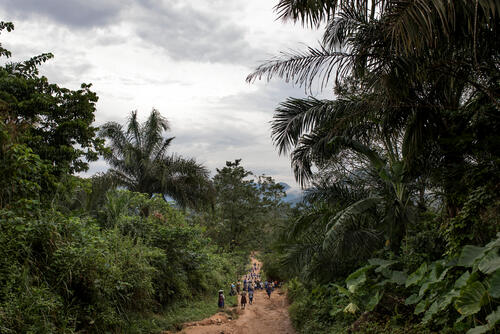
Situation in Cameroon
Political disputes in Cameroon’s South-West and North-West Regions escalated in late 2016. After secessionist armed forces proclaimed an independent state, they were confronted by the National Army.
Since then, daily violence has caused thousands to flee their villages and find refuge and protection in neighbouring Nigeria.
Despite concerns over the escalating violence, there has been very little aid response by the international community either inside Cameroon, where access for humanitarian groups is severely limited, or in Nigeria.
By the end of November 2018, an estimated 437,000 people were internally displaced within the South-West and North-West Regions of Cameroon.
Most have fled to the bush, where living conditions are poor and there is a lack of adequate shelter and access to food, water and basic health services.
MSF response
To help meet the medical and health needs of these displaced populations, MSF is strengthening the referral and emergency systems of district health structures in Buea (South-West Region) and Bamenda (North-West Region) and developing the capacity of community health workers to provide decentralised care.
MSF is concentrating its activities in rural and peripheral areas where peaks of violence are preventing large numbers of people from accessing health services.
With an estimated 30,000 refugees also sheltering in Nigeria, in June 2018 MSF launched activities in Cross River State. From July to mid-November, medical teams conducted 3,890 consultations.
More than 75 per cent of patients we are treating are women, children or elderly peopleScott Lea, MSF field coordinator in Cross River State
Most consultations are for respiratory diseases and skin diseases such as scabies, both related to difficult living conditions in the villages and in the camps where refugees are staying.
MSF medical staff are also treating patients for chronic diseases such as hypertension and diabetes; patients with malaria, which is mostly endemic in the country; and patients needing surgery for traumatic and non-traumatic injuries.
‘Like brothers and sisters’
When the first Cameroonian refugees began to cross into Nigeria, they were completely reliant on the assistance and support of the local villagers, whose living conditions were already difficult.
Fortunately, because of their geographical proximity and the long-standing ties between them, the refugees received a warm welcome.
As the world grapples over an unprecedented migrant crisis since the Second World War and as United Nations members officially adopted and implemented the Global Compact for Safe, Orderly and Regular Migration on 10 and 11 December in Morocco, Augustine Eka shows his solidarity to a vulnerable population by hosting Cameroonian refugees in his house in the Nigerian village of Amana.
![Augustine Eka, 46 years old, with a group of Cameroonian refugees that he hosts in his house. Some have lived there for more than a year.
He is a member of the host community in Amana village and chairman of the village’s WASH committee. Augustine works as a contractor with the MSF watsan team to build latrines and boreholes in the village. He has been hosting Cameroonian refugees since the political strife in the North West and South West regions of Cameroon deepened in November 2017 and people started crossing into Nigeria to escape the violence.
“My name is Augustine Eka, I’m from the community of Amana, a village in Cross River State, Nigeria, near to the border with Cameroon. I work as a contractor with MSF. When MSF arrived, they started to help the Cameroonian refugees that were here, and also the host community. They’ve helped so much, dealing with water, sanitation and hygiene.
We didn’t have public toilets here and that was a big problem for our health. With MSF, we built public toilets [four cubicles per block hence 16 latrines put in strategic areas of the village]. They also helped us build boreholes. All the community was suffering from a lack of clean water and, often, there were long lines of people trying to get some water for their houses.
I host a group of Cameroonian refugees in my house. They have been living here for more than a year now. Some of the people are now in the camps in Benue State and in Ogoja, others are still in the villages, living with the Nigerian community.
All the communities here, in Cross River State, are very hospitable and friendly towards the refugees from southern Cameroon. Over the last year, we’ve hosted more than 100 refugees in my community; men, women and children. But people continue to cross the border between Nigeria and Cameroon every day because the unrest is not over yet.
At the beginning of the influx, we had many problems because the refugees didn’t have access to free healthcare services and they didn’t have money to pay the costs of the treatments. Now they can be treated for free. This makes me more happy and hopeful for the future.
I’m the chairman of the WASH committee. The duty of the WASH committee is to supervise and check there are enough good toilets and water supplies in the communities.”](https://img.msf.org/AssetLink/m8330o80erpoxx0lj63besuet0cxu4m3.jpg "Amana, Cross River State")
People started to cross into Nigeria, but they didn’t have anything – they didn’t have a place to stay. So we decided to welcome them, to let them live in our homes like our brothers and sistersAugustine Eka, from Amana, Nigeria
“All of the communities here in Cross River state are very hospitable and friendly with the refugees coming from southern Cameroon,” says Augustine. “During the past year, we’ve hosted more than 100 refugees in my community: men, women and children.”
Fidelis Kigbor is one of the refugees living in Augustine’s house. He fled Cameroon on 1 October 2017, the day that secessionist forces declared independence. “I lived with all my family in Mamfee, where I was a farmer,” says Fidelis. “I built my house there, but it has been destroyed.”
Fidelis and his family crossed the border. “When we arrived in Amana village, the local inhabitants welcomed us, even if they didn’t have so much to offer,” says Fidelis. Fidelis hopes to return to Cameroon when the situation allows, but he knows that it will not be easy.
“I would like to go back to my country when things get better, but I know that I have lost everything there,” he says. “I will need help to rebuild my life.”
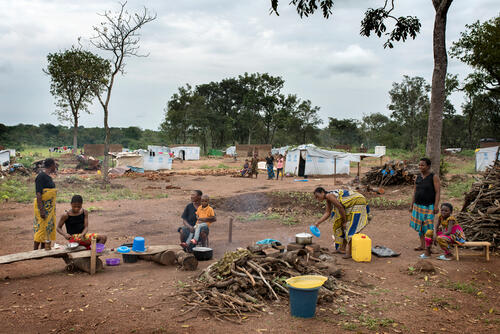
‘We fled from violence’
While some of the refugees are living in the Nigerian border villages alongside local inhabitants, others have been moved into refugee settlements.
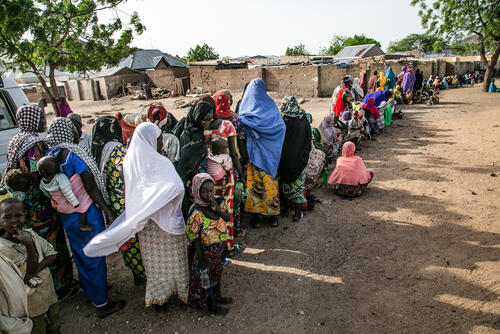
The refugee settlement in Adagom, run by the United Nations refugee agency, UNHCR, was constructed in mid-August 2018. As of early December, more than 6,400 people are staying there.
Gmoltee Bochum, aged 31, sits outside his tent with his two-year-old child, Sema.
“Back in Cameroon, I lived in Bamenda, one of the biggest cities in the Anglophone region,” says Gmoltee. “I was a computer engineer and a teacher. I don’t know when violence will end but I know that I lost everything. Now I live with my family in this refugee camp but life is tough. We all live together in a very small tent.”
MSF’s Dr Precious Mudama says that people’s needs in Cross River State are enormous. “Prior to MSF’s intervention in Cross River State, there were overwhelming needs in the health sector,” says Dr Precious.
“There was a big pressure on the state’s healthcare system, and a lack of staff and materials to take care of the local and refugee population. Our intervention was timely and we are now meeting those medical needs with our mobile clinic activities.”
The medical teams are seeing an average of 120-150 patients per day, with an average of 80 per cent refugees and 20 per cent members of the host communitiesDr Precious Mudama
Lydia, aged 40, is a Cameroonian refugee sheltering in Adagom settlement. She lost her brother and two sisters as they fled Cameroon.
She now lives in a tent with her sick husband and their six children. She saw an MSF doctor when she fell ill, and believes that otherwise she might have died.
“I felt sick for a long time with bad abdominal pains,” says Lydia. “When I arrived in Adagom camp, I heard that MSF was helping people with free healthcare. Therefore, I decided to meet the doctor and get some help. They visited me and then referred me to the hospital without asking for any money. Without MSF’s help, I would probably have died, but now I feel much better and I’m back in the camp with my family.”
In addition to providing medical assistance, MSF water and sanitation teams have rehabilitated 27 hand pumps, dug four boreholes and built 52 latrines in villages where both locals and refugees are living.
MSF Cross River Project started with WATSAN activities in Obanliku and Boki Local Government Areas (LGAs), namely boreholes and latrines. Medical activities started in the last week of July 2018 with an outpatient clinic at the Comprehensive Health Centre (CHC) in Ikom to serve both the host and refugee community. MSF now operates six mobile clinics in Obanlinku, Boki, Ikom, Ogoja and Etung Local Government Areas. From late July to mid-November, our teams have conducted 3,890 consultations.
Within the South-West and North-West Regions of Cameroon, MSF is supporting district health centres and hospitals in Buea and Bamenda to strengthen their referral and emergency systems. MSF has establishing ambulance services, donated medical and logistical supplies, and prepared mass casualty plans in several health facilities. MSF also provides training and capacity building to community health workers to support them to provide decentralised models of care, and runs mobile clinics in Buea, Bamenda and formerly Kumba.
Nigeria
Critical humanitarian situation unfolding among internally displaced people in Bama, Borno state
Press Release
17 Aug 2018
Lake Chad Crisis
Fighting psychological fears in conflict-affected communities
Project Update
3 Aug 2018
Nigeria
“The situation in northeast Nigeria is deteriorating after years of conflict”
Interview
18 Jul 2018